

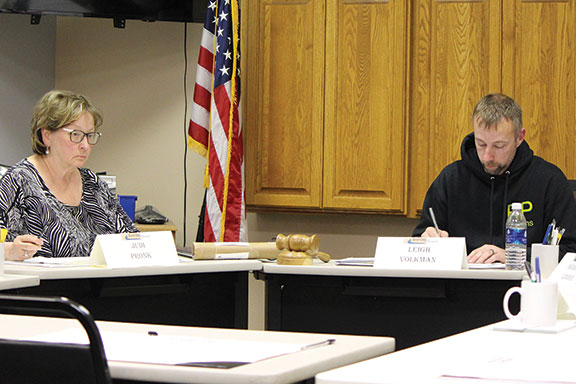
The new year kicked off for the Rushford Council on January 12 with the swearing in of new council including new mayor Leigh Volkman and Councilors Nick Smith and Judi Pronk. Also sworn in was new Library Board Director Jessica Sherlock.
Several designations and appointments were also made including council members to various boards and commissions. Councilor Jim O’Donnell will remain on the Planning Commission and Library Board. New Councilor Judi Pronk volunteered to serve on Community Education, Labor Management, and the Safety Committee. Councilor Andrew Linder will continue to serve on Trees, Trails & Parks and the Airport Commission. Mayor Volkman and Councilor Nick Smith will serve on the Economic Development Authority. Smith will also serve on the Electrical Commission.
After posting of the City Clerk position internally, the council unanimously approved moving Deputy Clerk Tiffany Jacobson to the position. The position opened at the end of last year following the passing of longtime City Clerk Kathy Zacher. The new pay scale will need to be reviewed as further office operations expenditures are gone over.
“Right now, dust hasn’t settled. There’s a lot of things that change naturally on their own and there’s things you guys are working on that will be changing. Efficiencies will be different; processes will be different. I think we should lean on department heads to do their own stuff that hadn’t been done in the past.”
The Personnel Committee will meet to determine whether or not to post the deputy clerk position internally. It’s possible Julie Frick may be moved into Jacobson’s former position. It’s also likely the committee will meet with Jacobson in the future to determine whether or not positions can be combined or if another person will need to be brought on staff to bring the office back to three positions.
Rushford Ambulance Director Joey Busse and Assistant Director Shannon Meier were at the meeting to request a change in the way on-call pay is paid. Last year, the council approved the ambulance service to issue $5 per hour, daytime, and $1.50, night and weekend, on-call pay in effort to improve scheduling and incentivize service members to pick up coverage, as well as improve member recruitment. On-call during daytime hours receives a higher stipend to encourage members to sign up for those harder to fill hours. Recruitment has gone up roughly by five personnel since the initiation and it’s also caused current members to be more forthcoming with signing up for on-call shifts.
“It’s been a year now since we’ve been doing this and the schedule is nice and tight,” said Busse. “We’ve been able to fill gaps where need be. It’s more cohesive with all the staff members and very seldom do we have holes that we have trouble filling.”
“We discovered, by going through all the runs… some of the crew that weren’t on the schedule to begin with, were being docked x amount, as a rule,” added Busse. “They were actually losing money for going on these runs. Once or twice it doesn’t really matter. It doesn’t add up much, but you build it up cumulatively and it does add up to a fairly significant amount.”
Meier described how when on-call members go on a run, regular call pay kicks in on the run, essentially causing the on-call member to lose their on-call pay bonus for the time taken for the run. The average run is roughly 2.5 hours, so on-call members could lose $12.50 in on-call pay while on a run. The service is asking to abolish the removal of the on-call pay, instead making it straight on-call on top of the run time. The service will also start managing logged hours in-house since city hall staff doesn’t see their scheduling, but rather pays out based on the hours logged.
“As a department head, I would like you to be keeping track of this stuff,” said Volkman. “We have some things that we need to iron out budget-wise to better understand. I understand what you’re saying and I hear where you’re coming from, but we also would like to get an administrator in place. Do we have the money available to make those changes? It’s probably not going to be a substantial amount of money, but we also don’t want to approve that tonight, because we don’t know.”
The council opted to table the issue and asked the service to provide comparative data on the past year’s costs and projected cost if the requested change is made.
According to Meier, the ambulance service has developed a team of members that will work in-house to oversee members’ logged hours and continue to improve efficiencies.
The council also unanimously approved local bond financing for a Student Housing Revenue Note for a Winona State University Housing Project. John Olson, Vice President of University Advancement, discussed the project, bond, and revenue for the city of Rushford on behalf of the Winona State University Foundation.
The $30 million, 340-bed housing facility is scheduled to begin construction next month. The foundation will utilize local bond financing from municipalities, up to $10 million for each municipality each bonding year. These pass-through bonds allow municipalities to designate bond financing to non-profit organizations for eligible projects. There is no risk to the city, which will receive revenue from the borrowing entity through a standard fee.
Leave a Reply