
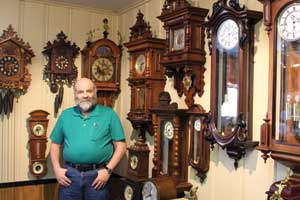
A surprising little shop, tucked in amid the businesses on Lanesboro’s Coffee Street, is Lanesboro Clockworks. The shop is bringing visitors a bit of history, a whole lot of appreciation, and the ability to bring new life to those family heirloom clocks and watches.
Collector Richard Goodin will be the first to tell you he likes to chat. The Anoka native has a 40-year clockworks hobby and his knowledge is downright impressive. From origins, types, values, and histories, the jovial Goodin is quick with facts and is eager to share his pastime.
Goodin is a fourth generation watchmaker, beginning with his great-grandfather Edward Corrow, who resided in Canada, but eventually moved to Minnesota. Corrow operated a general store in Dayton, Minn., where he sold and repaired Hampden Brand watches. Corrow’s daughter, Eulalie, or “Lily,” married John Goodin, and although he worked as a crane operator while they lived in Minneapolis, the two were part of the family business. When their son, LeVerne, was born in 1920, he, too, became interested in the the repair of clocks. He become an active clock collector and watchmaker after having attended four different institutes for horology (the study of time and measurement) in the 1930s, prior to serving in the armed forces.
Upon his return from overseas, LeVerne and his father worked together opening a clock and jewelry shop in north Minneapolis. It’s here that Richard Goodin gained his clock insight and informal education when his father gave him the opportunity to work together while Richard was in high school. The hobby remained largely just that while Richard was employed in the corporate world, but upon his retirement in 2012, the notion of owning a clockworks shop began to become a realistic notion. “It’s something we’ve always wanted to do,” notes Goodin.
“I like the collecting, but at some point you have to sell some of it,” Goodin laughs. The space needed some minor refurbishing, to suit Goodin’s needs and his impressive collection, including furnishings, such as Goodin’s uncle’s work bench and paint on the dark wainscoting to freshen it up to highlight the clocks. “Not everything in the shop is for sale. It’s a big display. We’ve had people come in and suggest it’s more of a museum,” laughs Goodin. “We have more than 100 clocks in here, watches, too.” The shop has become something of a destination for people from around the tri-state area.
The oldest clock in the shop is a Birge Mallory “triple decker,” estimated to be from between 1833 and 1837. The tall shelf clock features hand painting that was painstakingly done, in layers, on the back of the glass. The second oldest is a 1850s Riley Whiting clock with similar decorative painting and a wood and metal weighted assembly. Both are a source of pride for Goodin, but it’s the Austrian clocks he prefers.
“I favor the Austrian weight powered. Constant pressure from the weights contributes to accurate time,” he adds. Two of the clocks were in his father’s collection and eventually given to him. “The main difference between the Austrian, or German, which are incredibly similar, and American clocks was the intricacies of the mechanisms. They’re much harder to take apart,” notes Goodin.
Still, American clocks comprise a portion of the collection. They’re easier to determine histories of given that, despite the manufacturer, each is given a model name. Maritime and flight clocks, cuckoo clocks, pocket watches, as well as novelty and pendulette pieces also have places within the collection. Sample-sized clocks also adorn the store’s walls. Goodin points out that it was impossible for salesmen to travel with many of the bigger clocks, so clock manufacturers developed the sample replicas.
Most of the clocks in the collection are what’s known as “eight-day” clocks, meaning they are all hand wound, with a key every eight days. The market for antique clocks used to be higher, but the market dipped down and a three-weighted cabinet shelf clock may now be roughly half of its earlier value. “The prices are coming back though,” says Goodin cheerfully.
In addition, Goodin began collecting vintage, wind-up wristwatches in 1984. Their ages range mainly from the 1930-1940s. “Of course, they’re not water resistant,” points out Goodin. “That wasn’t around yet when these came out.” For investments, the bulk of watch money is in high end Swiss wristwatches.
“I like the complicated watches; chronometers,” he notes, discussing the certified accuracy of their time keeping abilities. “Some of them are stopwatches, some have calendars or mechanical alarms. It takes a higher skill level and is usually better for an investment purpose.”
“The challenge in clock collecting is making sure you’re getting something quality,” suggests Goodin. “You’re farther ahead to buy something that’s right to begin with, buying something that’s mainly whole, that only needs mechanical work.” In the past, he has done wood clock cabinet repair and refinishing, but he finds the work too cumbersome and has chosen to focus on mechanical repair, which can come with its own set of struggles.
“I used to tell people, ‘Buy an heirloom so the kids have something to fight over,’” jokes Richard. Goodin used to sell his clocks and watches at antique shows, but with the shop, he’s keeping his work time closer to home and both locals and visitors are steadily coming to see him.
Goodin is a Member of National Association of Watch & Clock Collectors Association and specializes in the repair and crafting of vintage clocks and watches. While he will help some with modern watches and clocks, he notes he does not stock batteries or parts for them. 2018 will be the first full summer in Lanesboro for the shop.
“I had to do something with my clock collection, so why not have fun with it?”
Pat ditrocchio says
Coming to Lanesboro Saturday would like to ask you some questions about a clock
Amy Cennamo says
This guy rules! He really knows what he’s talking about in detail! Check him out if you need old wind-up watches or clocks related!
Amy Cennamo says
Repaired!