
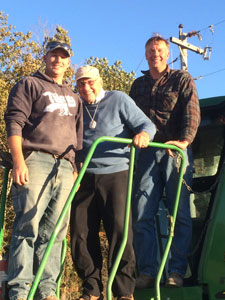
Headquartered just three miles south of Fountain, Eickhoff Fertilizer Incorporated (EFI) has a long tradition of leadership in the business of agriculture. Started in the 1950s by Donald Eickhoff, the family-operated venture was initially part of the International Flying Farmers organization.
“He flew to Mexico City to a farming conference and heard that applying nitrogen to corn fields was going to be the next big thing in agriculture,” says Richard Eickhoff, chief financial officer and partner. According to the story, shortly after returning from that trip, Donald was approached by a Twin Cities salesman seeking a local salesperson for area farms. Agreeing, he began applying anhydrous ammonia on his own fields and neighbors.
Early on, Donald would pick up 1,000 gallon tanks containing two tons of product in Spring Valley, then haul them to the farm. “He would syphon the product off and apply it into the ground,” adds Richard. Eventually, demand became such that bulk tanks were added at the current site.
The elder Eickhoff operated the plant until 2009 when he sold it to his son-in-law, Wayne Hebrink, son Steve Eickhoff, who is company chief operating officer, and grandson Richard Eickhoff. Wayne was a partner in the operation until his retirement in 2012, when Steve Carr, a family friend and Richard’s father-in-law, came into the operation as vice-president and partner.
The company now has 220 tons anhydrous storage on site and operates with additional employees Jim Specht, Scott Kellogg, Leon Vehrenkamp, and Larry Bushman helping manage the influx of customer needs.
While the mainstay of the company has always been anhydrous, the way the product is applied has vastly changed since the 1950s, or even the after the turn of the millennium. “We have invested heavily in technology to ensure we get row to row, even application across the fields we apply on,” notes Richard Eickhoff. “We began a custom application service and started applying anhydrous for area farmers.”
Precision is the name of the game. Equipment is equipped with custom toolbars with pressure gages on each row to ensure even distribution, as well as auto-shutoff and auto-steer to avoid over application and overlap. “If a farmer wants to apply 100 pounds of nitrogen, we have the technology to apply it at the target rate, evenly over the entire field,” stresses Richard.
The company also invested in a Veris Soil mapping machine with which it can test PH levels, organic matter content, and electrical conductivity of the soil. Nine PH samples are taken every two and a half acres and the organic matter and electrical conductivity are mapped on the fly, taking a reading every second. “The higher the conductivity, the more clay content the soil has. Lower readings indicate more sand. This reading is converted to a cation exchange rate which gives us the nitrogen holding capacity for the soil,” adds Richard. “The organic matter map reads how much organic matter is in the soil from plants and animals decomposing in the soil. Higher organic matter means more nitrogen is available to be converted organically in the soil and that can indicate zones in the field where we can lower our rates and still maintain yields.” All this technical data is utilized in creation of a variable rate prescription map for fertilizer, planting population, and lime applications; a targeted solution to a specific area.
“It’s all to try to put the right product at the right rate in the right area of the field to cut costs on unproductive areas of the field and put more resources in higher yielding areas of the field,” explains Richard. “Our goal is to use just enough nitrogen to get the corn to maturity and do as good a job as we can to protect our waters and not waste product farmers pay for. The more we can learn about how much nitrogen to apply to each different soil type throughout each field, the better stewards we can be for the environment. Farmers invest a lot of money to grow a crop and the last place we want that investment to go is into the rivers or the drinking supply.”
Another recent upgrade for the company is a Yield 360 Soil Scan machine. With it, nitrate levels in the soil can be tested, with a reading produced within five minutes while out in the field. “This eliminates sending a soil sample to a lab and having to wait a week or more for the results,” adds Richard. “It can also be used as a tool to help create the variable rate prescription maps.”
Despite the impressive upgrades in technology, there are challenges for the company. “Not being able to offer financing options such as the John Deere Farm Plan or others that bigger co-ops can offer has been a challenge,” admits Richard. They counter that hurdle by offering immediate solutions, personal attention to detail, and cost savings whether farms are large or small.
“Anhydrous ammonia is the cheapest, most consistent form of nitrogen for area farmers,” stresses Richard. “We can apply it with 1-2% accuracy and it’s a natural, slow-release form of nitrogen. We are committed to continue to selling the lowest cost nitrogen product, offering the same price to our customers whether you buy 10 tons or 500 tons. We want everyone to be able to have the same opportunity to get the same price for their nitrogen regardless of size,” he adds.
“A lot of farmers don’t like handling it because it takes time to apply, but we pride ourselves on being able to apply in a timely manner and will work around the clock to keep ahead of the planters in the spring. Because of the topography of the area we are following the University of Minnesota guidelines and applying nitrogen in the spring and summer and we believe that it is the right product because of its natural slow release,” concludes Richard. “We are committed to doing everything we can to follow the 4 Rs in management practices; the Right Rate in the Right Place at the Right Time with the Right Product.”
Anonymous says
Great article Richard!😊