

We have too much or not enough, depending upon our viewpoint and our situation.
That applies to most things.
A friend uses the email closing, “I wish you enough.” That’s a good wish, but we’d still want more or less.
A good reader wrote me about his ravenous rabbits. Their numbers had exploded in his neighborhood, and he was thinking of hiring a fox or two.
There are three kinds of rabbits: Bugs Bunny, the Easter Bunny and Peter Cottontail hopping down the bunny trail.
Or are the three the Trix Rabbit, Br’er Rabbit who zigs and zags, and the Energizer Bunny?
Perhaps the three are Roger, Thumper and Crusader?
Maybe the three are Harvey, the White Rabbit and Velveteen?
There are three lagomorph species in the state. In Minnesota, our two hare species are the white-tailed jackrabbit and the snowshoe hare, and our only rabbit species is the eastern cottontail. The cottontail is the rabbit we commonly see. Hares are born well-furred with eyes open, and move around shortly after birth, whereas rabbit babies are born blind, hairless and helpless. The white-tailed jackrabbit is the largest member of the rabbit or hare family in Minnesota. The jackrabbit is a hare with exceptionally long ears, is 2 feet long, and weighs 6 to 10 pounds. When surprised, it bounds off like a kangaroo. When frightened, it speeds away at up to 40 mph. It can leap 10 feet at a time. The snowshoe hare is slightly larger than the cottontail rabbit and can reach speeds of 30 mph and jump 12 feet in a single bound. Its coat is brown in summer and white in the winter, earning it the nickname “varying hare.” Snowshoe hares live in the upper half of the state, where they’re typically found in young forests, dense woodlands, thickets, and forest bogs and swamps. They’re about 20 inches long and weigh 3 pounds. The snowshoe’s food changes with the seasons. In summer, it feeds on grasses, berries, wildflowers, clover and other green vegetation. In winter, it eats bark, twigs and evergreen needles. The snowshoe hare roams a 7- to 17-acre home range. An acre is slightly smaller than a football field.
The increase in cottontail rabbits in the reader’s yard this year could be due to a combination of factors, including favorable weather, abundant food sources and a cyclical population boom. Mild winters can allow rabbits to have higher survival rates. If there’s an abundance of food, such as fresh growth from gardens or landscaping, rabbits thrive and reproduce more successfully. Mild winters don’t work that way for humans. I have retired friends who spend mild winters in Texas or Florida, and they don’t bring home new additions to their immediate family. Rabbit populations naturally fluctuate, with periods of high abundance (booms) and low numbers (busts). The current year may be a high point in the cycle. Rabbits thrive in areas with a mix of grassy areas and low, dense cover for protection. Changes in predator populations can affect rabbit numbers. Numbers can vary significantly from one locale to another. If you have too many rabbits, a couple of foxes would be a good hire.
I have brushpiles and our yard has great herb appeal, so I always have more than my fair share of bunnies.
My elders told me to plant marigolds to keep the rabbits at bay. While marigolds are suggested as a rabbit deterrent, they aren’t effective. Rabbits eat them, but that doesn’t make a bunny Snidely Whiplash. The marigolds did keep the sharks away.
I’m having more trouble with chipmunks. The cute little buggers take a bite out of the bottom of the tomatoes on a vine and lap up the juice. I expect to see them running a tiny stand selling tomato juice at the end of our drive.
Rabbits have their redeeming qualities.
Rabbits are funny. A priest, a minister and a rabbit walk into a bar. The rabbit tells the bartender, “I think I might be a typo.”
When you become irritated with a rabbit, remember the time that a cottontail saved your life. And don’t tell me you’ve forgotten that.
A rabbit might demolish your garden, but the good news is that your carrot cake is safe.
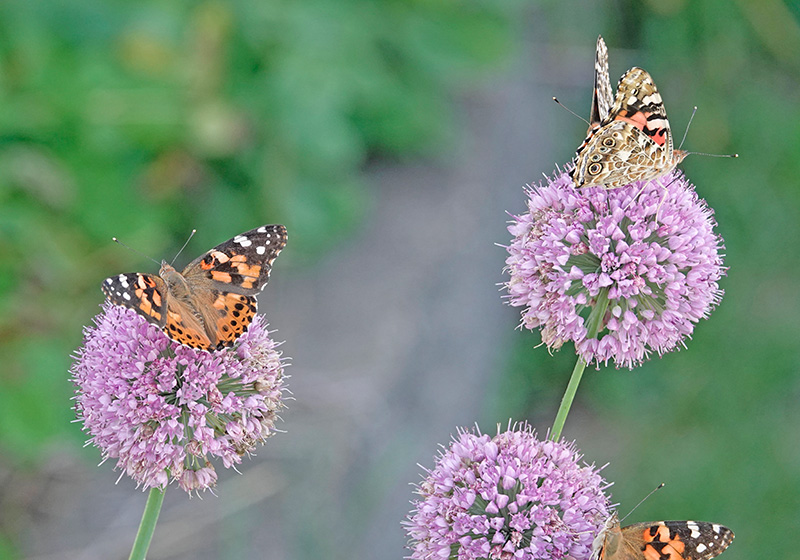
Photo by Al Batt