
In May and June 1854, a caravan of 13, mostly oxen-drawn covered wagons, was heading west from Dodge County, Wis., to settle in the Root River Valley. On June 9, they stopped for a meal near Cushon Peak, a familiar landmark in the valley, two miles west of Houston. While there, some of the party came upon a small, cage-like structure on the side of a bluff, in which sat, in an upright position, a human skeleton. It was the practice of the Sac and Fox Indians to leave their dead in a sitting position until the flesh and organs decomposed, after which time they would collect the bones.
According to the History of Houston County, 1919, “It must have been 1853 that a man whose name pronounced Cushon, located on Section twenty-five in the western part of the town(ship). Near his place is a high peak standing out solitary and alone, as a huge sentry overlooking the valley below and the neighboring ridges for miles around, and which used as a landmark for travelers when this was a vast trackless region, and was named Cushon Peak.
“This man is remembered as an intelligent and educated man, but from whence he came or whither he went, as he soon did, no one knows. He sold out on leaving, in 1854, to Mr. Hendrickson and a few years later it passed into the hands of Mr. G. O. Laugen.”
Unless there was exceptionally high water, Cushon Peak was the furthest a steamboat could navigate from the Mississippi River up the Root River before cargo would be transferred to wagons for the final leg of the journey to Rushford.
In 1866, when railroad tracks had reached Houston but not yet Rushford in 1867, the western terminus of tracks was a miniature train depot at first called “Red School House,” later known as Money Creek Station – not at the present site of the village of Money Creek but instead on the northwest side of the Root River just below Cushon Peak. Stage coaches ran between Rushford and Money Creek Station, the latter offering meals for passengers waiting between stage coach and railroad arrivals.
After railroad tracks reached Rushford, Money Creek Station became a “flag station,” where trains only stopped when signaled or “flagged” by a passenger. After railroad service was discontinued, Louis Laugen purchased the building for $5, moved it to his farm and used it as a chicken house. In a deteriorated condition, it was burned along with a corncrib about 1987.
About 1936 to 1942, the Boy Scouts developed a scenic site for camping and picnicking on the banks of the Root River below Cushon Peak, then part of the Louis Laugen farm. The Houston Village Council gave the Scouts an old abandoned townhall building. Under the supervision of scoutmaster George Moore, the building was dismantled and moved to the campground, where it was winterized and used year around. Former Boy Scout Robert Moore recalled, “It was a good tight building, and we enjoyed many a winter night up there with a heating stove and cook stove.
“We were on an overnight camp sleeping on the floor … when someone smelled smoke. We got out and found that the woods were on fire, and the fire was racing up toward the peak from the area close to the track. We took shovels, blankets, jacket and whatever we could find and beat the fire out.
“Apparently, a railroad crew … had left their fire not completely out. Anyway, the railroad company found out what we had done and unloaded piles of bridge timbers for us to use. My dad supervised, and we built the picnic table out of those timbers.”
Roger Johnson, 98, recalled being a Boy Scout camper as a young teenager in the early 1940s. The adult leader and boys would walk from Houston to the camp. Some boys pitched tents, but Johnson preferred sleeping in the cabin. One summer day, he was among a few campers hiking up the path to the summit of Cushon Peak when they encountered a rattlesnake. They proceeded safely to the top, but they descended on the other side of the peak.
There has been disagreement concerning the spelling and pronunciation of the name of the landmark. Herb Wheaton, editor of the Hokah Chief newspaper, was adamant that “Cushing’s Peak” was correct and published a 1951 tirade against “the mongrelized hillbilly concoction of CUSHION, given it by the one who is smarter than everybody else, which name has clung to it for no other reason than that there is nobody with sufficient moral courage to stand up on his hind legs and oppose this man.”
Wheaton opined “Cushion” had evolved from “Cushing’s” because “too many people are slovenly and shabby in their speech. They talk about their cookin’, their sewin’, huntin’, fishin’ and skatin’. Eventually, the apostrophe was dropped and it became “Cushins,” then Cushens,” and finally “Cushen.”
At one time, word around Houston was the original settler was probably French, in which case the accent would have been on the second syllable, “cu-SHON.” That is the pronunciation used by the current owner, but most still pronounce it as they would a seat “cushion.”
A wooden cross was erected on the peak on Good Friday of 1989 by then owner Lloyd Vix and family. The peak now looks down on a campground owned and operated by that family.
From a poem by Lloyd Vix:
“A patch of fog creeps onto
the flatland below.
Under its curtain I hear campfire laughter and songs from young hearts preparing
for Manhood.
Yet, as the sun burns away, only a clearing where the Boy Scouts have vanished.”
Sources: The History of Rushford: The First Decade, by Alden O. Droivold, DVM; History of Houston County, Minnesota, 1919; Cushon Peak – A Landmark, complied by L. Vix; “Cushing Peak, A Chapel in the Clouds,” a poem by Lloyd Vix
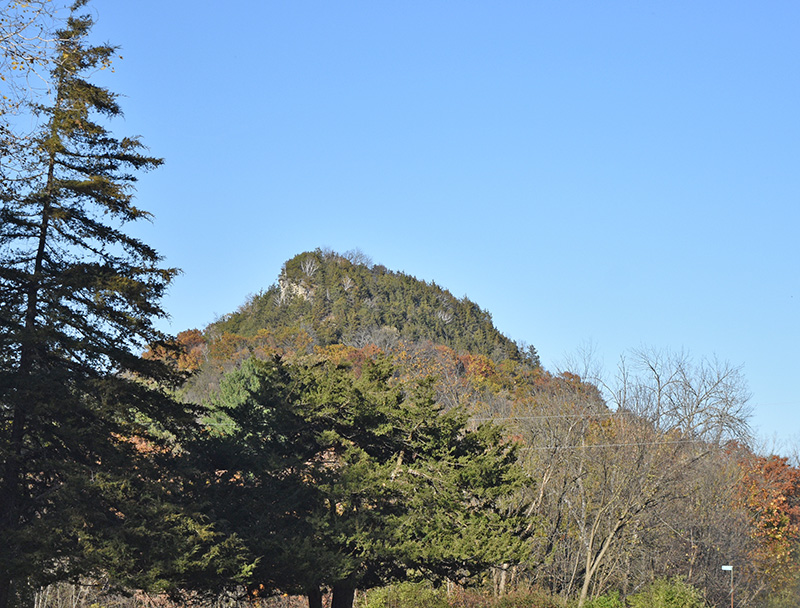
Photo by Lee Epps
Anonymous says
Mr. Epps,
Thank you so much for your research and sharing your findings with us!
I thoroughly enjoyed reading about our local history!