

I made myself a mug of steaming hot tea because I’m a wizard in the culinary arts.
I set the mug on my desk and promptly forgot about it until I took a sip and discovered the tea had cooled. Move over Aristotle. That happened because I’m a wizard at becoming distracted. The unexpected lukewarm tea caused me to fall prey to the elevens — that pair of wrinkles that form on my glabella (that smooth space between my eyebrows) when I frown or furrow my brow.
I thought about warming the brew in the microwave, but I didn’t want to anger the tea. I don’t know if that’s possible, but I didn’t want to do it.
There was a moment in the long ago when I’d craved a piping hot cup of tea. I stopped at Meier’s Lake Roadhouse, a charming spot nestled alongside the stunning Richardson Highway in Gakona, Alaska, between Delta Junction and Glennallen. I don’t think I’ve ever visited Gakona proper, but the World Population Review says it has a population of 139, so it’s hard to believe I missed it. Big cities look best from a distance, but small towns look best up close. The Richardson Highway heads south from Fairbanks and parallels the Trans-Alaska Pipeline, winding through mountain passes, over rushing rivers, and past breathtaking views of forests, lakes, glaciers, canyons and waterfalls on a 368-mile trip to Valdez, gateway to Prince William Sound. None of the canyons is the Grand Canyon, which is big, but not that big.
Meier’s Lake Roadhouse is a working roadhouse with a restaurant, bar, convenience store, motel, gas station, cabins, lodge rooms, RV park, and historic displays and photos.
Meier’s Lake Roadhouse was established in 1906. It burned in 1925, 1950 and 1961. I figured it had a history of making blistering-hot tea there.
Alaska is more than twice the size of Texas, but a brochure left by a traveler claimed Alaska had 17,681 total public roads, while Texas had 683,533. That wanderer was probably from Texas.
A hospitable server directed me to a menu where there were no specials because everything on the menu was special, but there was a sale on a peanut butter and jelly sandwich for only $67.50, and I was told there were 7 1/2 rooms for rent. It didn’t take long to stay overnight in the 1/2 room. The proprietor said he hated making peanut butter and jelly sandwiches and was about to raise their price because he was losing money on each one he prepared.
I was hungry enough to eat a spruce tree if I could find enough ketchup or watch a man eat pickled bullhead whiskers, but I didn’t want a PB&J. At that sale price, I’d have had to start a crowdfunding project to afford one.
I grew up eating peanut butter or jelly sandwiches made with Wonder Bread. “It helps build strong bodies 12 ways,” that bread promised me. I ate peanut butter or jelly sandwiches because I enjoyed them more than peanut butter and jelly sandwiches. Peanut butter sandwiches quickly established a dominance in my life and have never relinquished that position to jelly sandwiches for even a day. I love peanut butter on toast. Jelly is good there, too. Grilled peanut butter sandwiches are divine. I’ve never tried a grilled jelly sandwich.
I do wonder how much Wonder Bread I ate during my formative years. Wonder Bread got its name when a Taggart Baking Company executive witnessed the wonder of hundreds of hot air balloons at the International Balloon Race at the Indianapolis Speedway in 1921
Wonder Bread hit a bump in the road when the U.S. government banned sliced bread in 1943 during World War II as a wartime conservation measure to save resources. The ban was intended to conserve wax paper and to halt the use of bread-slicing machines, as wax paper and steel were needed for the war effort. The ban was unpopular with consumers and was rescinded two months later.
The hot tea I enjoyed at Meier’s Roadhouse wasn’t on sale, but it was sizzling.
I didn’t spill a drop.
I didn’t want to take the chance of the Roadhouse burning down again.
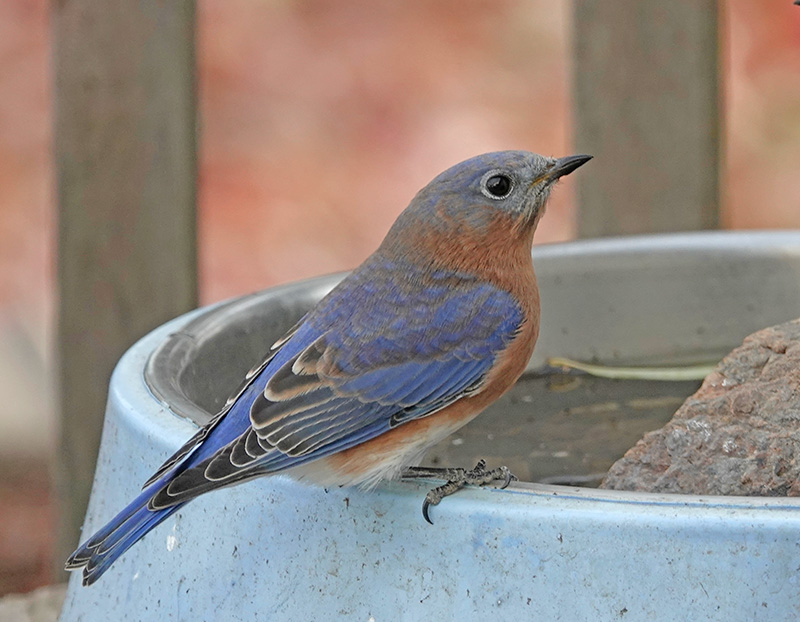
“How the waiting countryside thrills with joy when Bluebird brings us the first word of returning spring. Reflecting heaven from his back and the ground from his breast, he floats between sky and earth like the winged voice of hope.”– W. L. Dawson. If a bluebird you see, happiness will be.
Photo by Al Batt
Leave a Reply