
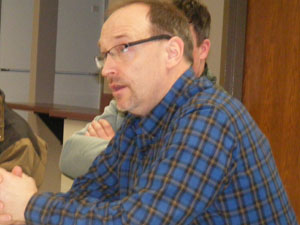
A large number of community members participated in Walz’s “Southern Minnesota Way of Life Tour” at the F & M Bank community room on February 8. This mix of employers, people associated with business, farmers, local government officials, and educators were asked for their ideas and given the opportunity to express their concerns as they relate to transportation, infrastructure, health care, workforce development, agriculture and more. The meeting in Preston was toward the end of the tour which included all 21 counties of the First Congressional District in Minnesota.
This kind of round table gives people the opportunity to participate in the democratic process by directly informing a member of Congress as to what issues are of greatest concern and what could be done at the federal level to improve the quality of life in southern Minnesota.
Walz’s chief of staff, Josh Syrjamaki, explained that a lot of the feedback across southern Minnesota has been economic based. Peder Kjeseth, congressional aid, said we are trying to learn what is going on and where people think we should go.
Participants were surveyed on three questions. The first was what is the best aspect of life in southern Minnesota? The generally positive responses centered on community, concern people have for one another, and access to clean and beautiful spaces.
The second question was what is the most serious challenge facing our rural communities? Declining population and the inability to keep and attract younger people into the workforce were concerns. There are more “gray hairs” than kids. Business isn’t able to find the talent they need; we need people. Unemployment isn’t the problem. There are more jobs than people.
There are underemployed people; we need to invest in ramping up skills. A gentleman from the ethanol plant said it is hard to compete against Mayo Clinic for lab technicians. It has been necessary to cast a wider and wider net to get any applicants.
Kids have large student loans and can’t afford to take a $25 per hour job. If kids didn’t have to pay off student loans and could get inexpensive health care they could stay here.
Another man explained affordable housing for young people is a big challenge. There is too much emphasis on a B.A. degree and not enough on technical training. Matt Schultz, superintendent Lanesboro schools, maintained that teachers are few and far between. Years ago there use to be several hundred applications for a teaching position, last year there was only one.
Syrjamaki said he was hearing that student loan debt disadvantages rural areas more and that baby boomers are retiring with less new, young workers coming in or staying in rural areas.
It was noted that the state legislature has recognized a shortage of large animal veterinarians, so some students that go into large animal practices for a period of years may be eligible for student loan forgiveness.
Another cited the housing industry in Rochester which is booming, noting there is a shortage of people in the building trades. These are jobs that demand a good salary. Many aren’t aware these good paying vocational jobs exist. The unavailability of necessary infrastructure in rural areas (broadband) limits tele-commuting which could allow people to live in small towns/rural areas and receive the greater income available in larger cities.
One woman suggested it may be time for free community colleges. Syrjamaki said he was hearing that the survival of a community depends on trained workers and there are not enough of them. Why isn’t the labor market correcting itself? One gentleman said that when we talk about our own kids, we want them to do better than us. Another noted there are plenty of college grads serving hamburgers.
One gentleman said there is no value in agriculture right now. One spouse has to work off the farm to get health insurance. In order for a young person to start farming there needs to be support from a parent. A farmer explained he has three sons and it is hard to encourage them to farm when the margins are so slim. There are fewer and fewer farmers left that survived the 1980s.
The third question was what is the one thing you would want the federal government to do to enhance the way of life in southern Minnesota? Affordable health care seemed to top this category.
Broadband could allow the capability for tele-medicine for primary care where a clinic is not nearby. Gabby Kinneberg, chamber of commerce, said from a small business perspective, the cost of health care is crippling. A person near retirement is paying premiums of $1,000 per month. How can small business owners afford health care for themselves and their families?
Syrjamaki said health care has been the top issue at round table meetings. He explained that the lack of “regular order” in Congress interferes with the crafting of bills, the reviewing of laws on the books, and the updating of policies and programs. Since the passage of the Affordable Care Act (Obamacare) in 2010, there have been no changes or amendments to fix problems with the program. Polarization has brought Congress to a screeching halt. Syrjamaki asked what do you want Walz to do?
Four avenues to go forward were listed. Let states each do their own health care program. Enact Medicare for all/single payer system. Establish high risk pools like Minnesota has had in the past. Or, do none of the above. The group seemed to be split on these options.
One gentleman suggested that malpractice insurance is driving up costs and needs to be reformed. Another insisted affordable, quality and convenient health care is necessary; he encouraged tele-health.
Chief Deputy Kevin Beck acknowledged the problems and work load involved in dealing with mental health/chemical dependency inmates. He said people with these issues can’t just be put in jail because it is a place to put them.
Shawn Schloesser, congressional aid, reviewed Walz’s efforts on behalf of a veterans home in Fillmore County. An effort is being made to push for all three proposed veterans homes in Minnesota (Bemidji, Montevideo, and Fillmore County). He is meeting with the Secretary of Veterans Affairs in mid February.
Syrjamaki reported that this is Tim Walz’s last year in Congress. Walz wants to write an exit memo for the next person that succeeds him to represent the First District. He is planning three regional summits to discuss the “future of southern Minnesota.”