
By Dan Wermager
Technician, Root River SWCD
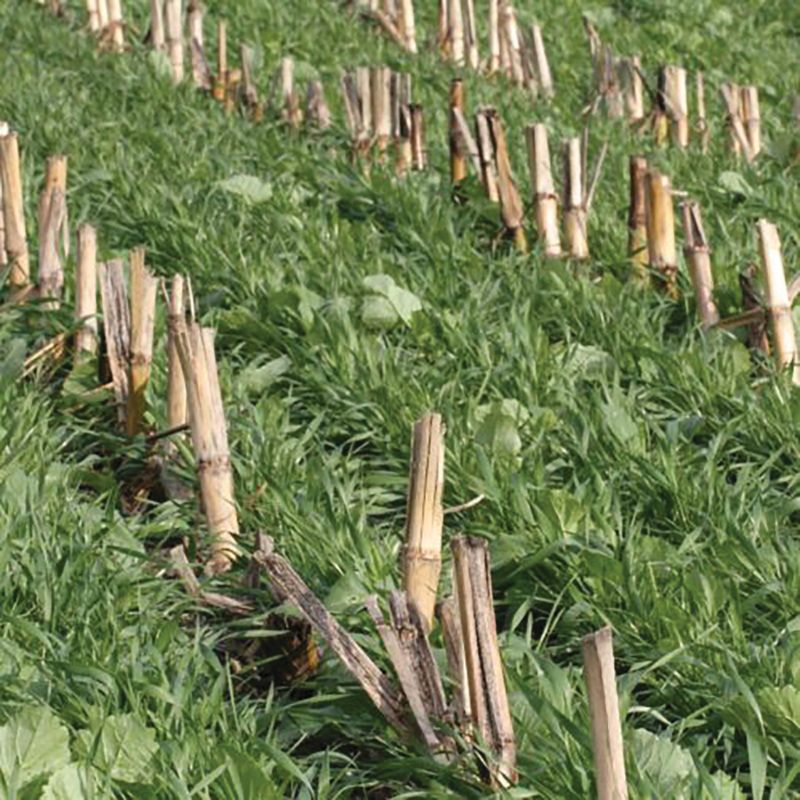
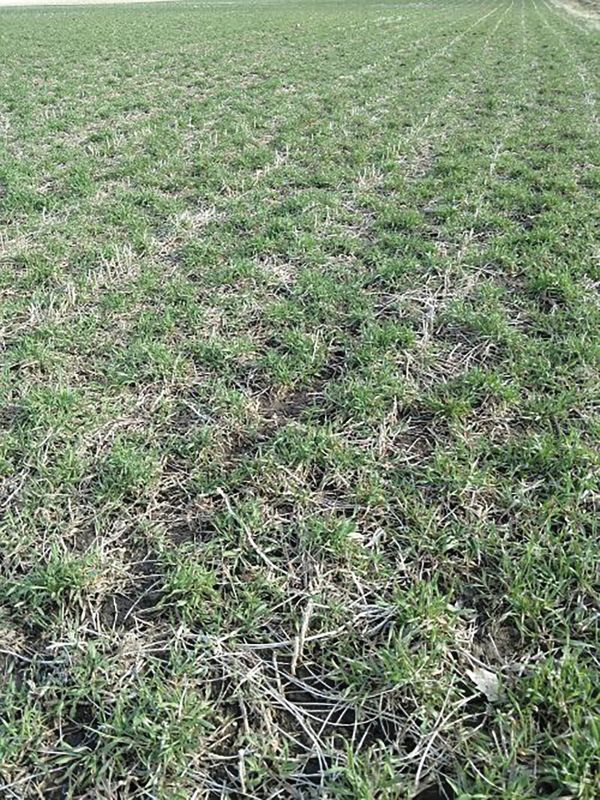
As you are driving through the area in late fall or early spring, you may notice more green fields than you normally would. If it’s not a hay strip, then the green vegetation you are seeing is likely winter rye that has been planted as a cover crop. Cover crops are gaining a lot of traction in the area in recent years, and for good reason. They have many benefits, including reducing erosion, building soil organic matter, fighting weeds, minimizing soil compaction, and recycling nutrients in the soil. Let’s break down these benefits further and discuss how you can get started in planting cover crops, if you have not already.
With our highly erodible silt loam soils, combined with our steep terrain, sheet and rill erosion is a huge problem in our area. In fact, it is a huge problem across the globe. Eroded soil is the largest source of pollution to surface water in the world. Once our precious topsoil leaves our fields, we don’t get it back. It gets transported down to the valleys where it pollutes our trout streams. From there it hits the Mississippi, causing huge problems as it fills in our dams, backwaters, and barge traffic routes. Unfortunately, there is no financially feasible way to remove it from here and transport it back onto our fields. Eventually it reaches the Gulf of Mexico where it is lost forever under the saltwater. In the meantime, our remaining cropland soils are getting more and more depleted. It is best to stop this problem at the source. No-till planting and having contour strips of grass or hay are great ways to address this erosion problem, but cover crops are another great tool for farmers to have in their arsenal. Our soil loss models estimate that on average, cover crops prevent 1-2 tons/acre/year of soil erosion. That is a big deal; one ton of soil is roughly equivalent to one cubic yard.
Cover crops are a large part of regenerative agriculture. If you plant a tiny rye seed, it will grow into a large plant, up to five feet tall. In order to grow, it is taking nutrients out of the soil. But if you do not harvest it, the plant dies, and then all of those nutrients return right back to the soil. How are we gaining anything by this? It is because as the plant is growing, it is also taking carbon out of the air, and pumping it into the soil. All for free. Remember, plants “inhale” CO2 (carbon dioxide), and “exhale” O2 (oxygen). Where does the carbon molecule go? Into the plant and into the roots/soil. If the plant is not harvested, and is allowed to go back to the soil, you will buildup carbon (organic matter) in your soil. Carbon is what gives the topsoil that (hopefully) dark brown or black color. Our soils in this area likely used to have organic matter levels of 5-8%. Now a lot of them are around 2%. Cover crops can help change that.
Cover crops like winter rye can suppress problematic weeds like waterhemp or palmer amaranth by covering bare soil, which is prime real estate for weeds. The cover crop also blocks the sunlight that the weeds need to germinate and grow. Some cover crop species such as rye also have allopathic effects that suppress weeds.
Cover crops also fight soil compaction. Our soils have a fair amount of clay in them. When we drive heavy machinery on them, especially when the soil is moist, all of the water molecules between the microscopic layers of clay get squeezed out, and we get a type of compaction towards the soil surface that is hard to un-do. Planting a cover crop, and choosing a species that has a fine fibrous root system (like rye, wheat or oats) is a good way to treat and prevent this type of soil compaction. You can also get compaction deeper in the soil due to past or present plowing, at whatever depth the plow was set at. The “shearing and smearing” action of the bottom of the plow on the soil causes a compacted layer called a “hardpan” or “plow pan.” A way to treat this type of compaction is by planting a cover crop species with a deep taproot, such as deep-till radish.
Cover crops also recycle nutrients in the soil. With nitrate groundwater pollution in the news, this is an important benefit. Nitrates are soluble in water, and they move downward through the soil profile towards our groundwater. Studies have shown that rye cover crops can be effective at intercepting nitrates before they leave the root zone. Once their roots absorb the nitrates, they pull the nutrient back up towards the surface. Once the cover crops die, the nutrient becomes available for the next row crop. You can also plant legume species of cover crops which will pull nitrogen out of the air for free, and pump it into the soil, once again for the next row crop to use.
So, as you can see, cover crops offer many environmental benefits. However, it is an additional expense for farmers, in a time of low commodity prices and high input prices. To help with this, Root River Soil and Water Conservation District offers cost-share for getting started in cover crops. Cost share rates and acreage caps vary depending upon the grant. Right now, there are several grants available, and payment rates vary from $40/acre to $60/acre. If you are just looking for technical advice on planting or managing cover crops, Root River SWCD can help you with that as well, even if you don’t signup for cost-share.
Call Root River SWCD in Caledonia at 507-724-5261, ext. 3, to learn more about cover crops or cost-share that may be available.
Leave a Reply