
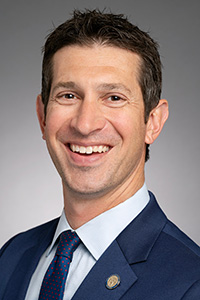
State Senator Jeremy Miller (Winona) has signed on as a co-sponsor of Senate File 3669, a bill that would lower license tab fees for Minnesota vehicle owners by reversing changes made to the registration formula in 2023.
“Many constituents have reached out with concerns about the increase in license tab fees,” Sen. Miller said. “Minnesotans are frustrated by seeing their tabs remain stubbornly high year after year. We are already an expensive state to live; this is one easy thing we can do to keep a little extra money in people’s pockets.”
The 2023 changes increased the tax rate on vehicle registrations and slowed down how quickly a car is allowed to depreciate on paper, meaning drivers are taxed on an inflated value even as their car loses actual real-world value. A vehicle that has actually dropped 40% in value might only be recognized as having lost 10% of its value under the current formula.
The result is many drivers are experiencing sticker shock of tab fees that barely budge from year to year, no matter how old their car gets.
The Miller proposal reverses the 2023 changes. It lowers the tax rate back to pre-2023 levels and restores a faster depreciation schedule so that what you pay reflects what your car is actually worth.
Minnesota’s vehicle registrations are already among the highest in the region. Tab fees here are 36% more expensive than Iowa, and more than 700% higher than Wisconsin and South Dakota for a typical new vehicle over five years.


Anonymous says
Miller seems to be isolating a single variable contributing to the cost of owning a motor vehicle, preferring to focus upon a single factor, assuming that those hearing his message will reflexively agree, and not trouble themselves to examine the facts. The costs of owning a motor vehicle depends upon many different factors: 1) Initial purchase price (new typically costs more than used), 2) Fuel economy, 3) Fuel tax (which may seem invisible), 4) Sales tax at time of purchase, 5) Insurance costs, and 6) The oftentimes overlooked cost of vehicle damage due to inadequately maintained roads, including but not limited to tire damage, suspension parts/repairs, alignment issues, axle or steering components, and damage to the undercarriage. Of course, there are likely additional contributing factors besides the preceding.
There were likely those who praised the quality of the production of “My American Cousin” at the Ford Theater in Washington, D.C. on April 14, 1865 who didn’t trouble themselves to consider the brief cameo appearance by John Wilkes Booth.
Of course, it would be helpful if Miller bothered to disclose the sources for the cost of license tab fees that he is decrying or are we simply supposed to take him at his word? According to the World Population Review in 2026, this webpage displays a map of the United States, and by hovering your cursor over each state, you’ll see that the costs in Minnesota are lower than any of its next door neighbors. Here’s that article, for your consideration: https://worldpopulationreview.com/state-rankings/car-registration-fees-by-state
Potholes are an obvious culprit, and pose special concerns for those riding on two-wheeled vehicles, particularly during periods of darkness, or when snow or puddles can mask the depth of those miniature road craters.
Presumably, those who can afford to own vehicle that is less than five years old can afford higher costs. Maybe Miller would prefer that the cost of license tabs be increased for people owning older vehicles so that those owning newer vehicles can be “rewarded” for their presumed financial success, while incentivizing poorer people to “work harder” so they can afford newer vehicles?
According to this article by CBS News, the license tab costs for Minnesotans owning older cars is actually becoming lower: https://www.cbsnews.com/minnesota/news/minnesota-car-license-tab-fee-increase/
If Minnesota wishes to maintain good road quality, as it compares favorably with what you’ll find in many other states, those funds need to come from somewhere.
Would you prefer that the costs of lower license tabs be shifted to another source of funding?
Some might prefer to increase the income tax, so that people who don’t even own a car can share in the burden? Maybe increase the gas tax, so that those who drive the most can pay a higher share? Maybe the costs could shift depending upon the weight of the vehicle, as heavier vehicles presumably inflict more damage to the roads/streets they are traversing? Or would you prefer needing to pay more for vehicle repairs caused due to poor roads, since at least that money wouldn’t be collected by the government?
The latter factor may oftentimes be overlooked, but it is real. Deferring maintenance makes as much sense as skipping dentist appointments until you have a raging toothache. Maybe there’s something to be said in favor of the “ounce of prevention, as opposed to the pound of cure?” KOAT-TV 7 Action News in Michigan has published a timely story about this very topic: https://www.koat.com/article/true-cost-of-americas-roads/64971342
This story, dated March 28, 2026, addresses the relative costs of owning a motor vehicle in all 50 states. This may come as a shock to Miller, but Minnesota can be found in the middle of the pack in terms of the overall five-year cost, at #25: https://stacker.com/stories/autos-transportation/total-cost-car-ownership-state-2026-cheapest-and-most-expensive-places
If you take the time to peruse the table for all 50 states, which can be found at the link in the preceding paragraph, you may note that for the category of repairs due to poor road conditions, Minnesota is tied with North Dakota at #33 in terms of those costs, which is considerably better than average.
“The great enemy of the truth is very often not the lie – deliberate, contrived and dishonest – but the myth, persistent, persuasive, and unrealistic. Too often we hold fast to the clichés of our forebears. We subject all facts to a prefabricated set of interpretations. We enjoy the comfort of opinion without the discomfort of fact.” – John F. Kennedy
At best, Miller seems to be proclaiming a partial truth in hopes that those who prefer to believe what he is saying will swallow what he says without question.
“The great enemy of the truth is very often not the lie – deliberate, contrived and dishonest – but the myth, persistent, persuasive, and unrealistic. Too often we hold fast to the clichés of our forebears. We subject all facts to a prefabricated set of interpretations. We enjoy the comfort of opinion without the discomfort of fact.” – John F. Kennedy