Part two of a two-part series
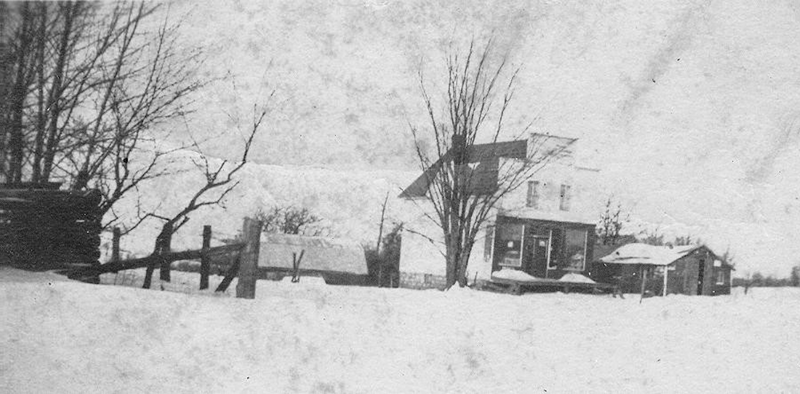
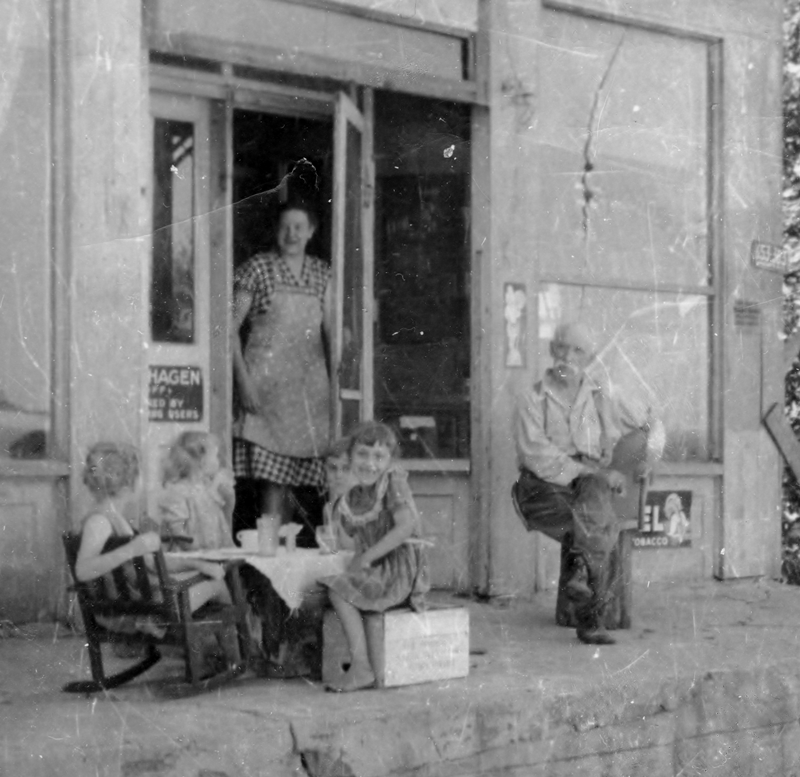
He was quickly recognizable by his “burly mustache that turned to a ruggedly silver color as he aged.” But his nickname was “Shakes,” reflecting his medical condition which caused tremors in his arm and hand. He did not mind, since the moniker provided not only notoriety but likely, also popularity for his business, the South Ridge Country Store, affectionately known as “Shakes Town.”
Born in 1880 to German immigrant parents, Reinhold Albert “Rein” or “Shakes” Wolter, founded the store in section 10 of Mound Prairie Township, Houston County in 1908 and was its popular proprietor for 40 years.
As described by area historian and former customer David Beckman, “Several events and activities occurred throughout the early 1900s, which attracted new customers to the store, resulting in Rein’s business continuing to prosper.” The South Ridge baseball team located their ball diamond in a hayfield just to the north of the store. The September 9, 1914, edition of the Winona Republican reported a picnic and ball game, won by Looney Valley, 8-1.
When telephone lines were strung across South Ridge, each farmhouse had a hand-crank telephone hanging on a wall. The switchboard was located for many years inside the South Ridge Store, operated by Rein, his wife Christina and her sister Lena Hanson.
Rein’s brother-in-law and farmer John Schumacher lived across the road from the store and for years, had ground feed for himself and for neighbors. When increased demand required more labor than one farmer could manage, John and Rein formed a partnership to set up an improved milling facility.
In December 1921, a gasoline-powered, single-cylinder engine and milling machinery were installed in a building just south of the store. Due to the high compression ratio of the powerful engine, two Schumacher sons stood on a spoke of the huge pulley, about three feet in diameter, and jumped up and down until the engine would turn over enough to initiate a spark and start. More than two decades later, the machinery was gone, probably the metal having been recycled to support the war effort during World War II.
Summer meant weekly social ice cream evenings at the store but also resulted in trips to town for ice and therefore required an annual winter workday. “Farmers, who wanted ice available throughout the summer months,” wrote Beckman “would meet … on a designated day in late January with their team of horses, sled or stone boat and head down the hill to harvest ice from Pine Creek.”
For blocks of ice to survive a hot summer, they had to be at least 12 inches thick. Special ice saws were used to cut blocks of ice by hand before being loaded onto the sleds and pulled up the steep hill to the store. The blocks were tightly packed in sawdust and stored in Rein’s ice house, a shed behind the store, until the next summer.
At some point, Rein installed a large icebox in the back of the store for perishables. And after President F. D. Roosevelt’s Rural Electrification Administration (REA) of 1935 brought electricity to South Ridge, there was a refrigerator in the store.
Most of the “essentials” stocked at the store were described in last week’s column, except for vinegar. In the rear of the store were two wood stave barrels, one containing white vinegar, the other brown vinegar. Farmers would bring their own jugs, some as large as five gallons, to be filled.
Vinegar was commonly used for a wide variety of purposes – medicine, cleaning, baking and preservation, the latter especially for pickling. “The empty barrels themselves were also highly coveted and always spoken for by farmers,” noted Beckman.
Arlene Schumacher, Rein’s niece-in-law, recalled her mother removing lime deposits from her tea kettle by filling it with vinegar and setting it outside over a winter night. By morning, the lime was cracked and could easily be scraped off.
Beckman, from his boyhood, remembered Hank Mades, who on a sweltering August afternoon being overcome by heat while threshing grain. He drove his bundle wagon up to the house, hurried inside and asked for a cup of vinegar, which he took into the shade of a large elm tree and gulped it down. Young Beckman became nauseous while watching, but a few minutes later, the elderly man resumed the rigors of threshing, “apparently completely recovered.”
There was also considerable revenue from selling what Beckman termed “luxury items,” such as candy, pop and gum for the youngsters and for the men, smoking supplies and chewing tobacco, all kept behind the main counter. “Rolled cigarettes were expensive, and rolling your own required stopping whatever work one was doing, so both hands could be used to prepare a smoke; as a result, chewing tobacco was favored by most farmers. ”Some men were “clean” tobacco chewers, who intentionally went undetected, except by their wives.
One large round brick of cheese was the only dairy product at the store. Everyone churned their butter at home and processed their own cottage cheese. “Buttermilk, a byproduct of making butter, was used for baking and preferred over milk for drinking by a few of the most-hardy.”
At age 68, Rein Wolter sold the store and retired with his wife Christine on her family farm. He died at age 79 in 1959.
In 1951, the store was sold again to Rein’s nephew Ed Schumacher, who with his wife Arlene operated the store for another 14 years until its closure in January 1965.
Ed told Beckman in 2010 he believed two major factors led to the demise of the country store. The “advent of the automobile,” made it convenient to travel and shop in towns. And the introduction of department stores and larger grocery stores with lower prices made it impossible for the small country store to survive.
Beckman concluded, “The country store was a major community player in an era where travel was limited and social contact and reliance upon family members and neighbors were essential for survival and progress.”
Source: South Ridge Country Store, 1908-1965, by David H. Beckman, 2010