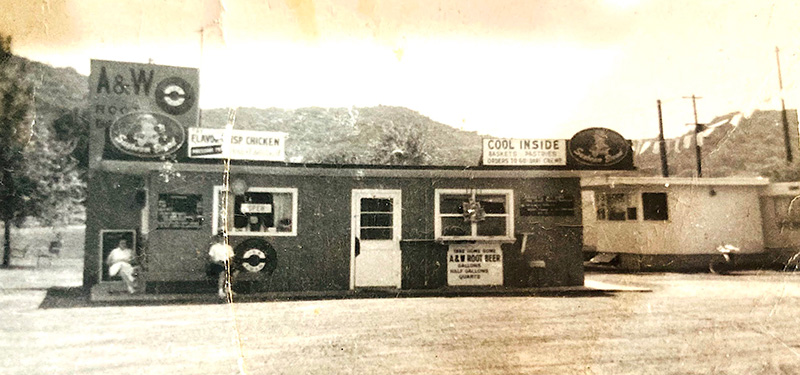
Head to Houston (Minnesota, that is) was the reply when Mr. and Mrs. Jack and Lyla Simonson reached out to the A&W restaurant corporation for a franchise opportunity somewhere in Minnesota. Living in Washington state, the couple wanted to move back to Minnesota for health and family reasons. Having previously resided in western Minnesota, they moved to Houston in 1959.
A&W root beer, ice cream and ice cream floats were the recognized A&W offerings. Lyla and Jack provided the rest of the menu. They peeled and sliced the onions and prepared the patties for the hamburgers. It was more peeling and cutting while converting potatoes into French fries. Those preparations usually took place after closing to be ready for the next day. The menu also featured pizza and homemade pies.
It was mostly a family affair with daughters Krystle, Geraldine and Charlotte Johnson along with daughter-in-law Betty Johnson on the staff. A few high school girls worked there at times.
When A&W debuted in Houston in 1959, there were already A&W root beer stands in Caledonia (before 1953) and Spring Grove (since 1953). And in nearby Rushford, there was already a popular root beer purveyor, The Frosty Faucet. While Houston was the last in the area to receive an A&W, it was also the first to lose its A&W. Caledonia locations remained into the late 1970s and maybe later. Spring Grove enjoyed those root beer floats until 1976. Despite the popularity of root beer and burgers in Houston, the good times lasted short of six years.
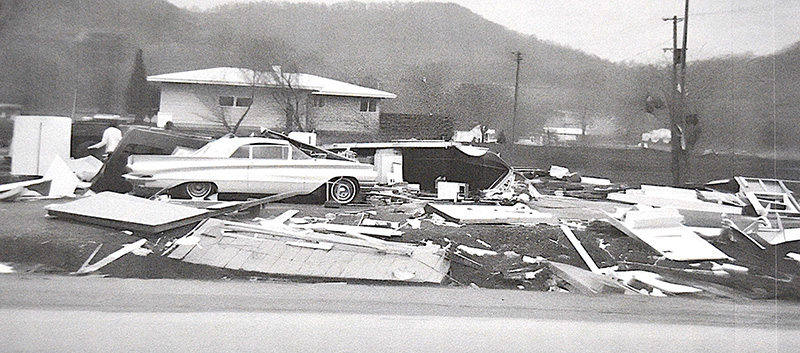
It was a Wednesday evening but still daylight, May 5, 1965, when a tornado roared through the west edge of Houston. Lyla, Jack and youngest daughter Charlotte were in their trailer home behind the A&W when they heard the storm approaching like trains or jet planes overhead and raced to the drive-in. “We lay down on the floor, and all we could do was pray,” Lyla told a Winona Daily News reporter. A grandson recalled hearing they were near the refrigerator as the building was destroyed as was their trailer, which ended up on top of the drive-in. All three crawled out, uninjured. The newspaper stated, “They survived without knowing how.”
Debris was hauled to the farm of daughter and son-in-law, Krystle and Lowell Kinstler. All that remains today are a small section of the bar, a couple of bar stools and some mugs and souvenirs. Lyla and Jack returned to former hometown Hanley Falls in western Minnesota. Daughters remained, with the youngest Charlotte graduating from Houston High School the following spring.
Downtown Houston was spared, but just barely – the main intersection only three-tenths of a mile from the A&W.
A mile west of town on the turkey farm of Vincent Poppe, the wind left no structures standing, removed large wheels from tractors, destroyed a truck and twisted machinery. Humans survived and many of his 6,000 turkeys “were running everywhere.” School was dismissed early the next day for students to round up briefly homeless turkeys.
At the car lot of Bud Johnson and Leonard Tracy, automobiles were overturned and buildings destroyed. A small house near the lot was lifted off its residents – Alfred Elleson, who was deposited into a slough and Hjalmer Schipstead blown into a field. Miraculously, neither was injured.
Destruction had begun to the southeast. One of the first farms hit belonged to Gordon Lanswerk in Iowa, about five miles south of Harmony, Minn. No buildings survived, but the family had rushed into the basement. A 13-year-old girl, with bruises, was taken to a Cresco, Iowa, hospital. The tornado then continued into Newburg Township near Mabel.
The storm passed through the Yucatan Valley, where the next day, a Caledonia man recalled seeing the path of the storm. He observed the destruction of the trees down a bluff on one side of the valley and up through trees on the bluff on the other side of the valley – and then dropping down into the Root River Valley toward Houston.
The next day, the newspaper photographed a Holstein, alive but unable to move with a broken leg amidst the rubble at the Looney Valley farm of Norman Peterson. One animal was dead in the barnyard, and there was additional dead stock in the barn. The home and granary were all that remained in usable condition. Norman’s brother Fred also lost a barn and livestock.
On the LeRoy Larson farm, a modern, eight-room brick home was lost among other buildings. “You wouldn’t know there’d ever been any building on the place,” reported one observer.
The Lower Looney Valley School had been conducting classes for 99 years before the tornado of 1965 blew away the brick building, leaving only the wooden entry. The 12 students and their teacher Mrs. Harold Kremer closed out the school term in the town hall in Houston.
Up on South Ridge, “bees buzzed all over” the morning after Frank Otto lost his machine shop and his bee hives. At their home, Mr. and Mrs. Harley Goede and their daughter “huddled into a corner when they heard the roar and prayed. The roof was taken, windows popped out and clothing hung in trees.”
It was insulation hanging in trees after a newly-constructed insulated barn of Sidney Boldt lost its roof. “There were splinters everywhere.”
Walls remained, but there was no longer a roof, and the windows were blown out at the Victor Beckman farm. His son Paul and family lived in a nearby trailer. Paul’s wife and daughter bolted for the main residence. But Paul, after first putting on his shoes, had only reached the steps before he was “carried by the wind down the hill. Sheets were torn off the beds in the house and hung out in the trees.”
Tornadoes made their way through southeastern Minnesota that evening 60 years ago. Amazingly, there were no local human fatalities, but there was an airborne Houston school bus, and there would be deaths elsewhere in the state – to be continued …
Sources: Storm coverage, Winona Daily News, May 6 and May 7, 1965