
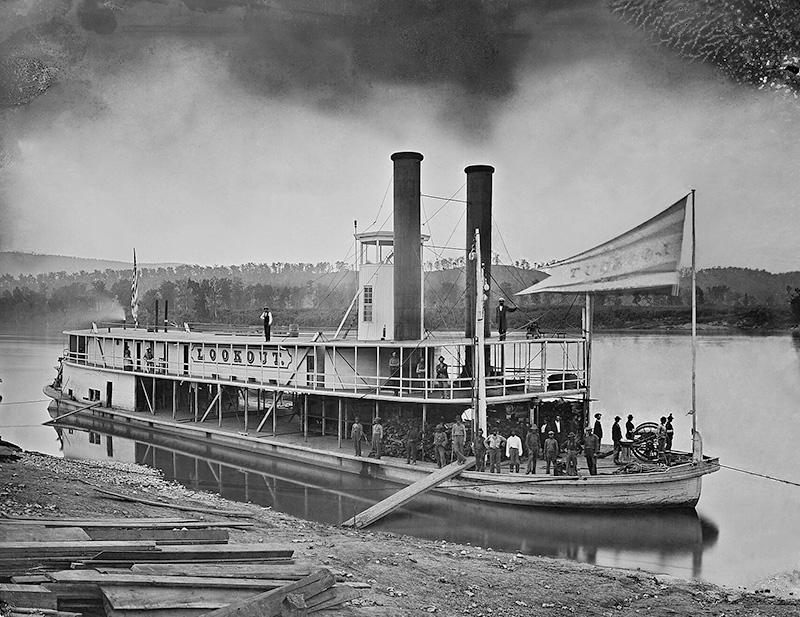
Public domain photo
He did not state the reason his parents moved halfway across a continent. “While yet a boy, my mother, two sisters and myself left a comfortable home in the East for the then far West, my father going before to size up the situation and locate. The change from the classic old State of Massachusetts to the then wild territory of Minnesota was a long stride from civilization.”
Captain Samuel B. McIntire, at age 63 in 1901, wrote of coming to the Yucatan Valley at age 14 in 1852. He opened each chapter of his memoir with a poem, the first of which was:
Although with Eastern
comfort blest,
We sought the hardships
of the west,
Bade friends goodby; then
sped away,
To where The Star of
Empire lay.
Those friends in the East expressed their fear for the McIntires’ safety when encountering both Indians and the “wild beasts of the forest.” But “Cap’n Mac” noted his family was not the first to leave comfortable homes behind and “through whose courage, later, reaped the real and substantial benefit.”
Their journey began by rail, continuing to Dubuque, Iowa, which in 1852, was as far west as a train could travel. It was then by steamboat up the Mississippi River. He admitted the train was a speedier way to travel in those days but suffered in comparison to the “ease and comfort” provided by a steamboat.
“I can well remember how much more pleasant it was to ride on the water than on the rail, the former being free from dust, the accommodation for eating and sleeping much better, and the passengers far more sociable and agreeable.”
Mac reminisced about standing on the upper deck during the steamboat’s various stops while watching a gang of Negroes loading and unloading freight at various stops, “singing in chorus some quaint but meaningless old darkey (sp) melody, as they followed each other with quick step to and from the boat, at their work.
“Now and then a Negro growing frisky would make a “hop, skip and a jump” and let out such an infernal yell as to lift me off my feet and cause the dark forest along the bank of the river to echo far and wide.”
It was likely young Sam’s first experience observing men of color. It is not evident from his description whether those Negroes were slaves or free men. Both were common steamboat laborers. Sam’s observations were in free territory, but the discipline was harsh.
Sam noticed if the boss was also a Negro, he would be more demanding on the men, 10 to one, than would a white boss. “Should a Negro lag or slight his work, the sharp crack of the black boss’ whip would warn the laggard to his duty, and if that did not suffice, then the lash swung with a force sufficient to cut deep into the hide of an ox, would cause the victim to howl with pain, twist his body into a knot, and having unwound himself, jump to his work.”
Young Mac was amazed that the Negroes seemed to prefer rather than avoid the heat. “When off duty, instead of seeking the shade, he would throw himself full length on his back, face turned upward, ‘neath a broiling sun, and thus sleep, snore and never sweat a hair …”
His young teenage fascination and fondness for that upstream experience never abated. Much later in life, when standing on the riverbank at either La Crosse or the “lonesome and bleak depot at La Crescent,” the “shrill whistle” of a steamboat and the “peculiar thump of the paddle wheel” would leave him longing to return to those days when he was a boy and “all care was lost in happiness of the new and ever changing scenes.”
His idyllic voyage finally reached Minnesota Territory at Brownsville, where he saw a long line of teams of horses, that extended beyond the village, each waiting to unload grain at the warehouse. Brownsville was alive as a wheat boomtown.
Wheat was then “almost the sole source of revenue from the farm” and profitable both to sellers and buyers. The scales were unreliable, and the quality of contents in the bag was not always consistent either. McIntire described it as a game of “tit for tat” between the farmer and the buyer, each attempting to get the best end of the bargain. The market price was known only to the buyer. In later years, the price would be published in the Stock Journal, a copy of which was found in many farmhouses.
The wheat boom would not last, but its demise turned out to be a benefit to the farmer. The continual sowing of nothing but wheat was on the way to “sapping the life” out of the soil, as McIntire described it.
The land office in Brownsville bustled with activity. That frontier village even had a newspaper, the Southern Minnesota Herald. Steamboat traffic on the Mississippi made Brownsville the early center of commercial enterprise in what became Houston County. But later, the path of the railroad would take the most prominent prosperity elsewhere.
Sam’s father Edmund P. McIntire met them at the steamboat landing to take them to their new home in the Yucatan Valley. He was “clad in the then western style: an old straw hat, a red flannel shirt, a well-worn pair of overalls and brogans (shoes) to match, smoking a corncob pipe.” It was the first time he had seen his father smoke, albeit awkwardly as an obvious beginner. Sam informed smoking a pipe or cigar was considered a luxury but thought it to be enjoyable only in the light of day when smoke was visible curling from the mouth into air. In the dark, it was like “kicking at nothing.”
The McIntire family left Brownsville on the same afternoon of their arrival heading in the direction of the Yucatan Valley, about 30 miles down the road. To be continued …
Source: “The Yucatan Valley In the Early Day by One Then There” by Captain Samuel Bates McIntire, 1901, originally published serially by the Houston Valley Signal.
Leave a Reply