

Third of a three-part series
“He formed everything from door hinges to implements required to clear the land, plow, seed and cultivate the fields and fashion the tools used during the harvest.” Houston County researcher Josephine Hefte thus characterized Thomas Abbotts, originally from England, who arrived in Caledonia in 1856, establishing a blacksmith shop, and later a wagon, sleigh and implement manufacturing business. The skills of a blacksmith were essential to pioneers establishing homes and farms on the frontier.
In addition to getting cash crops to market, a blacksmith shop, like every business that relied on bringing in raw materials or offered finished products, was greatly challenged by the labor and expense of transportation by horse-drawn wagons over primitive, often unpassable roads. Railroads offered welcome relief when they first crossed the northern townships of Houston and Fillmore counties in the 1860s. But just to the south, even the county seats of Caledonia and Preston would have to wait for over a decade of organizing, planning and financing.
When rails reached nearby Houston in 1866, but bypassing Caledonia, Abbotts became a vocal local, urging action to bring a narrow gauge railroad to Caledonia. After 13 agonizing years of problems, when the first Caledonia, Mississippi & Western Railroad (CM&W) train arrived in Caledonia, Abbotts carried a gold-painted shovel as he led a parade from the depot grounds through the streets of Caledonia.
The Caledonia Journal, which for years had battled opposition while fervently supporting the campaign for a railroad, declared: “The long looked for and long wished for event has been realized, Caledonia is a railroad town …”
The History of Houston County, 1882 stated, “… a train entered the town on the 25th of September, 1879, and after waiting so many years the people were at last gladdened by the sight of the locomotive, and the sound of its welcome whistle … That the narrow gauge road is going to benefit Caledonia there is no question. It has already made a good wheat market for us, and soon will be a good cattle and hog market. And so the citizens began to feel that, after all, they were a part of the great world, that they were let out from their imprisonment and were now free to go and come whenever they pleased – by paying the regular fare.”
Spring Grove, as well as Caledonia, was a market stop on the CM&W. The following entries from the Spring Grove Herald offer a glimpse into life along the rails in the 1890s and the decade thereafter.
“As a precaution against fires during the dry season, section foremen on the narrow gauge have been ordered to patrol their sections after the passage of each train. Sun. night a 60-foot railroad bridge, four miles east of Caledonia was burned and Monday’s trains were delayed several hours. On a telegraph pole near the bridge was tacked this notice, which was signed by “S:” ”Fix your crossings or more bridges will go.” This indicates that the fire was incendiary, but so far as known suspicion does not rest with anyone in that neighborhood. ”S” evidently means business and is not disposed to waste words about it. He is a laconic cuss and the railroad folks will do well to keep an eye on that section.” (September 7, 1893)
“Big trains on the N. G. (narrow gauge) – “We had occasion to take a trip to our neighboring village of Caledonia on Saturday’s east bound freight, which on leaving this station consisted of no less than 31 cars, 26 of them being solid loads. This we believe was one of the heaviest trains ever hauled over our narrow gauge road with one engine. It was pulled by engine 414 with engineer Dan Hanlon at the throttle and run from here to Caledonia as made without a stop. (October 12, 1893)
“I. D. Johnson of Quandahl (IA) shipped 2400 lbs. of butter from this station Monday and also while here remembered the needy printer.” (August 25, 1904)
Caledonian William E. Dorival was a student at Hamline University in St. Paul when he invited a classmate buddy from Minneapolis to spend a few small-town days with him during spring break of 1946. After three days of leisure, away from their studies, they bused to La Crosse where the guest would board a train back to St. Paul.
As that train departed, Dorival noticed across the tracks a small train with an engine and a couple of passengers cars. Entering the station, he inquired if that train was the one that ran down the west side of the Mississippi through Reno, Minn., on the way to Dubuque. If so, could he purchase a ticket to Caledonia. That puzzled the station master who said it had been so many years since he had sold a ticket to Caledonia that he did not know how much to charge. But they agreed on a fare, and Dorival boarded the train. They crossed the Mississippi River and headed south through Brownsville before Dorival got off at Reno.
The train from Reno to Caledonia consisted of an engine, a couple of boxcars and a caboose. He climbed into the caboose and sat down. He was soon joined by the train crew, who of course asked what he was doing there.
They did not know what to do with the ticket he handed them, but one man tucked it into his shirt, leaned out of the rear platform, signaled the engineer, and off they went. After passing through Freeburg, they ascended the grade toward Caledonia. Mr. Ferris, the Caledonia station master, had not expected to see Dorival emerge from the caboose.
Dorival looked back at that serendipitous passage. “It was quite a thrill to ride in a caboose and being, as far as I know, the last paying passenger on the Reno to Preston Railroad … Although the train is gone from the town, the memories of that trip in a caboose still remain, and will, for many years to come.”
Sources: “The Caledonia, Mississippi & Western Railroad Line,” by Benjamin Pennington, and “The Last Paying Passenger Aboard the Reno—Preston Railroad,” by William E. Dorival, both published in Caledonia Pride, 1854-2004 edited by Alan Fleischmann.
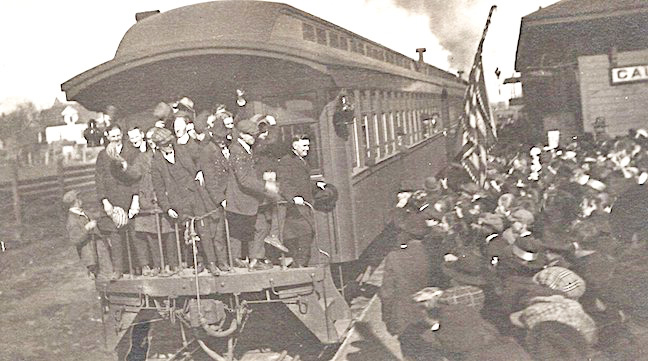
Photo courtesy of the Houston County Historical Society