

Part four of a series
Little Willie rushed into the house, excitedly exclaiming, “Mother, I just saw a man making a horse! Mother told him that was not possible. Willie replied, Well, anyway, I just saw him tacking on the feet!”
Sister Agnes Hafner included many jokes when publishing her recollections of growing up on a Houston County Farm in the early 1930s. She noted that planting and harvesting crops comprised the “backbone of farm life,” and in her observation, were also the most exciting times.
Springtime
Springtime brought great excitement. When new chicks hatched in the incubator, it was a thrill “to hear the first peeps and see the chicks struggle out of their hard-shelled nests …”
Puggy would have a new litter of blind kittens, and Scottie gave birth to cute puppies. In a new batch of piglets, there would be a runt that required house care to survive. Parents displayed pride in the birth of a colt. “What thrilling additions, “friends” these were to the rural family!”
Flowers began blooming; Queen Anne’s Lace adorned rural roads. Children gifted mothers with bouquets of dandelions, which “as if they were roses,” were placed in he center of the table during meals. Children explored the woods for daisies, buttercups, Jack-in-the-Pulpit and Lady Slippers, the Minnesota state flower. However, it was illegal to pick Lady Slippers due to their scarcity.
For men, there was machinery repair, plans for crop rotation and deciding when planting would begin. Grapevines and orchards required attention; women planned flower beds as well as huge vegetable gardens.
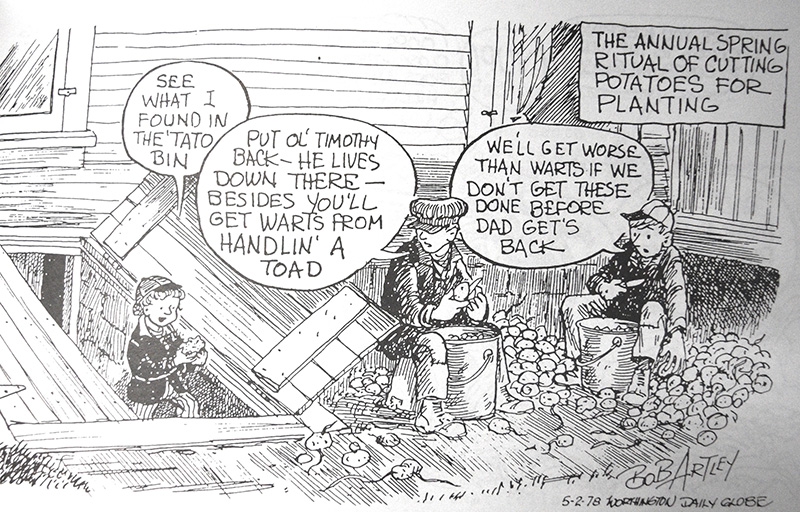
Last year’s potatoes would be hand-cut into pieces, keeping at least one eye in each piece to be planted in anticipation of a large potato plant.
Least enjoyable for the youngsters was picking up stones in the fields where crops would be planted. Everyone dreaded having to hoe down button weeds and Canadian thistles to keep them from spreading into those crop fields.
In later years, farmers would plow while sitting on a tractor and pulling a row of plows that made several furrows simultaneously. But in the 1930s, one horse pulled one single plow with one farmer walking behind. It took quite a while to prepare a large field – one row at a time.
“Late spring brought haying time,” Agnes reminded. “The first fruits of the field began to fill the hay mow.”
Canning Time
In the woods, from late summer into autumn, wild blackcaps, blackberries, chokeberries and gooseberries were picked. In orchards, trees and bushes yielded plums, cherries, grapes and apples. In the Apple Capital of Minnesota, every farm had apple trees.
Women canned hundreds of quarts of fruit and garden vegetables, a busy time in the kitchen preparing “homemade jams, jellies marmalades of the finest quality” along with juices, sauces and crocks of pickles and sauerkraut.
Wine was made from grapes and dandelions. Children did not drink wine in the ‘30s, so mothers used root beer extract to make root beer.
Harvesting
Only with a good team of horses, could a hardworking farmer plow, drag, plant, cultivate and harvest.
Everything required hard work, but harvesting provided satisfaction that all that work was paying off with the hay mow, corn crib and granary filling up. Harvesting hay involved mowing, raking into rows and tossing by hand onto the hay wagon, where it was hand-spread with a fork. Or a hay loader may have been used to put it on the hay wagon. It was then “taken to the barn, pulled up on pulley by a big hayfork, drawn by a horse, into the haymow and there spread with a small fork.”
Corn was plucked by hand, one ear at a time. Using a corn husker attached to the right hand, men and older boys would separate the ear from its husk, one by one, and throw them into a waiting wagon. At the corn crib, each ear was unloaded by hand.
Grain, such as wheat, barley and oats, was harvested with a binder, a machine that cut standing grain and formed it into bundles, which were tied with wire (in later years with twine). Binders were first pulled by horses, later by tractors. Six to eight bundles were hand stacked into shocks for drying.
On threshing days, bundles of grain were hauled by wagon to a threshing machine, which separated grain from straw (stalks) and chaff (husks). Grain traveled down a chute into burlap bags to be emptied into grain bins in the granary. Straw was blown into a pile, often used for animal bedding.
Threshing days were hard-working but festive cooperative efforts by neighbors, special days, described by Agnes as the “highlight of life on the farm. Spending two or three days on each farm of the threshing crew bound the neighborhood together as nothing else could!”
In mid-morning and mid-afternoons, kids carried dishpans laden with “delicious sandwiches,” coffee and water out to the crew of 10 to 12 threshers. Dinner time was “a jovial, upbeat time with lots of teasing, delicious chicken dinner, homemade bread and jam plus goodies from the garden.”
Thus, autumn ended with corn cribs, granaries and haylofts filled or bulging. Cellars were filled with large potato bins and shelves loaded with canned vegetables, fruit, jam, juices and meat. When all had been harvested, canned and stored, there was great relief, satisfaction and gratitude. “Thanksgiving Day was a day of gratitude in church as well as feasting,” Sister Agnes emphasized.
In late autumn or early winter, meat for the cold winter months came with butchering a cow or pig. There were no freezers or lockers to process meat, so women canned meat. The finale of food preparation was making “wurst” (sausage) with the sausage machine. “Neighbors came together, played cards, then enjoyed fresh delicious homemade wurst!”
Another chuckle: One one occasion when William Howard Taft was campaigning for president in unfriendly territory, someone threw a cabbage head, which rolled to a stop at Taft’s feet. Taft commented, “I see that one of my adversaries has lost his head.”
Sources: A series of guest columns published in the Houston County News, (La Crescent, Minn.) were later published in a book, “Life on the Farm in the 1930s,” by Sister Agnes Hafner, FSPA, 2004. The cartoons by Bob Artley were originally published in the Worthington (MN) Daily Globe, and later in his book, “Memoirs of a Former Kid,” 1978, and again in 2004 in Sister Hafner’s book.
Leave a Reply