
It probably wouldn’t happen in the 21st century, with GPS and cell phones. But it was common for motorists to stop and ask for directions during the 20th century – but usually not by someone driving two secret service agents – and the president of the United States!
On September 12, 1938, about three weeks before his 75th birthday, Fred. C. Sandte, clad in his farm-work overalls, approached a car that drove up to his Fillmore County farm to ask directions to Chatfield. When asked by the driver, Mr. C. L. Fischer, if he had ever seen the president, Sandte replied that he had seen the president four years ago in Rochester. “Well, here he is again,” said Fischer. In the back seat, a smiling Franklin Delano Roosevelt spoke up, I’ve been visiting in Rochester. I have a son who had an operation there, but he’s doing very well.”
Sandte told the president that his sons had also undergone surgery in Rochester, and an impromptu conversation ensued.
“He talked just like anyone I would talk to in Stewartville,” noted Sandte, who lived in Stewartville about six miles northwest from where he farmed 620 acres with his sons Delbert and Ralph in Sumner Township, Fillmore County. The president asked about the condition of the crops, to which Sandte replied, “They’re pretty fair around here, although it’s been pretty wet.”
The president continued to chat between five and 10 minutes while secret service agents displayed some impatience. “I have a farm, too,” said Roosevelt. “I have 80 acres of Christmas trees about 80 miles from New York,” as he explained how they are planted eight years before being cut.
One famous farm owner wished a surprised farmer well, and the travelers were on their way to Chatfield. According to the Post Bulletin newspaper, “Sandte did not say that he had asked the president what he planned to do to lift farm prices, but according to reports, Roosevelt promised he would do everything possible.”
“I only wish Ma had been there,” Sandte imparted when he was persuaded to recount the visit at a meeting of the Stewartville Parent-Teacher Association.
The presidential entourage, consisting of two cars, also carrying Rochester police, including Chief Louis J. Claude and secret service agents, drove unannounced down Highway 63 from Rochester to Stewartville and then east to Chatfield before returning on Highway 52 to Rochester. The stop at the Sandte farm came during the only leg of the trip during which the president was not escorted by state highway patrolmen.
It had become necessary to ask directions when the party became disoriented. Sandte advised backtracking, slowly on a rural road, which had been “softened by recent rain,” to locate what was known as the South Road leading to Chatfield.
Residents of Chatfield and Stewartville were also taken by surprise, but when some realized a dignitary was passing through downtown, business district sidewalks became crowded as the president smiled and waved to stunned onlookers. Roosevelt was shown Stewartville’s new community center.
It was reported the president was interested in farms and crop conditions during the 54-minute ride through the area’s rolling farmland that ended at 5:30 p.m. Upon return to Rochester, Roosevelt stopped at the Kahler Hotel to pick up his wife and then visited his son James at St. Marys Hospital.
1934
When Sandte said he had seen the president four years previous in Rochester, he was referring to August 8, 1934, when Franklin D. Roosevelt visited Rochester to honor the Mayo brothers for giving free treatment to World War I veterans and to tour their world-famous medical facility. It is not surprising that four years later, the Roosevelt family chose Rochester for surgery for son James.
As part of a western tour, FDR departed St. Paul at 12:30 a.m. on a train that arrived in Rochester at 5 a.m. Four-and-a half hours later, he was greeted by the mayor as well as Dr. and Mrs. William J. Mayo and Dr. and Mrs. Charles Mayo and three or four members of an American Legion citation committee.
The president and both Mayo brothers drove in an open vehicle through downtown where well-dressed throngs lined the sidewalks. With temperatures in the 90s and no porta-potties, estimates ranged from 75,000 to 100,000 sun-drenched onlookers. Accompanied by his sons, Franklin D. Roosevelt, Jr. and John along with members of his cabinet, FDR addressed an estimated crowd of 40,000 and a nationwide radio audience from Soldier Field.
Roosevelt was taken by automobile to Wabasha, where he boarded William Mayo’s yacht to inspect a Mississippi River improvement project. Later that afternoon, Roosevelt took a train from Winona, where 35,000 to 40,000 waited for him. Just before the train pulled out, son John helped the physically disabled president out onto the platform for a brief unscheduled greeting, “Hello, hello! How are you?” The next day, FDR was in Green Bay, Wis., where he delivered another national radio address.
Winona
In southeast Minnesota, the presidential prize goes to Winona, where seven different presidents have made eight appearances. But Winona was a primary destination only once when William Howard Taft delivered a long speech at the opera house, the same 1909 day he dedicated the new YMCA building in La Crosse.
Otherwise, Winona was on a presidential pathway to somewhere else. As a primary railway junction, Winona was often a brief stop for refills of coal and water and change of crew for many trains between the Twin Cities and points south and east.
On a slow-moving train in 1887, Grover Cleveland waved from the rear platform. Teddy Roosevelt made brief remarks from a train platform in 1903. “Silent Cal” Calvin Coolidge did not speak, but waved to a small boy while stopped in 1927.
FDR was surely asleep when his train moved through, without stopping, near midnight in 1937. Harry Truman made campaign stops in 1948 and 1952. Jimmy and Rosalynn Carter and daughter Amy waved to more than 6,000 from a steamboat in 1979.
Sources: “President and Party Lost; Farmer Chats With Roosevelt,” Post Bulletin (Rochester), Sept. 13, 1938; “Presidents Day: A look at presidential visits to Rochester,” kaaltv.com; “Winona “on the way” for presidents,” by Jerome Christenson, Winona Daily News, Feb. 20, 2015.
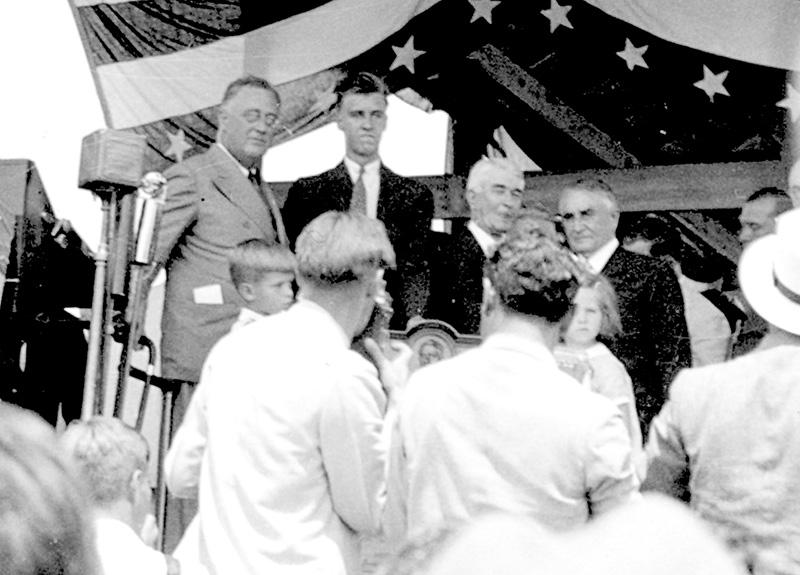
Photo courtesy of the Houston County Historical Society
Maison S says
How was this story discovered?
I’m trying too a build a family tree and i came upon this