
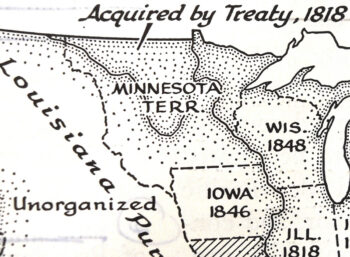
Image submitted

Part two, Portland Prairie, 1850s
After Minnesota was organized as a territory in 1849, pioneer settlers arrived in numbers sufficient enough that statehood came nine years later – in 1858. Wisconsin had become a state after 12 years as a territory, Iowa after eight years. Minnesota Territory extended west to the Missouri River, which now crosses both central North Dakota and central South Dakota. When Minnesota statehood came, the area between the Missouri River and Minnesota’s western border remained unorganized until Dakota Territory was organized in 1861.
The 1850s saw immigrant settlers arriving in what would become Houston County, either directly from Europe or after a few years or months elsewhere in the United States, most frequently Wisconsin. And there were also many Americans moving west from eastern states.
Along the Iowa border, Irish, Scots and Germans settled in the southeast corner of what would become Houston County. Norwegian immigrants flocked into the southwestern corner. In the middle, the township line between WilmingtonTownship and Winnebago Township cut through an area known as Portland Prairie, which also extended south into Iowa. The first settlers on that Prairie were Yankees, American-born citizens from New England, mostly the states of Rhode Island and Massachusetts.
Government land in Minnesota was sold at low prices at land offices to both settlers and land speculators, the latter intending not to farm but to sell at a profit to newcomers. By the mid-1850s, most of the prime land that would make a good 40-acre farm had been purchased. Fortunately for speculators, newcomers kept coming, some being friends or relatives of the earlier Yankee arrivals.
Transporting household goods from the east entailed packing them in large boxes made from pine boards an inch thick. When later disassembled, the boards and nails would be salvaged for use in pioneer dwellings. Freight traveled more slowly than passengers. One box of Albee family clothing never arrived.
With original prairie land being divided by steep-sided ravines, the Portland Prairie community consisted of smaller or moderate-sized farms. In the 1850s, the larger farms did not much exceed a quarter section (160 acres) with a few having an additional 40 acres. Eighty acres was most common with some no more than 40 acres. Those of smaller acreage would likely in time be purchased and attached to larger adjacent farms. Many settlers also acquired distant wooded lots, maybe on timbered ridges.
A pond hole might be dug to retain rainwater, which could be used to wash clothes until hogs running loose would spoil the site.
About 1856, a mail route was established from Brownsville, Minn., to Dorchester, Iowa, with intermediate postal stops at Crooked Creek, Winnebago Valley and Portland Prairie. That Portland Prairie post office was kept at the house of Asa Sherman. There was not a lot of attention required with mail delivered only once a week, and even then, there was usually no more mail than would fill a fourth of an ordinary mail sack.
Railroads would soon reach the other side of the Mississippi River at Dubuque, Prairie du Chien and La Crosse. During warmer weather, there were two boat lines transporting freight and passengers to the Minnesota side of the river. La Crosse was the nearest railroad terminus to Portland Prairie, but still over 30 miles away.
During those earliest years, flour and meal came only by horse-drawn wagon from Lansing, Iowa. It was a major advancement when flour, cornmeal and feed was milled at Dorchester, Iowa, about five miles from the center of the Portland Prairie. That village would soon feature a store as well as a blacksmith and wagon shop. A sawmill was built on Waterloo Creek above Dorchester, not far from wooded property owned by some Portland Prairie farmers, who could cut logs and haul them to be sawed into lumber.
Prairie farmers cultivated oats, wheat and corn in the early 1850s – all before machinery was common. A limited amount of wheat could be harvested with only the aid of oxen for dragging. All else was accomplished by hand, sown by hand, cut with cradles and pounded out with flails. Sam Evans was known for using the first reaper in 1857, about the time a horse-powered threshing machine was first used. Much family fare came from vegetable gardens, but there few, if any, early attempts to plant fruit trees, which were thought unable to survive winter weather.
Minnesota was not spared from the financial panic of 1857, resulting from inflation overextension of credit, over-expansion of railroads and manufacturing, land speculation, unsound banking and European wars. There was severe depression in the industrial Northeast and agricultural midwest.
There was unprecedented unemployment in cities. But even on Portland Prairie farms, for almost a year, there was little or no money available for store purchases. Few letters were written because they required expensive three-cent stamps. Sarah Albee wrote, “We were so hard up I did not know where to get the next bar of soap to wash my babies’ aprons with.” But despite its severity, the panic was relatively brief.
The first Wilmington town meeting at the Norwegian schoolhouse was known to have occurred on the same day that Minnesota Territory became a state on May 11, 1858. However, news of statehood did not reach the Prairie until the weekly newspapers arrived. It was also the year a schoolhouse was built, which would stand for a decade.
There were no daily newspapers available on the frontier, but there were numerous excellent weeklies published in cities but intended for rural circulation. Delivered by mail, those weekly publications covered both national, legislative and even foreign news along with editorials and speeches. Even though it was commonly understood and accepted that this news might have been a week or 10 days old, maybe foreign news three or four weeks after the fact, its arrival was highly anticipated.
Political discussions ensued on the Prairie after the weeklies were received, and there was plenty of political news in the 1850s leading up to the Civil War.
Sources: Old Times on Portland Prairie, Houston County, Minn. (1911); The American Republic, Vol I, to 1865. (1959)
Suzanne Neubauer says
Excellent and so interesting!!
Suzanne Blagsvedt Neubauer