
 First of a series
The first telephones in Caledonia were probably the legal “string phones,” but could they have been prohibited versions of the patented “electric speaking telephone?”
In the spring of 1883, an article in a Caledonia newspaper sought subscribers for a telephone exchange with an investment of $25 plus $10 dollars for an instrument (telephone) and the necessary amount of wire, poles, etc. A few weeks later, the newspaper reported the venture had been successful, and telephones were in use in the homes and businesses of subscribers.
At that time, Bell Telephone Company held the patent for the battery-powered “electric speaking telephone” until 1894. Most of the few companies that infringed upon that patent were sooner or later found out and shut down. Bell did not sell telephones, but rented them (until the 1970s). So those 1883 Caledonia subscribers, by the fact that phones were purchased, were not using Bell phones.
The electric speaking phone used battery power for transmitting sound waves, while the string phone was a glorified version of two tin cans and a taut string. It did not actually use string but iron wire instead. The diaphragm was made of several materials, including a large piece of hardened leather. One talked into the diaphragm, which was usually in a wood box about 12 inches square. One’s voice caused the diaphragm to vibrate, and the vibrations were transmitted by molecular action to the attached iron wire, which ran up the street on poles to another box/diaphragm, often connecting a home and a business. The receiving diaphragm turned the vibrations back into sound waves.
If either party wanted to signal the other, one could tap on the diaphragm with a small mallet, which created a drumming sound or tinkled a tiny bell on the other end. Transmission was greatly limited by distance, usually three-fourths of
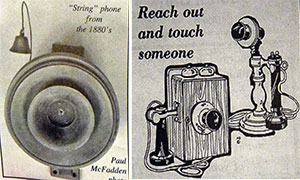
Photo and drawings courtesy of Houston
County Historical Society
a mile. Proper installation was required. The wire could not be too tight or too loose. There couldn’t be any kinks or damp branches or wet weeds. It was said that barbed wire pasture fences could work.
By the mid-1890s, after Bell’s patent expired, the electric speaking telephone business was booming with companies organized in cities and small towns. An 1895 newspaper stated, “La Crosse will soon have the means to communicate long distances while at Rushford, a proposition is being urged on the business men to incorporate a company having for its objective the building of a telephone line via Bratsburg, Highland, Lanesboro to Preston and from there to Spring Valley via Fountain and Wykoff. Also from Rushford to Arendelar via Peterson and connecting the entire system with La Crosse via Houston.”
A Caledonia newspaper called 1895 a “year of progress” with Caledonia and Houston having been connected by a telephone line, which also connected with Sheldon, Mound Prairie and Money Creek. Connection was soon completed to La Crosse. The long distance line would terminate in one or two locations in Caledonia.
A small community or rural area often had just one community telephone, located in a central location, such as a drug store, grocery store or doctor’s office. There were also “farmer lines” for making long distance calls. However, these had limited calling range due to poor line construction and insufficient battery strength in the phone. The community phone was large with three large battery jars. The farmer had one or two small battery jars and could call in to the community phone, which served the same purpose as a switchboard, to have a long distance call put through with the superior battery power. Going into town to use that community phone was a more reliable alternative. It was into the teens before a dry cell battery would be in each phone.
Phones soon began to appear in private residences as well as businesses. In late 1897, the Caledonia newspaper reported 22 telephones in Spring Grove. It read, “What town of its size can beat it?”
In 1899, the Standard Telephone Company (headquartered in Dubuque, Iowa), which was providing telephone service in Houston and Fillmore Counties and five Iowa counties, was given the franchise to erect poles and string wires on the streets of Caledonia. The next year, Standard put in a switchboard.
This column is based on the research of telephone historian Paul McFadden as published in Caledonia Pride.
Elizabeth Mitchell says
My Grandmother Fern Wilhelm- Mitchell was born in Caledonia. And worked for Northwestern Bell telephone Company for 32 years. It must have been around 1940 that she started working as a switchboard operator in Caledonia, going on to become Head Telephone Operator in Saint Charles, MN. (While raising my and Uncle alone.) She went on to retire from the Austin, MN office.