

Part two of a two-part series
“They’re all drunk. They have the corpse standing up in a corner, and one guy passed out and is in the coffin,” reported Ake Nelson to his wife, explaining why he was back home so soon. He had walked, carrying a lantern in the dark, “only” about two miles from home to pay his respects to a neighboring family after the death of one of the Brady brothers – probably Phillip in 1937 in far southeastern Houston County. It was in an old log cabin according to Nelson who continued, “They are so lazy that they didn’t even cut up their wood. They have a log sticking through one window and are feeding the other end of it in the stove.” Nelson termed it a “ real Irish wake.”
The later death of another Brady brother was recalled when the deceased was being transported into town to the funeral home. “For convenience – or perhaps humor – he was “sat up” in the backseat of the car. The driver parked and left the vehicle to go into the undertaker’s – or another? – establishment. A passerby stopped at the parked car to have a friendly chat with the chap he’d known well.”
A traditional wake was a period of time between death and burial, when according to some, there would be observation to make sure the deceased was undeniably deceased. It also provided travel time for some mourners to attend the funeral.
One story was told by an adult about a Jefferson Township wake he attended during his boyhood – one of the area’s last big Irish funeral observations after the passing of “Mikey” Donahue. The men would go outside and drink while the kids would play out there. “We were all little snots!” he admitted.
But he was impressed by the three-day event. “Everyone brought food and it was a good drinking party.” There was a lot of visiting and someone stayed awake all night, not wanting the body left alone. Finally, after three days, the church service and burial occurred.
After the passing of one of the Kenney boys, the bishop from Dubuque traveled all the way up to Minnesota. The bishop commented the money spent on a fancy tombstone might have been better used to fix up the cemetery. This so upset some family members that during a long lunch break, which included considerable alcohol, they became so incensed that they decided to get in their cars and go kill the bishop.
Alice Kubitz, who had helped serve the food, called down to the parish house, reaching the housekeeper, who warned the bishop, who hastened back to Dubuque. The local Father Hayes came to calm the situation and let it be known the bishop had departed.
During winter, burials were often delayed until spring. One historian noted the local fruit-bearing shrub, the “Juneberry” was also known as the “Serviceberry,” thinking it a curious alternative name. But the blooming time is also about the time that the spring thaw permitted spring burial “services.”
St. Patrick’s Catholic Cemetery was the only formal burial ground in Jefferson Township. The Catholic Church could deny burial in the cemetery. The obituary of Elizabeth Brad Peyton reported she “was preceded in death by four children as infants.” Family recollections indicated that only two of the babies survived long enough to be baptized and therefore eligible to be interred in St. Patrick’s Cemetery. However, the two unbaptized infants were not eligible and were buried at home near the lilac bushes. Documents verify only one baby being buried in the cemetery.
The cemetery was used and maintained long after the church building was no longer there. For the size of the cemetery, there are relatively few gravestones. But there are a great number of unmarked graves. For most of the cemetery’s first 100 years, only the wealthy could afford a marble gravestone. For most, such markers were not affordable. Each grave was marked by a mound of dirt. Infants were buried between adults. There may have been homemade markers, such as a painted rock or a makeshift wooden cross, none of which survived many years. And through time, family members moved away.
Most family plots were organized in rows, with each family maintaining its row. Since there were visible mounds of earth and everyone knew the order of death in their own family, individual grave markers were not necessary.
Those mounds and some crude grave markers were visible into the 1940s when community cemetery maintenance was organized. Any written records of burial locations had not survived. Modern mowing needed level ground.
One wooden cross was made of flat wooden boards with the names of deceased Brady family members painted in white paint. With deterioration of the wood, Phillip Brady had it covered with tin. If names were ever added, none survived as long as did the cross. But that deteriorating marker was replaced in 2007 by a cross made from treated 4x4s.
As noted last week in Part One, there were numerous undocumented, long forgotten burial locations, a few uncovered by weather or machinery. The 1882 History of Houston County reported the corner of a coffin appearing above ground after a heavy rain near Twin Peaks. It was a small casket with the skeleton of a child. After WWII, the county was digging shale out of a side hill along the road below the cemetery. Blasting charges unearthed some bones, and the project was halted.
Two children, visiting their grandmother one summer in adjoining Winnebago Township, went exploring along Eitzen Creek after a flood. They pulled two large “sticks” out of the creek bank. When they showed them to Grandma, she exclaimed, “Glory be to God, children! Where did you find these?” She sent them back to return the “big sticks” to the exact spots where they had been found.
Later, the kids suspected they had found two leg bones at a long-forgotten cemetery. Grandma’s reaction was sufficient to keep them from exploring that creek bed again.
Source: “A Creek Runs Through Me; A History of the Winnebago Creek Valley in Southeastern Minnesota” by Barbara Scottston and Terry Atherton, 2013
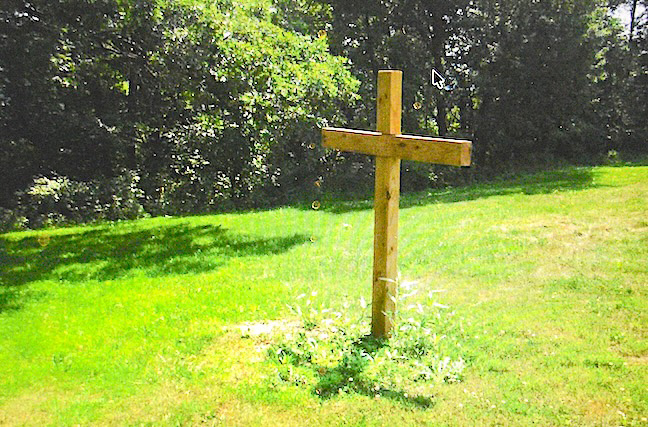
Photo courtesy of local historian Barbara Scottston
Leave a Reply