

Life was challenging and often brief for Houston County pioneers, as early as the 1850s. The two earliest recorded deaths in Jefferson Township, the most southeastern township in the county, occurred in 1856, both accidental. Rev. Leonard Sharp, a Protestant Campbellite, had been preaching in Winnebago valley as early as 1854, perished below a falling tree in January, 1856. In September, Patrick Cowley drowned. Both are cited in the 1882 History of Houston County as being the first death. Without citing the actual location of these mishaps, later historians noted one may have been the “first” death of a county resident and the other the “first” death that occurred in the county.
However, another accidental death may have occurred even earlier, when in December 1855, James Malone left his rural dwelling headed for Brownsville, but he became lost and died in a severe snowstorm. His remains were not discovered until after spring thawing. Malone had resided with his sister, Mary Hughes, who later died while visiting friends in Wisconsin. Her remains were returned for burial.
Thomas Collins, at age 21, along with friends on a Sunday afternoon in May 1893, was canoeing near the Mississippi River when he drowned after his canoe overturned.
On August 16, 1920, a mother and daughter, who were using gasoline (some sources say kerosene) to kill bedbugs upstairs when the liquid got on their clothing and accidentally ignited from a burning lamp. The teenage daughter jumped into a rain barrel, but although the house did not burn down, both died from their burns. Nick Rouster was left to raise three other children.
Many deaths, especially those of children and infants, were due to disease and flu epidemics. One of the most-enduring memories of family tragedy has been mentioned previously in this column. A young man, Henry Buckindahl (Buckendahl), Jr. had moved from the town of Winnebago Valley, Houston County, to South Dakota, where he became ill and died. His effects were shipped back to his family members, who were unaware he had died of diphtheria. A younger brother put on his deceased brother’s suit of clothes, which was contaminated with the disease. Five siblings died within a few days in that winter of 1899. There was no other diphtheria in the area. The quarantined family buried the children temporarily in the snow until the spring permitted proper burial at the Wheatland Church Cemetery across the state line in Iowa. According to a newspaper report and the census, two ill children and the parents survived.
In another family tragedy, which was remembered for decades, only the children survived. Martin and Anna Collins and some of their children came down with typhoid fever in August 1908. His sister Katherine came to care for the family, also contracted the disease and died October 16, eight days before Anna and three months before Martin. However, all nine children survived.
The most accepted explanation centered around, in this case, life-saving milk and deadly water, the latter concluded to have been poisoned by a deceased animal. With milk believed to be so essential for children, the adults saved the milk for the youngsters while themselves drank water. Another entire family died because of “something in their water.”
Starting in 1870, the Jefferson Township clerk began recording deaths of local residents, whether or not the death occurred in the township. For the first 30 years, they were recorded in a ledger book, sometimes noting the cause of death. When legible, historical medical terms included: pemphigus, dropsy (swelling related to congestive heart failure), Scarofula (sic) (scrofula is caused by swollen lymph nodes caused by tuberculosis), phisical (sic) prostration, grippe and la grippe, the popular French terms for influenza.
Many deaths were recorded in 1871, probably an epidemic of typhoid fever. Cholera claimed many lives in the 1860s as did Diphtheria in the 1870s. Scarlet Fever, typhoid and diphtheria “took their dreaded toll of lives in this new country,” reported the 1919 History of Houston County. Surviving did not always end suffering. The death certificate of Annie Mangner noted a long period of institutionalization at Anoka State Hospital. Her family said she had continued to suffer after an influenza epidemic.
St. Patrick’s Catholic Cemetery was the lone formal place of burial in Jefferson Township, but it was also common to bury family members on the family farm, especially before the Civil War (1861-64). It was convenient, and families felt close connection to their most valuable possession – their land. During an era of large families and many descendants, they did not envision a time when the family would no longer occupy the property.
John F. Brady’s wife Mary and stillborn daughter died together in 1904. Her burial was noted in the ledger as “Jefferson Township.” One oral history remembered her being buried “on the bench behind their house.”
There were several other undocumented burial sites. One interviewed resident said his father was especially bothered by brush growing near the edges of his fields. He would cut such vegetation far back from the fence. However, he allowed one large elm tree to flourish near the edge of a field. When asked by his son why he had not removed that tree, the answer was, “because there’s a little baby buried at the tree. A couple came through here heading west, and they had a sick baby, and it died. They buried it and went on, leaving no marker other than that tree.” But eventually, that tree would also die, and no marker remained.
A man named Doyle was said to have been buried in a pasture on the George Smerud farm. There was once a small fence around the grave, which at one time, could be seen from the road. According to local lore, two soldiers were said have been buried on the Jordan F. Hurley farm. To be continued …
Source: “A Creek Runs Through Me; A History of the Winnebago Creek Valley in Southeastern Minnesota” by Barbara Scottston and Terry Atherton, 2013.
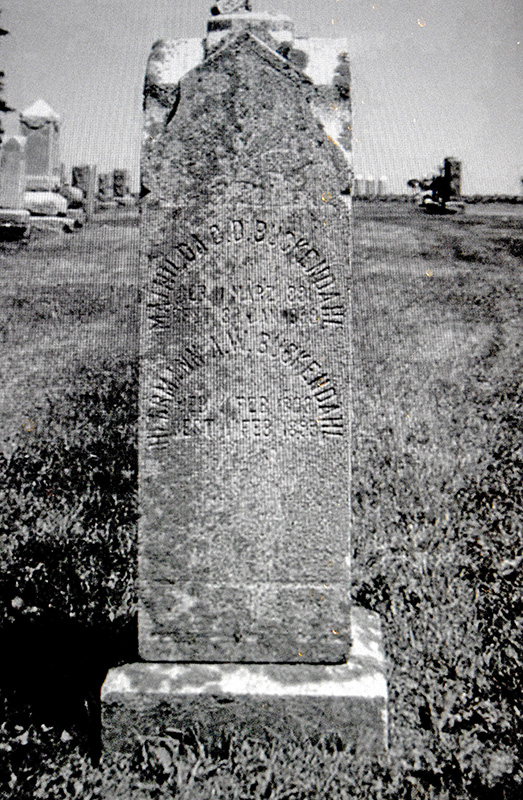
Photo courtesy of local historian Barbara Scottston
Leave a Reply