

Part two of a two-part series
An 1884 newspaper credited S. D. Torrey of Lansing, Iowa, for introducing the roller-skating rage to Caledonia. “We had the pleasure of witnessing the first experiment of some of our denizens on rollers at the courthouse Monday evening, and we enjoyed it hugely. We did not venture to try on a pair of skates, however, fearing that a certain part of our corporation would not stand the pressure of being sat down upon so unceremoniously as was that of several, of both sexes, who braved the danger of receiving a broken heart (?) while practicing on the unruly rollers. The fun will be kept up every evening this week.”
So well received was that week of roller skating that only a week later, the newspaper reported Frank Bacon had responded by including roller skating in his plans while constructing Bacon’s Hall for concerts, balls and conventions. In the mid-1880s, both Rushford and Caledonia had a new building that provided for indoor roller skating, both referred to as “The Rink.”
The facility in Caledonia opened on July 4, 1884, with almost every pair of skates available being used that afternoon while serenaded by an amateur brass band. A newspaper reported, “The strength and durability of the floor and foundation of this building was most thoroughly tested, not only by the natural weight of the throng that were circling around on the rollers but, more particularly by the sudden jar of those sat down who with (without?) premeditation or ceremony sat down with all the weight they could bring to bear upon what they probably considered the weakest spots in the floor with the strongest spot of their corporation. Our amateur brass band discoursed an occasional piece of music while the skaters wiped the perspiration from their brows.” That evening, the skaters were replaced by approximately 75 dance couples.
Later, mid-century skaters, who owned their own skates, were able to skate on hard-surfaced streets and sidewalks. During the 1950s and 1960s, Helen Houlihan enjoyed skating on a brick sidewalk, which still exists along East Main Street in Caledonia.
The Caledonia City Auditorium installed a portable wooden skating surface, in sections, on top of the concrete floor in the basement. One man remembered two friends attempting to teach him to skate. “With a friend on each side, he made direct contact with the center post.”
A September 15, 1950, advertisement announced, “the Caledonia Roller Rink would be open for the season on September 17th for skating on Wednesday and Sunday from 8 to 11 p.m.” On Saturday, children could skate from 7 to 8:45 p.m. and adults from 9 to 10:30 p.m.
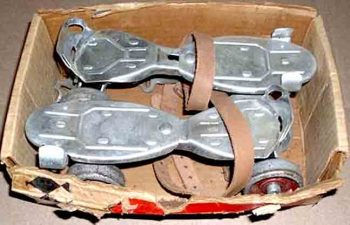
Photo submitted
This Caledonia Roller Rink likely opened in the late 1940s and closed during the early 1950s due to the dust problem. One account stated, “While most people remembered how dusty it was, they all agreed, “it was great fun.” There was also difficulty putting down enough resin to make the surface slippery enough to skate smoothly.
Most prevalent in the 1900s were traveling outdoor roller rinks, which pieced together a skating surface beneath a tent. Sides of the tent might be raised for open-air comfort during the day and then dropped down to enclose the flooring overnight. This would have been an exclusively warmer weather attraction. At one time, there was outdoor roller skating beneath a tent at a Caledonia location known as “Hokah Pond” at Lincoln and East Street.
As early as 1923, a Spring Grove newspaper notice read, “Knox and Lewis, who have been conducting a roller rink at the Opera House the past two weeks, returned to their home at Lanesboro Sunday.” Only one year in mid-century, there was a traveling tent behind the bank in Spring Grove, reportedly set up by a man from western Minnesota.
Traveling with a tent and portable floor was a common roller skating enterprise. However, Purple Heart war hero Peter (Junior) Wirth had a different part-time business plan. Based in Spring Grove during the 1950s, he traveled only with a trailer full of skates to a town where he could rent a building with a skating surface. The disadvantage was the condition of the venue, such as the unsatisfactory skating surface in the basement at the Caledonia City Auditorium, which caused Wirth to move on to a building on the fairgrounds in Waukon, Iowa.
It was a family affair. His wife Berthana had a younger brother, Wesley Bergsrud, who served as the skate boy, assisting customers with their clamp-on skates. Wes’ younger sister LuCinda was on the cleanup crew, whose job included sweeping the floor. Darla Wirth Hunzeker, the daughter of Junior and Berthana, said, “I remember riding around the rink on my dad’s and Uncle Wes’ shoulders when I was small (age three-to- five years). I also remember my folks waltzing around the rink.” Music was a prominent part of the experience. Phonograph records were available by mid-century.
In 1960, that former skate boy brother-in-law Wesley and his wife Peggy partnered with Mickey Scanlon from Caledonia to purchase and revive the business. Peggy, who previously as a Lanesboro teenager, with a girl friend or two, had hitchhiked 18 miles to the indoor rink in Harmony on autumn weekends after the traveling rink had left Lanesboro at the end of the summer.
Peggy and Wes, for four years, took the trailer of skates to the community center in Eitzen for Saturday night skating and then on to the school in New Albin, Iowa on Sunday evenings before returning home to Spring Grove.
All ages came, including a 75-year-old man who skated every week in Eitzen. Admission was 75 cents, including skates, or 50 cents if you owned skates. In 1963, 50 cents was comparable to $5 in 2023. Peggy realized the admission was serious money for some children when they paid all in pennies from their piggy banks.
In New Albin, there were boys who would sneak up onto the school stage in order to skate airborne onto the gymnasium floor.
Sources include Helen Houlihan’s article in the publication Caledonia Pride and also personal recollections of the Bergsrud and Wirth families.