
Photo submitted
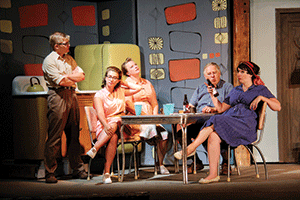
Photo submitted
Revised from his first two columns in 2020
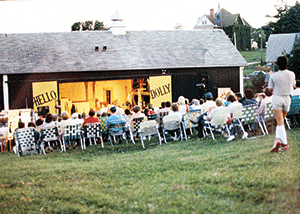
“Ye Olde Gray Barn” is not gray, but black. However, it is the “Gray barn” because the functional facility for draft horses was loaned by Dr. Jim and Karen Gray to an ambitious group of citizens, who in 1979 staged “Annie Get Your Gun,” the first of the often-acclaimed 46 summer musicals in Spring Grove – believed to be the longest-running annual event in town. COVID canceled the 2020 performance.
It all began with eight ladies, who had only an idea – but no money, no costumes, no lighting, no play or playhouse. Originally, there was no intention to perform outdoors. Jim Gray came home one evening to find the ladies pondering the problems and possibilities. One major task was finding a venue. Jim jokingly suggested the family’s horse barn. “I was just kidding,” he said. But the ladies went right down to look at it. Built into the side of a hill, the upper-level haymow became a ground-level stage; the horse stalls beneath had a walkout entrance in the back. Those horse stalls became dressing rooms for the cast.
Originally, the audience sat in the haymow while the actors were on a tiny elevated stage. The next year, Dr. Gray built two balconies overlooking the stage for additional seating. Some patrons began bringing lawn chairs to sit outside on the hillside. Dr. Gray then extended the width of the doorway from 14 feet to 30 feet to allow better viewing under the stars. Soon, all of the audience sat outside the barn, and the entire haymow became a larger stage with offstage wings.
One of the balconies was removed, but the other remained to seat the orchestra, the first of which was a family group led by Richard Ryan. The orchestra has been a prominent feature for decades, but a piano had sufficed for those first four fledgling productions.
There are features in a barn and elements out of doors that present special challenges. Choreographers have always had to work dance numbers around the large square wooden pole in the middle of the stage. Several-time director Kay Capps-Cross said the pole has been an extra character in every production.
The humidity, heat and wind can interfere with microphones. In “The Wizard of Oz,” director Scott Solberg said the microphones for the Cowardly Lion (Bill Fried) and the Tin Woodman (Lane Zaffke) had to be placed inside plastic baggies to keep humidity-induced perspiration from shorting out the circuitry.
Indoors, audience lights go down when the stage lights go up. Actors are almost always looking out at blackness. But outdoors in the summer, daylight remains until the second act, said Solberg. So, audience members can see each other as well as the performers, and the performers can see the audience during the first act. The stage cannot be blacked out for scene changes or special lighting effects – until later in the production.
There have been performances temporarily interrupted or canceled due to rain or lightning. A storm knocked out the electrical power during one of the earliest years. The audience went onto the stage, and the show went on – illuminated by intermittent lightning, headlights of Jim Gray’s truck and Karen Gray’s flashlights.
Only the first few cars were able to leave before the grassy parking area became too muddy. Jim Gray and his tractor toiled until 2 a.m. pulling out the rest of the vehicles one by one.
Don Vesterse performed in the first 16 shows, the first of 80-plus lifetime performances in three states. He christened the barn – as a stage – with a bottle of champagne in 1979.
One 2003 performance of “Sound of Music” had a one-night record crowd of 1,050. There was one road performance when the 1982 cast of “Fiddler on the Roof” accepted an invitation from Lanesboro.
In the 2000 production of Lucky Stiff, a “dead guy” character was rolled out in a wheel chair. In each of the four performances, the surprise “corpse du jour” was a different past stage personality – Jim Gray, Rob Gross, Greg Wennes and Pastor/later Bishop Jim Arends.
“I tended to die a lot,” chuckled Bill Fried, thinking back on six of his leading characters who met their demise during the play. He has had numerous starring roles among more numerous summer performances and also directed once. Fried ruled as King Arthur (“Camelot”), the king of Siam (“The King and I), the king in “Cinderella” and the mayor in “Grease.”
In 1999, Fried had new contact lenses, which caused a distraction when he was able to see faces in the audience for the first time. He also recalls another opening night when he managed to bluff his way through the lyrics when memory failed to provide the first verse.
Another paragon of this summer stage, Mary Deters, has appeared in at least 25 musicals and was involved in 40 of the first 41 productions in some way or another, very often involved with costuming. She said there were no costumes on hand for that first 1979 production. So, Nancy O’Connor borrowed costumes from the Historical Society in Preston. That had to be the most daring costuming with the performers wearing actual antique clothing, rather than reproductions. According to Deters, the 46 years of great entertainment are much due to the leadership of the late Jane Wold.
Kay Capps-Cross has directed several summer musicals since successfully answering an ad for a director for “Paint Your Wagon. “She was eight months pregnant while directing that 1990 show. Six years later, Capps-Cross was expecting again and had a clever expanding costume for “Wizard of Oz.”
David Storlie appeared in three summer musicals while in high school before directing as a college student in 1999. Scott Solberg and daughter Claire both debuted as fifth graders – he as one of the von Trapp children in ”Sound of Music,” 34 years before she had the starring role in “Annie.”
Leave a Reply