

Part three of a series
Her grandfather’s fortunate chickens dined on a freshly-baked loaf of bread, originally intended for humans. Her mother had baked the bread, not with wheat flour but with barley flour. “It was awful,” recalled Ingrid Julsrud, a Houston High School student at the time, “heavy, hard, coarse and dry, but the flavor was the worst.”
Those chickens benefited briefly while the United States was fighting World War I (1917-18), when there were shortages of some essentials. That winter in Houston, there was no flour at all. The government threatened to punish anyone caught hoarding food. So, when grandpa took some wheat to Redding’s Mill and two days later returned with four 50-pound sacks of beautiful flour, it was stored in an upstairs closet.
“Mother was happy but frantic,” Ingrid remembered. “She could just see herself going to jail … She need not have worried – every farmer in the country was doing the same thing. I think the government just closed its eyes.”
As the war dragged on, Americans at home experienced shortages, mostly foods. Honey was substituted often for sugar, which was usually scarce. In small towns, farmers and local butchers kept pork and beef in good supply. But in large cities, meat was not readily available.
With hometown boys risking their lives on European battlefields, folks at home did what they could to support the war effort. The Red Cross chapter in Houston was organized during World War I. The national Red Cross shipped boxes of khaki-colored yarn for women to knit for the army. The ladies eagerly adopted the cause, shipping out boxes of sweaters, scarves and fingerless mitts. “Women carried their knitting with them and knitted wherever and whenever they had a few minutes, everywhere,” Ingrid thought, “except in church.”
The local Red Cross also received boxes of gauze that needed to be folded into bandages. The former council room at the city hall was open every day so women could go anytime. Once, Ingrid saw them folding strips into two-inch squares. “This had to be done so precisely the women sat there with rulers and measured every fold. It was tiring, demanding and monotonous work.” Their diligence prevailed, and many boxes of rolled and folded bandages were shipped out.
As soon as the United States left the sidelines and finally entered the war in April 1917, many men enlisted in the armed services. But much more manpower was needed, and a draft was enacted by Congress in May. In the first week of June, men ages 21 to 30 inclusive were required to register for the draft. Later, it became those ages 18 to 45. Out of more than 24 million registrants for the draft, 2,810,296 were inducted into the armed services.
Adding in the 750,000 already in the Regular Army and the National Guard, about 3,500,000 saw service. The war was fought mostly by soldiers who had been civilians before war was declared. Thirty-two cantonments sprung up to house, feed and train those drafted and those in the National Guard. These were instant cities, each to care for 40,000 men, each costing $8 million to build and equip.
In addition to increased taxes, the war was financed by borrowing from citizens. The first war loan (the first Liberty Loan) also began in June of 1917 and was to run for 30 years, bear an interest rate of 3.5% and be exempt from all federal, state and local taxation. There would be five Liberty Loans with the interest rate increasing each time.
In Houston, Minn., there was a large celebratory rally at city hall to kick off the sale of those first war bonds. An all-girl quartet from the high school, including Ingrid Julsrud, sang as part of the program. They sang two popular, war-inspired songs, including well-known lyrics: “Send the word over there, the Yanks are coming, drums beating everywhere,” and “It’s a long way to Tipperary, but my heart’s right there.”
Two speakers came to town for that occasion to explain the Liberty Bonds and give pep talks for their sale. Julsrud remembered the smallest bond costing $18 ($456 in 2025 dollars) and when held to maturity would be redeemed at $25 ($633 in 2025).
Young folks and children were also encouraged to participate by purchasing Liberty stamps, which were to be pasted in a booklet, which when filled could be taken to the bank in exchange for an $18 Liberty Bond. Julsrud could not quite remember the cost of each stamp but thought it might have been a quarter ($6.33 in 2025 dollars). She did recall that hundreds of dollars of Liberty Bonds were sold that night.
Liberty Bonds were promoted not only among the civilian population but also among the troops. Sgt. Harry Kennedy, who enlisted soon after war was declared, wrote a letter to his parents in Caledonia from aviation school at Kelly Field in San Antonia, Texas. “Kelly Field is staging a campaign for the sale of Liberty Bonds and we sure have done well.” Their goal was $500,000, but $640,000 was sold the first day, and he expected it to reach a million within a few days. He wrote, “The fellows in the Army are willing, you see, to do the fighting and the paying, too,” and he went on to criticize “the slackers,” who were not willing to do either.
Harry said the best he could do was $200 ($5,000 in 2025 dollars), which he said, “will buy overcoats for at least a dozen of the old boys standing in the mud of the trenches this winter …”
Sources: The United States Since 1865 by Louis M. Hacker and Benjamin B. Kendrick, 1949; Remembering Old Times by Ingrid Julsrud, 1993 and a clipping from the Caledonia Argus, November 2, 1917
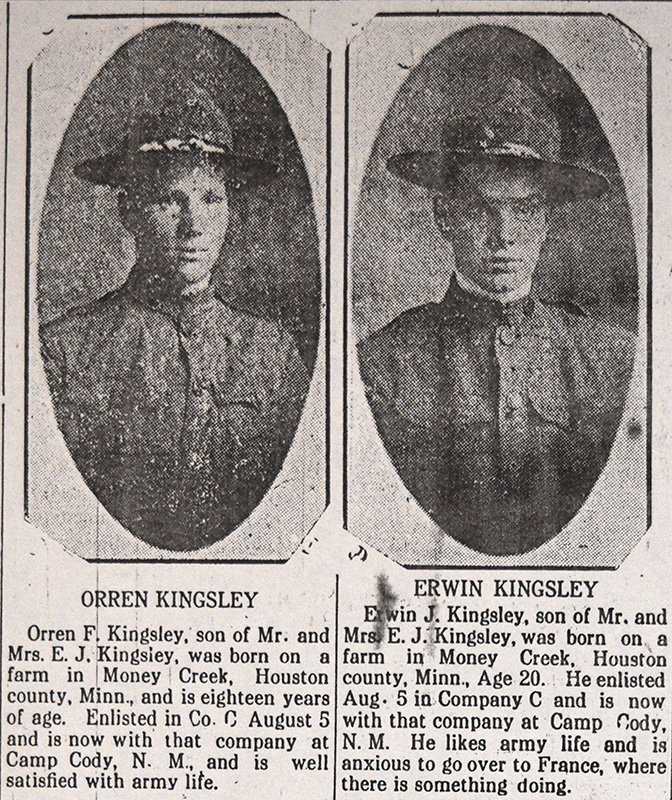
Photo courtesy of the Houston County Historical Society
Leave a Reply