

It was surely more pleasant watching the ride from a theatre seat than experiencing an actual ride on a stagecoach. Made famous by mid-20th century movies and television about life in the American West of the late 1800s, horse-drawn coach travel dates back to England in the early 1600s and came to North America during colonization. While stagecoaches contributed to the lore of the old west, they played a less-publicized but equally vital role in the early history of Houston County.
A stagecoach was a four-wheeled, horse-drawn vehicle that carried passengers, light packages and mail on journeys long enough to require a change of horses. The term “stage” referred to a preferable 12-mile distance between stations where horses were replaced and passengers could stretch. Thus, each coach covered its route in “stages.” About 50 miles separated more elaborate stations, which also catered to humans with telegraph service, food and sometimes overnight lodging. However, a dirt floor might suffice as lodging.
The coaches weighed more than a ton, cost between $1,500 and $1,800, and averaged about five miles per hour while covering about 60 to 70 miles per day. At top speed on better roads, a stagecoach could travel 105 miles in 24 hours.
Most profitable was securing a U.S. Mail contract, which did require building better roads. Where stagecoaches stopped, hotels, restaurants and shops appeared to serve travelers.
The first stagecoach line in the new Minnesota Territory opened in 1849, running between St. Paul and St. Anthony. In the next 10 years, the Minnesota Stage Company controlled all major stage routes in Minnesota. By 1865, the company employed 200 men and had 700 horses in service.
Most prominent in Houston County was travel from La Crosse, Wis., to St. Paul on the old territorial road, which crossed through the villages of La Crescent and Mound Prairie. Three stage lines traveled this route. The first major stop out of La Crosse was in Mound Prairie at the Lorette House, built and operated by Seth Lore. Many famous names of the era were found on the old register.
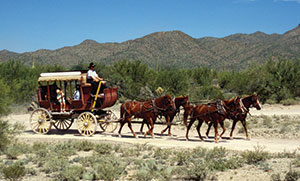
Photo submitted
Coaches with teams of four or six horses would unload passengers while horses were changed. The 1919 History of Houston County said loud-voiced drivers “gave noisy orders, gossiped with the loungers and quarreled with themselves.” At mealtimes, as many as 70 to nearly 100 guests might be fed.
Lorette House, which also became a post office in 1856, was a log house, 18 by 20 feet, with three rooms on the ground floor and one room above. An extension in the back was a cook room. The well-known landmark was known for its huge fireplace, which comprised about half of one side of the building. In 1859, a two-story, 20-by-30-foot frame addition was built.
Stagecoaches thrived in Minnesota for about three decades (1849-1879) before being replaced by railroads, Rural Free Delivery and automobiles.
Although stagecoach rides were uncomfortable, it was the only public option and safer than traveling alone. The most common passenger model was the Concord Stagecoach, which was braced underneath by leather straps. That provided a swinging motion instead of an up-and-down jostle by spring suspension.
There were three seats for a maximum of nine with little legroom. Passengers, willing to brave the elements, might ride on top as well. Those hoping to sleep had to do so sitting up. It was considered bad manners to rest one’s head on another passenger. There were many rules; if women were on board, there was to be no liquor, smoking or profanity.
Ponder the experience described in the 1928 poem, “Six Horses” by Captain William Banning and George Hugh Banning:
Creeping through the valley, crawling o’er the hill,
Splashing through the branches, rumbling o’er the mill;
Putting nervous gentlemen in a towering rage.
What is so provoking as riding in a stage?
Spinsters fair and forty, maids in youthful charms,
Suddenly are cast into their neighbors’ arms.
Children shoot like squirrels darting through a cage-
Isn’t it delightful, riding in a stage?
Feet are interlacing, heads severely bumped,
Friend and foe together get their noses thumped;
Dresses act as carpets – listen to the sage;
“Life is but a journey taken in a stage.”