

Second of a two-part series
He was a farmer, school custodian and school bus driver, but driving had nothing to do with the 40 passenger school bus (minus its roof) ending up in his living room or what had been his living room only moments before. It was 8:50 p.m. soon after nightfall. Farming a half-mile west of Houston, Aldis Gordon was back at his two-and-a-half-story house after completing chores only 10 minutes before the tornado descended from Oak Ridge. Wife Lou and teenage daughter Violet, the latter busy with homework, were suddenly aware of strong winds when Aldis hollered for them to get into the basement.
The ladies were only halfway down the stairs before the house collapsed above them. However, Aldis did not make it to the stairs, was thrown out onto and then off the back porch. He landed with his head about an inch from one of the cement blocks from the porch foundation. Gordon credited that block for saving his life by shielding his head and chest as the house walls collapsed down on top of him.
That Wednesday, May 5, 1965, storm barely missed the townsite but did demolish the A&W stand and owners’ trailer home. Neighbors from Houston responded quickly. Donald Otis arrived at the Gordon farmhouse first and was soon joined by others, who with flashlights began digging through the rubble, searching for the family. There were two exits from the basement, but both were blocked by debris. Lou and Violet were located by voice through the destruction. With flashlights in the darkness, the rescuers had to move both a refrigerator and piano before Lou and Violet could scramble into fresh air. There were no serious injuries, but Lou had been struck in the back by a two-by-four beam. While the search for Aldis continued, neighbors, unable to locate a doctor, took Lou and Violet to the home of a nurse.
The searchers did find Aldis in the rubble, and with no serious injury, reunited him with his family. Violet remembers her father being disoriented. Later, Aldis told a reporter that it was a “traumatic experience to say the least. I was in shock for quite a few days.” With so many area barns destroyed, he added that the timing could have been worse. “If it had come a half hour earlier, it would have caught some farmers doing evening chores with their milk herds in the barns.”
Violet’s older high school brother, Wayne, had not been home, still working at an after-school job. Houston firemen sounded an alarm when minutes after the tornado struck, lights went out about 9 p.m. Firefighters were active all night aiding the victims, releasing cattle and what else they could accomplish in the darkness.
The Gordons lost all farm buildings and almost all personal possessions. Friends helped salvage what they could. Josie Brevig was one of those who took all the scattered linens home, washed and ironed all of it and returned it ready for use.
A couple of days later, Aldis was walking in a field about 150 feet away from the house and came upon a chamber pot with the lid still on it without a scratch or crack. It had been in the attic before the roof blew off. Searching through the debris, they saw a small sparkle in the sunlight; it was Lou’s wedding ring.
One large tree in the yard survived but was pierced, each piece of metal left sticking out of both sides of the trunk. But yet, the family found light bulbs scattered around the property, all unbroken and still usable.
While building a new house on their farm, the family of four was able to live in a second-story apartment for a year. It was some comfort for Violet with her best friend living in the apartment below.
Sixty years ago, these storms devastated a long southwest-to-northeast path through rural Minnesota from the south side of the Iowa border to the Mississippi River. A twister claimed most of the Henry R. Boehm the farm near La Crescent. Near Dakota, William Thiele lost two barns, parts of which were carried more than 200 yards.
Near LeRoy, a family of four escaped uninjured after a tornado ravaged their farm. Rochester received hailstones almost one inch in size. With reports from the weather bureau in Rochester relayed by the Minnesota Highway Patrol, the sheriff in Winona issued a warning at 8:20 p.m. over KWNO radio to all Winona County residents to take cover. Motorists were advised to avoid driving into the storm area. City police alerted meetings all over town, including a choir concert at Winona Senior High School. The warning was lifted about 11 p.m.
Statewide that same Wednesday evening, tornadoes dealt destruction to farm property near two dozen communities. In addition to damage in the southeast around Houston, Rushford, Fremont, LeRoy and Harmony, there was heavy destruction to at least eight farms near Parkers Prairie in northwestern Minnesota and to farms and lake cabins near Detroit Lakes, Euclid, New York Mills, Alexandria, Frazee, Brainerd and Sauk Center.
Near Parkers Prairie, 8-year-old Terry Zimmerman walked out of a barn unhurt after a twister hit the ground 100 yards away. There were reports of only minor injuries that May 5.
There were numerous storm stories in the Winona Daily News on May 6. At the top of the page blared the headline, “Houston Area Suffers.” Lower on the page were headlines, “Tornadoes Hit Other Areas in Minnesota,” “How It Happened: The City’s (Winona) Big Tornado Scare” and in smaller print, “Strong Winds Miss Buffalo, Trempealeau.” There were four tornado-aftermath photographs from the Houston area.
It was miraculous that there had been no serious injuries or fatalities with so many storms over such a wide area. The following day, however, suburban Minnesotans would not be as fortunate. The day after tornadoes had ravaged rural areas throughout Minnesota, twisters descended on two dozen Minneapolis suburbs. The May 7 Winona front page headline was, “More Tornadoes in State; 12 Killed.”
Sources: interview with Violet Gordon Belter; “Tornado of 1965 recalled,” by Roseanna Kumpf, Gazette Too, May 22, 1984; Storm coverage, Winona Daily News, May 6 and May 7, 1965
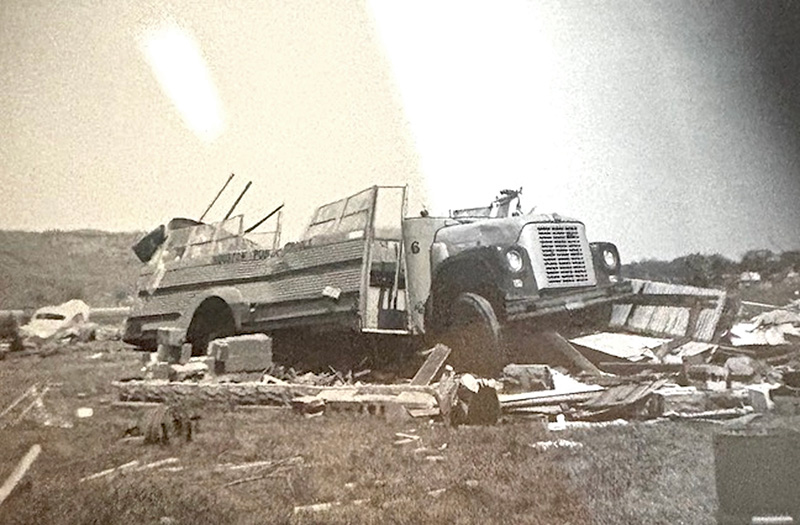
Photo submitted
Tom Hanson says
Thanks for the history of this tornado. I was 10 years old when the tornado hit Houston. The Gordon’s were good friends of my parents. Saw much of damage but quite honestly, at age 10 I did not have a good understanding of how it impacted Houston and individuals. Articles like this help me, 50 years later, better understand the impact the damage had to Houston.