

Part two of a two-part series
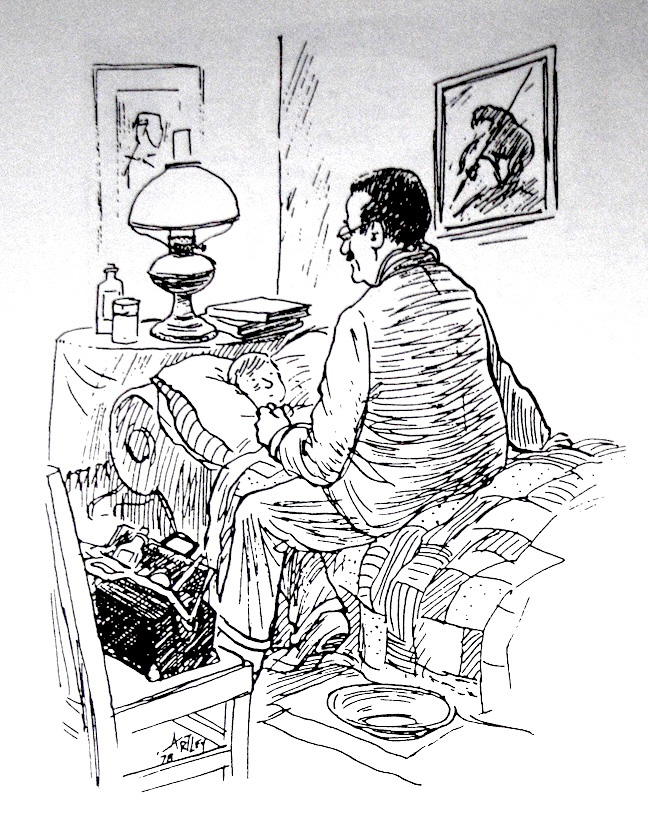
When making house calls, Dr. Giles James Sheldon would stay until the crisis was over. The first medical doctor in Houston County, Minnesota, was known to stay at the home of a patient overnight or even several days. In 1861, he remained with one patient from November 22 to December 2. The doctor left a handwritten journal that provides an understanding of medical treatment from December 1853 to January 1869. One biographer concluded his “most effective therapy must have been the measurement of his presence.”
Frontier doctors were always on call. Surely, there were days without call, but he was also a farmer in Mound Prairie Township and served as a county commissioner among other civic responsibilities.
On New Year’s Day, 1869, Dr. Sheldon dined at Dr. Pope’s house – “a good supper and two fine apples.” The next morning, the two doctors drove a buggy 13 miles to the residence of William Garret, where Sheldon operated on Mrs. Garret, “Paracentesis Abdominus, two inches below umbilicus. Through four inches of Adeps and got 10 qts. greenish yellow fluid – looked like spoiled milk. She fainted but soon recovered and bore the pain like an Indian – had to give freely of Wine – Had old liver and stomach trouble – Often vomited blood … 60 years old — will not recover poor women! Wishes to live, to return to Ohio. The sods of Minnesota will soon gain the victory.”
Doctor Sheldon was ever a student of medicine, possessing one of the most complete medical libraries of the day. He continued to purchase and study the latest medical books. Sheldon followed therapies and treatment he had been taught personally or from his medical books. He used standard medicines of the era, including the practice of bleeding.
However, he could also be critical of some medical procedures. He wrote in 1869 that typhoid fever was best treated without medicine. With medical treatment, one in six patients dies. “By no medication, only ventilation, food or nursing, one in sixteen dies.” He added that “rheumatism gets well quicker without medicine.”
So respected as a physician and surgeon, Sheldon was often asked to consult with other doctors about difficult cases. One morning a messenger arrived to ask him to to go to Preacher Smith’s residence to consult with Doctor Pope who was treating a compound fracture of both the tibia and fibula about six inches above the ankle of the pastor’s right leg. The fibula had cut through the ligaments, stocking and boot.
Smith had lain for 17 days without the bones being set, and gangrenous spots appeared, resulting from pressure of wraps. Doctor Sheldon remained there overnight until 4 p.m. when the leg appeared better. He used a spica bandage and discarded the box or trough made of three boards that Pope had constructed.
Sheldon had a good relationship with Doctor Pope, with whom he often worked, but another journal entry was critical of one of his friend’s diagnoses and treatments. One June 1, 1868, he wrote, “I went or was carried 16 miles through a heavy rain storm to see Mrs. S— one of Doctor Pope’s patients, sick 3 mns (months) with inflammation of the left eye. It is now staphylomatous.
“It was considered neuralgia and treated badly. By such management she has now colitis and stomatitis and in Brain. Know what the complaint really is before you open fire.”
Sheldon kept up with medical news beyond Minnesota. One diary notation referred to one month in Cincinnati, December 1868, during which 187 of 530 deaths (35%) were attributed to small pox. He continued, “Small Pox is prevailing now around Rushford, Fillmore County, Minnesota and already, I’m told 37 have died. No wonder: they drink great quantities of whiskey before and during the disease. It is a popular belief that drinking is a preventative.”
On the frontier, physicians were also charged with pulling teeth. Doctor Sheldon used forceps unless there was not enough tooth remaining to grip, in which cases he used an instrument called a turnkey. It resembled a very small cant hook used by loggers to turn logs.
In the spring of 1872, Indian Joe’s wife and Winnebago papoose showed up at the doctor’s house one morning to have a molar tooth extracted from her lower jaw. He cut around and hooked on, and because the gum held them together, pulled out two teeth instead of one. There was a lot of blood and pain. He concluded, “An Indian woman does feel, it hurt her. I gave tobacco and she started for her wigwam in the timbers.”
Sheldon, who had been sickly as a child and youth in central New York, still had his own health problems as an adult. In December 1868, he wrote, “I am sick and have been for more than a week. Bil. Rhumen and chills, fever, can’t sleep.” Within a few days, he added, “My health is mending. I began to sleep and have hopes of recovery.” But he soon lamented the severe winter. “How long to escape from this inclement weather and climate.”
There were no office hours for a farmer or a doctor. Sheldon persevered through his own health problems as evidenced through another 1869 entry. “I had been sick five weeks and was so weak, my limbs could scarcely hold me up – but I grew stronger and did not falter, and after visiting Mrs. Backer with Pope and staying up all night with her – got home at 4 p.m. of the 3rd better than when I left home. Spunk is good medicine at the right time!”
His spunk served him well for his 74 years of life, which ended with a stroke in 1880. He was buried on his farm.
Giles James Sheldon contributed as a jurist, surveyor and public servant in addition to being revered for his dedication to the medical needs of his fellow citizens on the frontier. He deserves to be remembered and appreciated.
Sources: “Backwoods Doctor Giles James Sheldon, First Practicing Physician In Houston County on the Minnesota Frontier,” by Ruth J. Mann, B. S. and Jack D. Key, M. A., M. S. Minnesota Medicine, Volume 68, 1985. “Notes on the History of Medicine in Houston County Prior to 1900,” by Nora H. Guthrey, Mayo Clinic, History of Medicine in Minnesota. February, 1946.
Leave a Reply