

There were always men looking for work. Growing up in Houston County during the Great Depression of the late 1920s and 1930s, Anita (Hartman) Palmquist said there was more work on the Hartman farm than the family could handle. They often hired men, who were either bachelors, widowers or younger unmarried men. Regardless of their job skills, they were glad to work for food and shelter. In 1939, Butch Steffens and Ed Steahl each worked for $15 a month plus room and board.
“Our hired men were always treated as part of the family,” wrote Palmquist. “We cared for their clothes, fed them, and they entered into family activities as they wished. We joked with them, worked alongside them and they made our life a little more exciting.” Some stayed for several months; some stayed for several years.
“Mother gave us appropriate precautions as they came and went.” In a family of mostly daughters, her mother did not worry about the girls working along with the hired men as long as their father was around or there were three or four of the girls together.
George Souchla was a “kindly and patient” Polish man, who came from Arcadia, Wis. Most likely a widower, he had some adult children. An abandoned log cabin where Anita’s father had been born was sided over to provide a comfortable home for George. There was a wood stove and a soft water cistern. George did not seem concerned about not having electricity or running water and lived there about two years before returning to Arcadia.
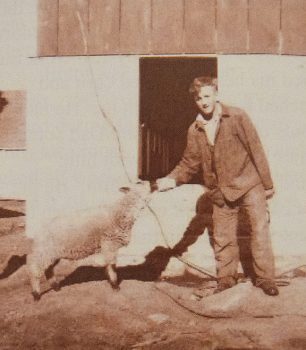
Photo courtesy of the Houston County Historical Society
George rigged up clever rat traps. One involved cutting a hole in an old tire with flour for bait. The children were intrigued by his Polish accent. When asked about his trap, he said, “When zee rat goes in the tire, den I wait. When zee rat comes out of the tire, den I am der wit der butcher knife.” George was invited for Christmas dinner, and he came wearing a black felt hat, black pants and a brown sweater. “We were glad he did not have to spend Christmas alone.”
Most of the hired men had limited wardrobes. The family had to keep up with the washing and mending. Overalls and underwear needed to be patched and socks to be darned. Anita, as an eighth grader, had a 4-H sewing project and learned to darn socks. There was immediate need for that skill.
When the hired men went to town on Saturday evening, they put on a clean work shirt and overall and walked the mile into town. They would wear a work jacket, a clean one if they had a second jacket. The local tavern was a popular destination where they could have a few drinks, visit with friends and “replenish their supply of tobacco.” If they consumed more than a few drinks, they might not feel well on Monday morning.
Herbie Walter was fond of nightlife. Following late night adventures, he struggled to stay awake during the daytime. While milking cows, he was known to “catch cat naps while leaning his head against a cow.”
Ed Steahl “never complained as some of the hired men did.” The girls enjoyed playing games and snowball fights with Ed. He completed high school and unlike most hired men, liked to read.
Johnny Engstler loved animals, never forgetting to supply the cats with milk. However, he lacked social graces and at meals, would take and eat all the fried potatoes (or cottage cheese) in the serving bowl. The family learned “to pass them to him last.”
The family’s former minister, after a nervous breakdown, was encouraged to engage in physical work. He recuperated on the Hartman farm for nine months before returning to the ministry,
Oswald “Butch” Steffens was shy and blushed easily. “We usually had to initiate conversation,” recalled Anita. The Hartman family was saddened when they learned of his being killed during World War II.
Anita closed, “Hired men came and hired men went. They were part of our family life. Each one of them remained in our hearts in some way.”
These remembrances came from a book by Anita Lee Palmquist – My Story: Memories and Writings.