

Second of a series
Shipping “King Wheat” to market was the primary reason railroad service into the interior of the new state of Minnesota was so critical during the 1860s. Since the late 1850s, wheat had been the major cash crop in an agrarian economy. Ironically, wheat production began to wane by the late 1870s when railroad service finally reached the Houston County seat Caledonia,13 years after rails had come to nearby neighbor Houston.
Wheat crops began to fail both in yield and quality, due to excessive heat in 1878 and 1879 and insects and disease in the 1880s. Yet, Minnesota was the leading wheat-producing state in 1889. But wheat prices would drop with foreign competition and European tariffs on American wheat. In about a decade, the average annual price for wheat fell from 92 cents per bushel to 67 cents.
Farmers had therefore turned to increased production of corn and oats. And there was greater demand for dairy products and livestock. Raising hogs was the first major livestock operation in Houston County
Railroads had opened up markets for grain back East, and then new developments in refrigeration and packing made it possible to market Minnesota dairy and meat products back East as well.
The late-arriving rail service in Caledonia utilized “narrow gauge” track and equipment. Narrow gauge railroads had three feet between rails instead of the standard gauge of four feet, eight and one-half inches. Narrow gauge was built in areas where the terrain was more challenging than standard gauge areas. News about narrow gauge success in Colorado by the Denver & Rio Grande RR convinced backers in Caledonia that such a line could be built up the Crooked Creek Valley from the Mississippi River to the prairies of central Houston County. And the cost of narrow gauge construction and rolling stock was usually less expensive.
The complicated interaction of such small independent rail lines ended with the consolidation into larger lines throughout the nation. Railroads became the United States’ first big business. In Houston County, all the railroads were consolidated into the “Milwaukee Road” system by 1880. This resulted in much of the freight from the interior of Fillmore and Houston counties being routed towards Milwaukee and Chicago.
Despite the growing grain and flour economy in Minneapolis, most of the agricultural shipments from Houston and Fillmore counties headed to eastern markets for many years. It was likewise for the neighboring Southern Minnesota and Winona & St. Peter railroads. This was much the case for shipments of livestock to packing houses in Milwaukee and Chicago. An exception were shipments of hogs west to the George A. Hormel plant in Austin. Meanwhile, there was great demand locally for lumber from Stillwater, Winona and La Crosse.
Records from May 1917 listed some commodities being shipped through the area. Moving east were merchandise, butter, tile, corn, flour, lumber straw, timothy seed, barley and kegs. Heading west were merchandise, coal, pipe, beer, eggs, crates and railroad company materials.
The co-existence of narrow gauge and standard gauge caused considerable inconvenience and expense at some points, such as Reno, Minn. It was unpopular that freight from one gauge to another had to be moved by hand from one railcar to another.
In 1899, the Minnesota legislature passed a law that all common carrier railroads using narrow gauge convert to standard gauge operations. This permitted larger equipment to be used system wide. The transformation began during the summer of 1901, and on Sunday, November 11, veteran W. W. Foot engineered a standard gauge train across the system.
Two years later, in 1903, the Milwaukee Road consented to build tracks between Preston and the Southern Minnesota line, connecting near Isinours station. But first, residents had to provide the 4.46-mile right of way. Voters approved on April 1, but rainy weather delayed progress. The first train traveled between Preston and Isinours Junction on November 23.
All over the nation, railroad business began to gradually decline after World War I (1914 – 1918) as the improvement of highways brought about freight competition from trucking and passenger competition from increased usage of automobiles.
Railroads compensated for the loss of passenger traffic by expanding the use of mixed trains, which were local freight trains with passenger coaches added to the rear. However, passengers were often delayed when stopped at towns while work crews executed switching operations. Mixed train service continued until 1957.
The Caledonia line (Caledonia, Mississippi & Western) experienced calamity on June 16, 1946 when 8.2 inches of rain damaged or washed away several miles of track and roadbed while destroying nearly three-fourths of the line’s bridges east of Caledonia. The small depot at Freeburg was carried downstream a half mile. Service between Reno and Caledonia was abandoned.
Therefore, Caledonia, which had first received rail service with a 12-mile branch line from town to the east down to the Mississippi River, was then limited to service only to the west on the ancient Southern Minnesota line. Caledonia was served by passenger trains until September 1949.
In 1955, steam locomotives operating between Preston and Caledonia were replaced by dieselized, shiny-new, black and orange General Motors engines. These smaller 660 horse power locomotives were introduced into the area due to the danger of the heavier engines crossing bridges. The new engines were more suited to little-used secondary and branch lines and were so sure-footed that train men referred to them as “donkeys.”
In the 1960s, the Milwaukee Road operated the Caledonia branch with trains known as extras, service not listed with a regular schedule. Commodities carried east at that time included coal, lumber, fertilizer, gasoline and fuel oil. Shipped westward were whiskey barrel staves, railroad cross ties and dry milk.
The Caledonia line continued to ship forest products such as barrel staves and railroad ties from Houston and Fillmore Counties until its final years in the mid-1970s. In September 1976, as the nation was celebrating its bicentennial year, rail traffic had declined to such an extent that trackage was abandoned between Isinours Junction and Caledonia.
Source: “The Caledonia, Mississippi & Western Railroad Line,” by Benjamin Pennington, published in Caledonia Pride, 1854-2004 edited by Alan Fleischmann.
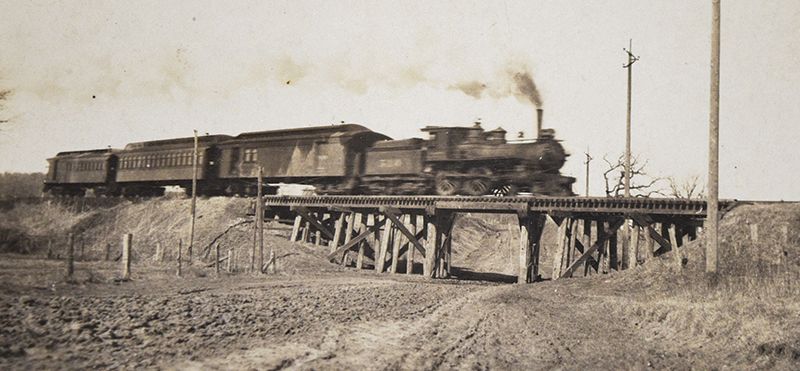
Photo courtesy of the Houston County Historical Society
Leave a Reply