

Second part of a two-part series
“It is a wise move and not a moment too soon,” according to The Houston Valley Signal newspaper published on January 25, 1883, “A call has been issued for a meeting at the Hall Saturday evening to organize a Fire Company. Any day might witness a fire that would sweep the best part of Houston away in an hour. Due precaution would do much to render property more safe against fire.” Fire was an ever-present danger in days before electricity when cooking and heating required burning wood and lighting involved oil-burning lamps.
Four months later, it was termed by the newspaper to be the first loss by fire inside the corporate limits of Houston when at 2 a.m. during a thunderstorm with lightning, the train depot caught fire. The station master, who lived upstairs, nearly succumbed to inhaled smoke before crawling to a window and jumping 15 feet down to the mattress he had thrown down.
The very next week, to be prepared for any future fires, the village board ordered the digging of three water wells in town and were considering purchasing hooks and ladders, buckets and other equipment. The following month (June 1883), the village purchased a $280 fire engine. There would be growing pains as Houston experienced the early use of a fire engine. The newspaper was quick to either praise or criticize.
The Signal stated, “With the five or six new wells now being dug and a fire engine and company, our town will be secure against any very extensive fire,” After several successful trial runs with the engine, the newspaper opined, “The engine is fully capable of caring for any fire that might occur in town. With the good company all ready for action, and a few more fire wells, we shall have the Fire Demon pretty well cornered.
The first real test was formidable. Shortly before midnight on September 19, 1884, a fire broke out in a warehouse and left a whole block of town in ashes. The heat was so intense that men’s hair and whiskers were singed while keeping the front of Dyer’s store drenched with water, brought and thrown in buckets. The front of the store caught fire three times and each time extinguished. Some businesses were saved, but built so close together, 12 buildings did not survive. Men, women and children did what they could to save whatever they could.
The fire engine did not perform satisfactorily early in the battle, but it was credited with eventually saving six buildings, keeping them sufficiently drenched with water while also retarding flames. The newspaper concluded the engine was not kept as readily prepared as necessary, and there was too much reliance on the fire chief to operate the engine. Men who lived closer to the fires than the chief were not able to contribute as needed until the chief arrived.
Opinions varied as to the cause of that fire, which began in a warehouse, but arson was suspected, since a few weeks previous a fire had been set in another warehouse nearby.
Three years later, in March 1887, Buell’s Rink was ablaze in the afternoon but saved by prompt action of citizens. But the fire engine was termed by the newspaper, “to be in such useless condition as to require three hours hard work to repair it, and in the meantime, had the flames got the mastery, the whole village would have been at their mercy.” The author recommended “thorough repair,” practice runs twice a month, a man hired to keep the engine in repair and to pay men to work it at practice.
A week later, the paper commented, “The fire engine is now in working order. How long will it kept so? Let the trustees answer.”
The editor’s eventual exasperation with fire engines or with those charged with its care reached a peak on February 28, 1889, when addressing plans in Caledonia for acquiring two fire engines: “two too many … A fire engine unless cared for and handled by an organized, uniformed, drilled and WELL PAID crew, is the most useless piece of furniture of which a community can boast; it is money thrown away, wasted.
“For about three weeks following the receipt of two fire extinguishers, Caledonia will strut, and be as tickled as a small urchin over his first hobby horse; plenty of hands will volunteer to work the brakes, a company will be organized, a captain chosen, a man to hold the nozzle selected, and squirting will be as profuse as a city sprinkler in dry weather; after that, the novelty dieing (dying) off, the engineers will be housed, have a rest, and there remain supremely idle until the first subsequent alarm of fire cuts the air, when a hop, skip and a jump will be made for the engine sheds, the contents dragged there from, and hustled furiously to the scene of the conflagration, but alas, only to find upon trial that a pipe or two has the rust, the bucket valve the ague, and the hose a leak; all is now hurly, burly. A rush and a push, a twist and a break, a swear and a damn, and then the thing is drawn off for repairs, which are never made… We would give more for a few ladders, hooks and buckets during a fire than all the fire engines ever imported into the state…”
The newspaper did comment on positive uses of fire engines – to “sprinkle the dusty streets.” In July, of 1890, “The village fire engine comes in good play now, pumping water from cellars.”
But nine years later, the fire engine had earned the respect and praise of the newspaper, which in in 1898 published, “Within two minutes from the time the fire was discovered, the hook and ladder truck was on the ground, and the engine connected with the hydrant … For firefighters and all around hustlers, Houston is second to no town in Minnesota.”
Source: “Fires, the Fire Department and Life in the Houston Area,” compiled and written by Michael Olson
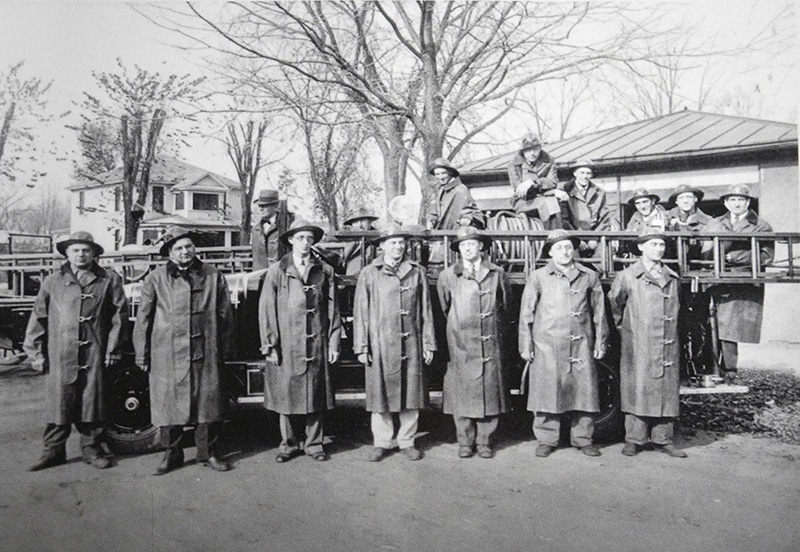
Photo courtesy of the Houston Public Library
Leave a Reply