

Part one of a series
They depended on flames in the 1880s and 1890s. Wood-fueled stoves were almost always used for cooking, and during long Minnesota winters, wood was burned to heat buildings. After dark, light came from oil-burning lamps. A fire getting out of control was feared but unfortunately, a common occurrence. “Lookout for fires these cold, windy days and nights,” reminded The Houston Valley Signal newspaper on February 9, 1899. Only a small sampling of that newspaper’s many, many references to fires, during those two decades, are recounted here.
Chimneys and stove pipes were were frequently deemed sources of building fires. A faulty stove pipe caused a fire at Murphy’s Mill in 1885. A defective chimney or the parting of the stove pipe was blamed for the 1887 fire in Buell’s Rink. A defective stove caused the 1885 fire at the schoolhouse in Freeburg, east of Caledonia.
The great need for better chimneys resulted in numerous designs with alterations to improve insulation, airflow control and construction materials. Those that received patents were known as “patent chimneys.” After a patent wood chimney caused an 1885 house fire, the newspaper praised the patent stone chimneys put up around Houston by Mr. Stiles from Hokah.
The most curious chimney item came in 1892, “Rushford’s musical chimney sweep made the rounds of Houston’s chimneys the last few days.”
Shavings, intended as kindling for the morning fire and placed behind the stove, caught fire overnight in Herb Smith’s new house. Another residential fire was caused by the remains of a yellowjacket nest having been built under the roof too close to the stove pipe.
In warmer months, lightning was a threat and was responsible for the loss of a large barn and nine horses in 1900. Sparks from railroad engines set off grass fires, including two one day in 1886, one near the residence of Mrs. Hempstead. In 1898, a spark from a steam wood sawing machine led to flames which engulfed the barn and spread to destroy the Catholic church. With high winds, only heroic efforts of townspeople saved homes and the entire downtown.
Wildfires on the bluffs were common and attracted much attention. A newspaper line in April 1886 noted recent snowfall “will put a damper on the bluff fires for a few days.” Brief comments continued for years, quoting only a few: “Bluff fires are becoming exceedingly numerous,” in March 1892. “Bluff fires raged north of town Saturday night,” in October 1893. “Bluff fires have been numerous lately, and doing considerable damage to small groves,” in April 1894. “Bluff fires are of nightly occurrence, and on account of the exceedingly dry weather they rage most furiously,” in 1897.
Children played with matches. In 1885, such a child ignited a set of upstairs lace curtains. The youngster ran down the stairs to alert the family, and the blaze was soon extinguished. Another small fire, which “consumed a pig pen and scorched the stable,” was credited to a “mischievous boy.”
Lamp oil needed special care. During the 1892 Christmas exercises at the town hall, an accidentally overturned lamp spilled oil that ignited immediately, causing a stampede out the doors. Mr. Baures smothered the flames with his overcoat. The lamp was hurled out a window and exploded upon its landing.
In 1894, a large hanging lamp was suspended from the ceiling by a rope that somehow caught fire and eventually caused the lamp to fall and spill its oil, which ignited on the floor of Buell’s bank.
Daytime blazes were sometimes quickly discovered and handled without major damage. However, late night fires were more destructive. With the temperature 20 degrees below zero, a fire broke out in a home just south of the village.While the children fled in their nightclothes to a neighbor’s house more than 400 yards away, their parents and grandparents along with the hired man and girls attempted to save what they could. Meanwhile, men from town were seen running through deep snow toward the conflagration.
Due to the isolation, rural fires often resulted in total losses. “Word reaches us from Looney Valley … while the family were absent, the residence of L. Johnson together with everything it contained, was consumed by fire.This is a hard blow to Mr. J as he is a poor man and has a wife and three small children dependent upon the exertion of his two hands.”
An 1886 fire on Buell’s farm near Black Hammer claimed his barn and agricultural machinery as well as five horses, belonging to tenant Michael Carabine.
Fires raged throughout the area during the late 1800s. Other major fires were reported in the Houston newspaper, notably an overnight 1886 summer fire in Mabel that consumed a hardware store, roller rink and three homes with a loss of $6,900 with only $1,500 of insurance.
Two months previous, a morning blaze broke out in La Crosse, destroying a lumber yard, a planing mill, soap factory and approximately 25 homes with an estimated total loss of $500,000 (equivalent to $17 million in 2025). Smoke “loomed up on the eastern horizon” in Houston.
The next night, another fire in La Crosse claimed Metzger’s drug store and part of Kroner’s hardware store with an estimated loss of $10,000. The two fires threw 800 men out of employment in La Crosse.
And conflagration was not limited to frame buildings. The large three-story stone hotel in Lanesboro was destroyed by fire in 1885, a total loss of $30,000 with only $7,000 of insurance.
The 1886 trial of Ole Grover vs. Adam Coon involved recovery of losses during a fire, which the plaintiff claimed was set by the defendant. After an hour of deliberation, the jury found in favor of the plaintiff. The verdict was to be appealed.
Men, often stationed on roofs of burning buildings, with buckets of water was a common emergency response to fires in town. But there would be a call for planned preparedness and better equipment; to be continued …
Source: Fires, the Fire Department and Life in the Houston Area, compiled and written by Michael Olson
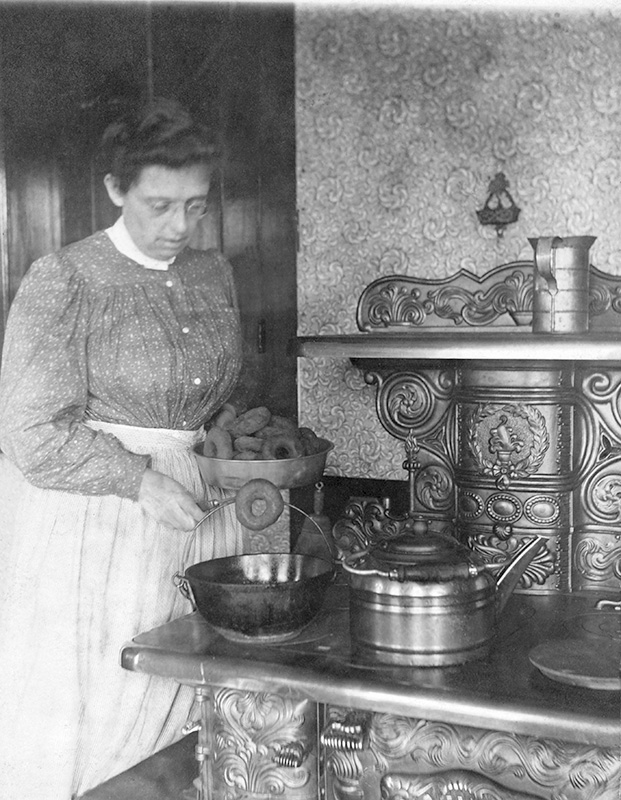
Photo submitted
Anonymous says
I always enjoy Mr. Epps’ articles.