

Houston and Fillmore Counties were thriving in the mid-to-late 1800s, greatly due to the transformation of transportation by the railroad – except for the two county seats, Caledonia and Preston. The early Minnesota railroads, built between 1862 and 1870, began in the eastern counties and generally expanded westward as did the settlements. These lines reached from the Mississippi River into rich agricultural territory. They were built in Minnesota by Minnesotans, although later tracks did cross the borders from Iowa and Wisconsin.
About the time of statehood in 1858, wheat had become the cash crop of prosperity. However, farmers any distance west of the river towns, faced major challenges getting their cash crop to market. Since most marketing occurred during the winter, most of the family’s annual income ultimately depended on farmers braving long, cold journeys – 60 miles on average – to a market at a river town along the Mississippi, specifically Winona and Brownsville in Minnesota and Lansing or McGregor in Iowa.
In any season during this territorial era (1849-58), roads were most often in poor condition. According to railroad historian Benjamin Pennington, “The counties west of the Mississippi were potential seas of grain, but without adequate and affordable transportation, they would remain covered by prairie grass.”
New market terminals were opened when the Southern Minnesota line was built through the northern townships of Houston and Fillmore counties with Houston reached in 1866, and by 1868, Lanesboro was at the end of the line. Some farmers in the Root River area were then about 50 miles closer to a grain market than in previous years. It would be the same as train tracks proceeded west.
Not only was the railroad a boon to agriculture, but almost every aspect of community life was changed. For personal travel, La Crosse was suddenly only a few hours away. Chicago and points east were only days away instead of weeks.
There was the sudden availability and regular arrival of supplies not produced locally. Raw materials and wholesale merchandise had to be transported to inland communities, such as Preston, Spring Grove, Chatfield or Caledonia. Before the railroad era, any business which offered finished products or needed raw materials was greatly challenged by the labor and expense required for transportation.
Wholesale merchandise such as lumber, flour and beer, had been carried by horse-drawn wagons to Caledonia, mostly from Brownsville, one of the busiest steamboat landings between Dubuque and St. Paul. Early on, enterprising merchant J. J. Belden carried U. S. Mail between Caledonia and Brownsville.
However, both county seats, despite being well-established communities, were bypassed when the Southern Minnesota was built in the 1860s. Both, with substantial commerce and surrounded by prosperous agriculture, could have well supported railroad traffic. Preston and Chatfield were considered as main line destinations, but the rail route went instead west of Lanesboro up a steep ascent through Fountain toward Spring Valley. There were plans for branch lines to Chatfield and Preston until 1872 when a state land grant did not materialize.
Railroad historian Benjamin Pennington wrote, “Caledonia, on the other hand, apparently was never a candidate for inclusion in the Southern Minnesota system. Branch lines from Hokah to Eagle Bluffs (Winona County) and Brownsville were authorized in the years before construction of the railroad began, but a similar line to Caledonia was evidently not considered.”
By the early 1870s, citizens of Preston and Caledonia realized the only way to obtain rail service would be to build their own line or deal with another established rail line. Railroading was an often-changing enterprise of mergers and consolidation.
But in late 1873, the Caledonia & Mississippi Railroad Company was organized and incorporated with all officers from Caledonia. Construction would commence the next summer to build a local railroad up the Crooked Creek Valley that would connect with the newly-opened line along the Mississippi from La Crescent to McGregor, Iowa.
Survey crews and construction workers were busy during the spring and summer of 1874 and grading for the roadbed began in June. But just as ties and iron were to be purchased, financial problems and public controversy arose. From the outset, due to situations beyond its control, the new company was beset with problems that would not be overcome. Foremost was the panic of 1873, resulting from issues with the Northern Pacific Railroad, which affected the entire nation. It was believed the crisis would be resolved by the following summer, but it was not.
Along with the financial woes, there arose public opposition that rail service would take business away from Caledonia to La Crosse. The problems and the opposing parties led to a war of words, which occupied one to three columns a week in two competing weekly newspapers. With the inability to pay for work completed, both the plans for this railroad and the controversy eventually faded into history.
Historian John Luecke wrote, “For the better part of the next five years, the citizens of Caledonia and Preston were without rails or any true movement towards obtaining them. If the wind was right, however, the citizens of both towns could hear the whistles of the railroads that had bypassed them. All that the towns had to show for the 1874 project was a few miles of grades to the east of Caledonia. Their grain, lumber and other produce continued to be hauled by teams and wagons.”
Progress was thus painstakingly delayed but would not be permanently prevented. Promoters residing in towns in both Houston and Fillmore counties reorganized the company as the Caledonia, Mississippi and Western on April 2, 1879, and negotiated with the Chicago, Clinton, Dubuque & Minnesota Railroad (CCD&M) to extend their tracks all the way to Preston if Caledonia would vote a bonus of $20,000. The bond issued passed on May 23. Citizens paraded through town as the first train arrived in Caledonia on September 25. Caledonia was at “the end of the line” until the day after Christmas when Preston became the final stop. Celebrations continued for days.
To be continued …
Source: “The Caledonia, Mississippi & Western Railroad Line,” by Benjamin Pennington, published in Caledonia Pride, 1854-2004 edited by Alan Fleischmann.
Lee Epps earned an undergraduate degree in History from Oklahoma State University and a graduate degree in History from the University of Michigan.
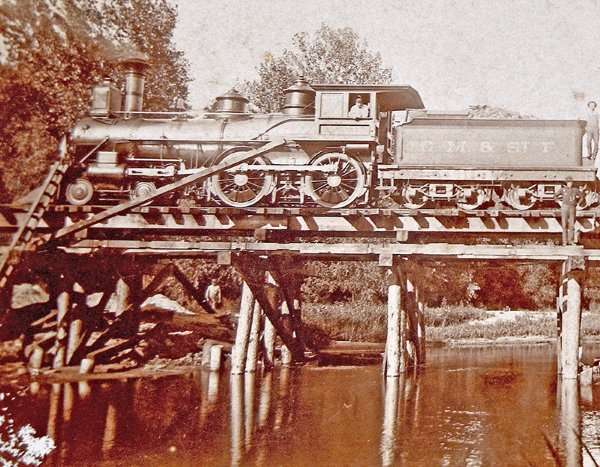
Photo courtesy of the Houston County Historical Society