
 Part two of a two-part series
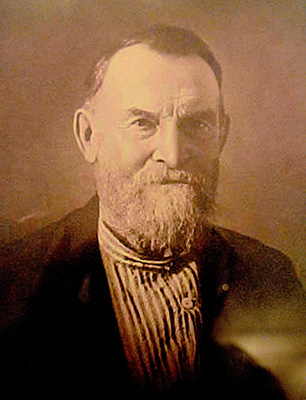
Eugene Marshall, an early surveyor in what became Houston County, was elected the first county surveyor in 1854. Massachusetts-born Marshall, at age 21, arrived in Minnesota Territory from Wisconsin as a farmer in 1853 before his surveying experience provided his main source of income.
Letters to his sister provide a glimpse into those first years of settlement. The first written in 1853 and 1854 were from Grove Prairie, an area south of present-day Caledonia. His subsequent letters were written from Caledonia (platted 1854).
In 1855, he owned 160 acres which he believed to be worth $1,600 cash, which could have been sold several times at that price, but he would have received only a down payment. However, with property interest rates from 20% to 40%, he wrote, “waiting for the pay is not a paying business.”
Nevertheless, Marshall considered purchasing more land. Even with those interest rates, he considered money invested in land as worth far more than the interest. In 1855, land values had risen such that he thought his land was worth a thousand dollars more in July than it had been in January.
In mid-summer, he owned six acres of wheat, two acres of potatoes and 44 acres of corn. Not all of the corn belonged to him, so he evidently had contracted for labor in exchange for use of some of his cropland. That allowed him time to explore.
Marshall traveled approximately 100 miles west exploring land as far as the Cedar River, which today runs through the city of Austin. His only companion was a pony, not more than four feet tall.
Carrying only a gun, a blanket and a valise with bread and dried elk meat, he spent eight days traveling, stopping at night “wherever I happened to be, sometimes alone on the bank of some little brook with no sign of man around.” There were times when he found a cabin of “some hardy pioneer and again at some embryo town with nothing but a few log cabins and a name.”
He saw some elk, several deer and one bear, but not much other game. Marshall described incredibly beautiful prairie land, but timber was scarce. He thus concluded it would be some time before the area was settled.
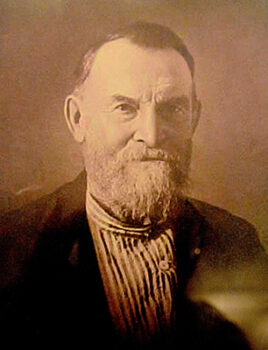
Photo courtesy of the Houston County
Historical Society
He had intended to explore even farther west but was advised not to travel alone through Indian country. The Indians were said to be friendly, but he added, “they are very great thieves ….”
His letter dated 20 months later in March 1857 noted an extended four-month snow cover delaying crop planting. But that provided an opportunity for socializing. A sleigh load of young people had come a few miles to spend the evening in Caledonia, but a storm snowed them in. With nowhere to sleep, they sat up “amusing themselves as best they could.”
One evening, some “old people” came to town, one of whom was a good violin player, made for a well-enjoyed dance. Marshall wrote, “last Friday, the old men turned out again, drove their teams all over the country and got all they could, young and old (myself amongst the rest) and had another dance. I contented myself by looking on and laughing at them. They stayed till midnight.”
Marshall was pleased with his investments. He had just mapped out a new town, in which he had a financial stake. In 1857, a sizable amount of land was granted for railroads, which Marshall expected to provide economic success, including for stockholders like himself. And he approved the territorial legislature voting to move the capital from St. Paul to St. Peter, which he believed to be favorable to Houston County. (However, political chicanery kept the capital where it was.)
In 1858, the year of Minnesota statehood, Marshall, a former teacher in both Massachusetts and Wisconsin and future Caledonia school board member, described Miss Mary Wheaton’s school in Caledonia. “The walls are of rough unhewn logs of all sizes and shapes except straight … the ceiling overhead is of rough boards supported by poles from which the bark has been peeled … The floor was of rough boards by no means level … The furniture of the school consisted of four chairs, two trunks and two benches of slabs on which the scholars sat.”
The presence of a bed, table and large box used as a cupboard plus pots, kettles, old clothes, a rifle and a whip adorning the walls indicated the teacher also lived in this room.
“There were some 14 pupils of all ages from four to 18 and of all degrees of proficiency except advanced. The pupils … moved around from place to place at will but seemed very attentive to their studies, particularly the older ones.”
Marshall was negatively impressed with frontier justice when he sat on a jury in a trespassing case. “Such a court I believe was never seen before in any community that claimed to be civilized. The Justice was a raw Irishman with far more conceit than brains, who believed that the office of Justice of the Peace was the highest in the gift of the people and that there was neither law nor power beyond or above his will, and that his decisions were the end of the law.
“Such being the case, the court was a perfect farce. The prosecuting attorney was also a raw Irishman who knew nothing whatever of law … As whatever motion he made was sustained by the court, the whole trial was a succession of ludicrous blunders enacted under the name of law.”
Marshall also disparaged a few available religious gatherings. “I have not the least particle of respect for the person who is preaching. It seems like mockery to hear such a man addressing a congregation on the subject of religion.”
Two years before the Civil War, Marshall was the speaker at political debates held in schoolhouses and private homes throughout the county. In 1861, he enlisted in the Union Army, serving against the Confederacy and in the west against the Sioux.
Lee Epps earned a Master’s Degree in History at the University of Michigan in 1968 after completing a Bachelor’s Degree in History at Oklahoma State University in 1967.
Leave a Reply