
Part two of a series
It was the same in southeastern Minnesota as it was everywhere in the nation that day. The President of the United States, Woodrow Wilson, proclaimed a Registration Day for a military census. On Tuesday, June 5, 1917, all men between the ages 21 and 30 inclusive were to register.
World War I had begun in 1914, three years before the United States finally became an official combatant. A very few days after the president signed a declaration of war in April against Germany, many young men – some leaving high school classes behind – had volunteered, enlisting in the Army, Navy or National Guard and were on trains, heading to training sites.
Fred Hutson, who had been working for S. N. Wheaton, was eager to enlist as a marine, but waited until crops had been planted on the Wheaton farm. Edward Buckley, desiring to enlist in the Navy, vowed to try a third time after twice being unable to pass the examination in La Crosse due to color blindness. The third try would prove successful, but he would not come home from the war.
The Caledonia newspaper reported that Dewey Messeral was back for a visit from his employment at the government arsenal at Rock Island, Ill., where he said he was one of 3,500 working there during two or three shifts a day. The plant was guarded by approximately 300 soldiers, and no one was permitted to enter without credentials. The work there was considered so valuable that the employees were not permitted to enlist in the military.
However, a week later, the same newspaper reported that Messeral, evidently no longer an employee, was one of four new Army recruits, who with a sendoff by “the band and a large number of citizens,” had just left on the morning train for Winona, where they had all passed the examination and were being sent to Jefferson Barracks, Mo., to be assigned to their regiments. Messeral was in Paris, France on the Fourth of July and later that month on the firing line as an ordinance sergeant.
Enlistment was initially substantial and would continue, but it soon became apparent that the nation would need additional soldiers, and a draft was authorized by Congress on May 18 with the Selective Service Act. Thus, the national June 5 Registration Day.
There was a county organization that included the sheriff, county auditor and county physician. Registration sites were established in all 23 precincts in Houston County; registrars were appointed and sworn in. Cards and materials from the federal government were distributed as were posters announcing the conditions of registration.
Out of 9,586,508 nationwide, there was a report of 1,185 Houston County men, including 27 aliens and one Indian, registering that day. According to a Caledonia newspaper, “A great many claimed exemption from military duty, some on very slight grounds.”
There were some occupations exempted from conscription. Clergymen, teachers and some classes of industrial workers were not required to serve, such as coal miners and those working in iron and steel industries that produced ammunition and vital equipment for war. Local draft boards could issue a dependency exemption for a man who was the only source of financial support for his family. There were agricultural exemptions due to the government calling for increased production, much sent overseas to our war-ravaged allies.
Doctors were needed at home but also in the military. In August, 1917, W. A Deters left for Minneapolis for an examination prior to enlisting as a physician in the Army Medical Corps. At that time, according to the newspaper, only 25% of the doctors needed by the Army had been secured. Dr. J. S. Collins of Caledonia and Dr. Helland of Spring Grove soon offered their services as physicians, expecting to be called for duty in France.
For the first national draft, the quota for Houston County was 81. However, due to the number that might be exempted or might fail to pass the physical examination, 162 (twice the quota) were called for the examination in early August. Only 53 from that first call were certified. With the county quota not yet obtained, another 162 were called to report during the third week of August.
The second call was more successful with 115 passing the examination. Dependency claims were entered by 52 while several had agricultural and industrial claims. The sheriff would investigate why two men failed to appear.
The county’s first group of eight draftees left the first week of September for training at Camp Dodge in Des Moines, for upcoming duty on French battlefields
In the village of Houston, local historian Ingrid Julsrud reported groups of four to six draftees left together several times during the year. They were issued uniforms before they left home, required to wear them when boarding the train. Not every uniform was a good fit, but it had to suffice.
A special train picked up the soon-to-be-trained soldiers. One warm afternoon, by the time the train reached Houston from the west, it was full. When that train pulled into Houston, there were a couple of heads sticking out of open windows. “The men were laughing, waving and talking – a sort of false sense of gaiety, maybe close to hysteria.
“A huge crowd of people had gathered at the depot to see the train and to bid farewell to the boys leaving from here. As the train pulled away and disappeared down the track, complete silence came over the crowd like it had been covered with a wet blanket. People turned away quietly and never said a word, some were wiping tears. Everyone knew that at least a few of those boys would never come home again.”
To be continued …
Sources: Remembering Old Times by Ingrid Julsrud, 1993 and clippings from the Caledonia Argus and the Houston Signal during 1917.
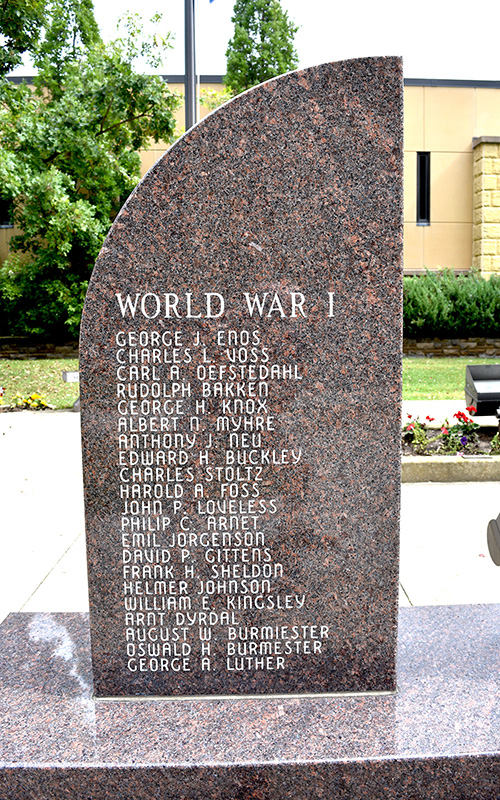
Photo by Lee Epps
Leave a Reply