
Image submitted
 In the latter decades of the 1800s, frontier settlers, including those in southeast Minnesota, were eager for entertainment that was not homegrown. There was not yet radio, motion pictures or television. Even if a more urban area was available, there were not yet automobiles or paved roads for convenient travel.
Traveling entertainers made a living in rural areas be they one-man-and-a-monkey shows or far more ambitious productions, such as medicine shows. The panic and horror from the 1862 Dakota War or Sioux Uprising farther west in Minnesota was two decades in the past. Even though Indians of other peaceful tribes were still seen in southeast Minnesota, there was still a fascination for indigenous culture.
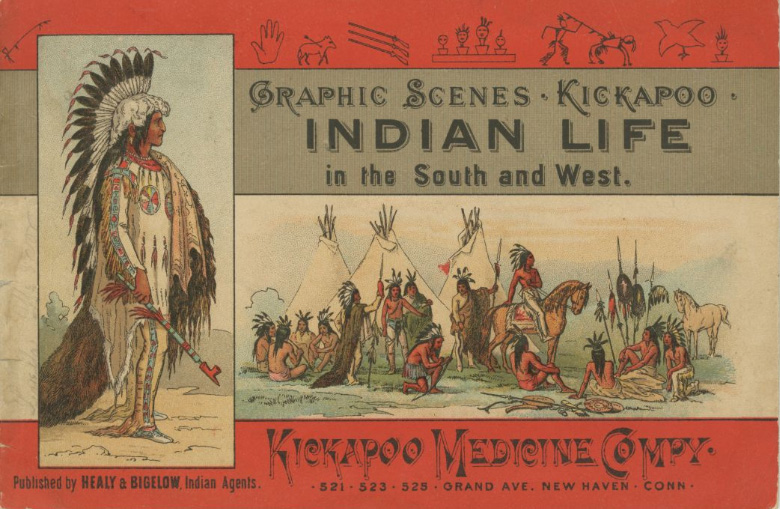
Responding to that fascination were traveling wild west medicine shows, which often included both native and non-native performers, recreating scenes of the American West. They also promoted and sold numerous medicines.
One of the largest was the Kickapoo Indian Medicine Company of New Haven, Connecticut, which visited Houston County at least twice. Among several medicines offered was their most popular being Kickapoo Indian Sagwa, promoted as made by the Kickapoo Indians and able to cure several maladies.
Local historian Paul Wiste researched area newspapers, including one from Houston, which reported the Kick-a-poos’ free concerts were drawing full houses each evening at their village opposite the American House in Caledonia and would then spend two weeks in Houston before moving on to Rushford.
“The Kickapoo Indians are here (Houston),” reported the Houston Valley Signal on August 22, 1889. … “The first performance in our village was given by the troupe Monday evening, and drew a large crowd, and all enjoyed themselves. The performance presented is really worth seeing, being in fact better than many presented on a more pretentious stage. The Indians dress and act as they do in the wild west, giving various dances each night.
“Dr. Goff, the manager of this interesting company, is a gentleman; a brilliant and fluent talker, who alone would entertain an entire audience during the evening by his excellent and original descriptions of the medicines he sells. Dr. Goff does not claim that his medicines are “cure alls;” they will not cure every disease a human being is heir to, but what he says of the medicines he sells he can prove, and is willing to do so, or refund the purchase money.
“All those buying a bottle of medicine receives a ticket, which entitles them to have teeth extracted free of charge, as Dr. Goff is also a first class dentist. The doctor can be found in his office, on the exhibition grounds, every day from nine o’clock a.m. until after the performance in the evening. The exhibition given by the company is a strictly moral one, and all are invited to attend. Everything is FREE including the teeth extraction.”
The big attraction at the Kick-a-poo camp on Thursday was a shooting show. The Houston newspaper continued, “On that evening the famous rifle and shot-gun shot (shooter) of the world, Nevada Ned, will give an exhibition, at the camp, of many fancy rifle shooting, shooting illuminated glass balls, etc. … Go see Nevada Ned, Pink Wilson, the comic colored genius, Perry Wilson, the juggler, and the Indians. To defray a part of the expenses of the evening an admission price of ten cents will be charged.”
Such grand praise by the Signal was greatly due to paid advertising. The newspaper explained giving about half its local space to the Kick-a-poos as it would “to any any other business firm or individual who sells goods and has money for local space, at ten cents per line. The Kick-a-poos are “biz” and Dr. Goff knows how to advertise.”
The newspaper went on to laud the Kickapoos’ main attractions, including the Banjo Juggling Act of Pink and Penny Wilson. There was a “short” yet “lively” contest between local ladies with Miss Lizzie Nelson taking the top prize, “a costly hand bag.” For the men, “Anthony Rowland was deemed the homeliest man on the grounds and was presented with a bottle of Sagwa. He has taken the medicine, and now the ladies, who thought he looked “just too awfully awful” wonder how in the world they ever came to choose him.
“The Kick-a-poos draw larger crowds each night. As the farmers find out the merits of the entertainment, they will also be on hand. The Kick-a-poo troupe does the village no harm. They stay here two weeks, buy the groceries they need from our merchants, patronize our hotels, restaurants, barber shops, etc. give free entertainments, and you do not have to buy any medicines unless you wish to. They are simply advertising their goods, which will hereafter be sold in our drug stores.”
The Kickapoo show left Houston with “over $1000 in hard cash,” a greater financial success than the previous stay in Caledonia. Six years later, in the summer of 1895, the Kickapoos were back in Houston with Miss Louisa Wood taking the top prize for being the “handsomest lady in town.”
There were more smaller-scale Indian performances than wild west extravaganzas. In March 1888, the newspaper advertised an Indian dance in Houston featuring 10 braves and four squaws under the leadership of Wan-no-kee-scos-ka, admission 25 cents. Two weeks later, the newspaper noted the performance was well attended, including a few folks from Money Creek.
Some local young folk evidently did not wait for an advertised performance. The May 10, 1888, edition reported approximately 25 Indians being encamped on a hill just south of Houston and noted some young folks from Mound Prairie had visited “the Indian camps last Saturday evening, and were entertained by some fine dancing.”
In 1900, an Indian medicine show spent an August week in Mound Prairie, which according to the Houston newspaper, “is worth double what they charge.” The next week, those performers entertained in Yucatan before leaving for Chicago.
Most renown was Buffalo Bill’s Wild West Show, which had legendary roots in Lanesboro, Minnesota. To be continued …
Source: Local historian Paul Wiste, whose research is being published in his 2026 book, Native American Excerpts from Early Newspapers in Houston, Fillmore, and Winona Counties of Minnesota.
Leave a Reply