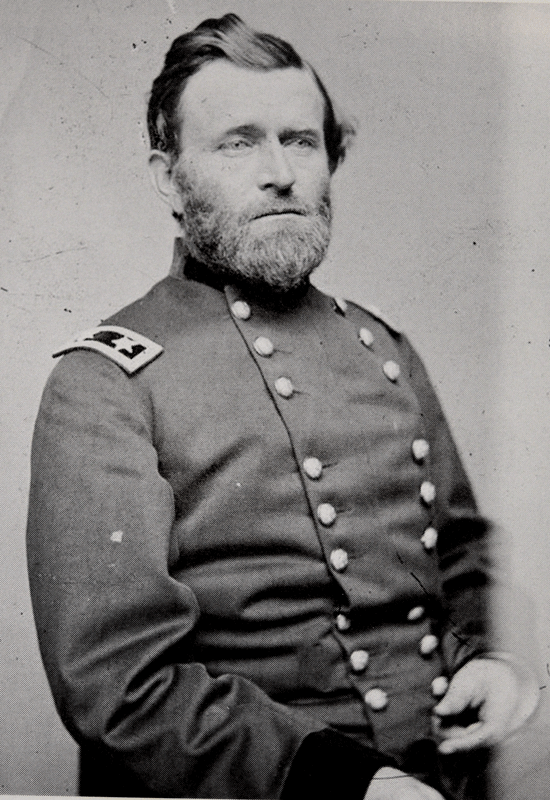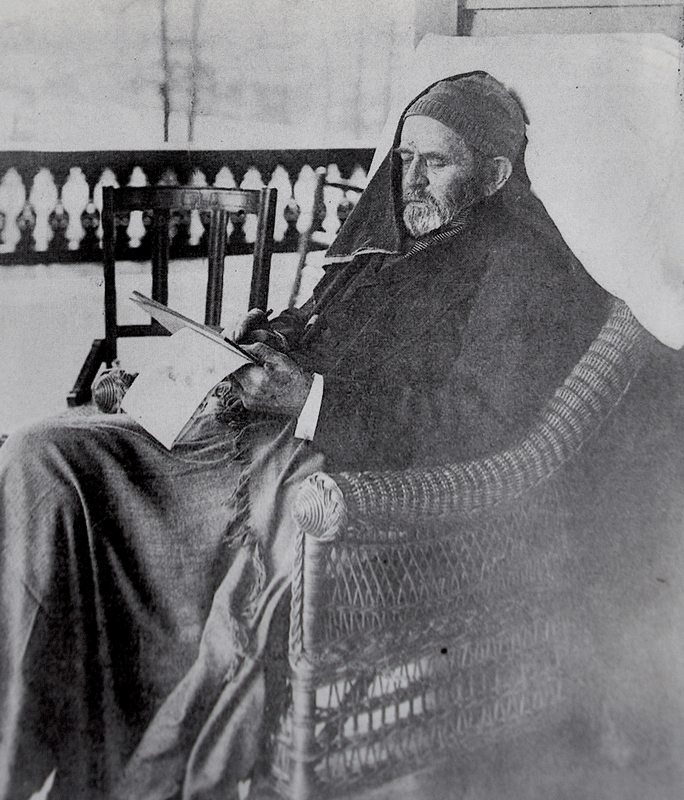
Did a United States president ever visit Houston County? The answer depends on the interpretation of the word “president.” Ulysses S. Grant visited Houston County several times, but it was before he led the Union Army to victory in the American Civil War (1861-1865) and go on to become the 18th president, elected both in 1868 and 1872. It is thought no sitting president ever visited Houston County, but one of the most famous presidents had fond memories of days spent in Caledonia. He surely was the most famous fisherman at Beaver Creek.
Grant and wife and sons moved to Galena in northeast Illinois in May of 1860 to work for two younger brothers, who had been set up in a leather shop by their father. Ulysses, as a boy, had sometimes worked in his father’s tannery in Ohio. The work conditions were described as “horrible – skinned and raw animal carcasses everywhere, their hides tossed into kettles of stinging, stinking chemicals.” One biographer wrote, Ulysses “hated the work and swore to his father that once he was an adult, he would never do it again.”
However, in Galena, Ulysses described his tannery position as a “clerkship.” He also was a travelling salesman of leather and buyer of hides. In his memoirs, written after his presidency and shortly before his death, Grant wrote about his time in Galena. “I travelled through the Northwest considerably during the winter of 1860-1. We had customers in all the little towns in south-west Wisconsin, south-east Minnesota and north-east Iowa.
“These generally knew I had been a captain in the regular army and had served through the Mexican War. Consequently wherever I stopped at night, some of the people would come to the public-house where I was, and sit till a late hour discussing the probabilities of the future.” The future would soon develop with secession and the War Between the States.
But before the horrors of that war, Grant enjoyed his stops at Caledonia, which had been founded by Sam McPhail, a soldier comrade during the Mexican War. In 1929, a writer for the Caledonia Journal, seeking to remove any doubt about Grant being in Caledonia, wrote, “NO DOUBT ABOUT IT – U.S. GRANT WAS HERE. Many Attest to His Visits to Caledonia in ’58, ’59 and ’60.”
Harriet Buell, formerly of Caledonia, wrote that her brother Dwight Buell had “often heard father speak of having seen Grant in Caledonia in the days before the war, when he came into that region to buy hides and sell leather to Dan Haines – and to go fishing with his old comrade of the Mexican War, Captain Sam McPhail. He liked to come to Caledonia because Sam lived there; and the fishing must have been pretty good in those days along Beaver Creek, and along the South Fork.” She continued to say Grant always came in the fall and usually stayed a week.
Harriet added, “My father was then register of deeds and Captain Samuel McPhail brought his friend over for a little call one day, introducing him as Captain Grant. Years later, when father went to the Centennial (1876), he saw him again – now President Grant, but the same Grant he had seen at Caledonia – no doubt about it.”
The article also referred to a writing by Dwight Buell, submitted to the editor of the Hokah Chief newspaper. “Grant and McPhail were together in the Mexican War and were great friends. Grant came to Caledonia several times between 1857 and 1860, and stayed a week at a time. He and Sam made an odd-looking pair, as Grant was a short broad-shouldered chunk with a square face and jaw and Mac was a long, lean strapper with a lantern jaw. Billy Bunce kept saloon in the little frame building now owned by J. F. McCormick which stood where the big stone store now stands, and on one of Grant’s visits to Mac, Billy played an awful trick on them.
“A big pile of rock stood in the street and during the night Billy weighed several of them separately, marking each with a private mark. When Grant and Mac came in for the morning round of drinks Billy offered to “go them one” for the house on the weight of one of the stones. Billy lost, but as the crowd was small it didn’t mean much. Next morning they had a repitition of this and Billy lost again. And for a couple more mornings they did the same. Then one night when the place was crowded Billy won. Grant lost, and it took all the money he had and all that Mac could get hold of to treat the house.”
The Caledonia article recorded testimony from “other respected citizens: Michael Madigan declares he often entertained Grant in his billiard hall, the small building between his residence and the J. F. McCormick building, used for many years by the late Captain W. H. Harries for his law offices.
“Sam Wheaton says he often heard his father speak of U. S. Grant’s visits here. Mrs. T. R. Stewart states that she heard her husband speak of U. S. Grant’s visits here. R. D. Sprague states that “Billy” Bunce told him he had entertained Grant here many times.”
The Journal writer concluded. “All of which would indicate pretty conclusively that Grant was here ….”
I, Lee Epps, digress concerning my previous writings about Grant, who was born and raised near my maternal ancestors along the Ohio River in southwest Ohio. In school year 1838-’39, his last year of school before attending West Point, Grant attended a private school in my ancestor’s hometown, Ripley, Ohio.
During the Civil War, President Lincoln conferred with Grant on an Epps plantation (Appomattox Manor) in Virginia, from which Grant commanded the Union Army. Owned by the Epps family for 344 years, the site is now preserved as a national battlefield.
Did a U. S. president ever visit Fillmore County? – the answer, next week.
Sources: “No Doubt About It – U. S. Grant Was Here; Many Attest to His Visits to Caledonia in ’58, ’59 and ’60.” Caledonia Journal, 5 June 1929. “Ulysses S. Grant: Life Before the Presidency”, by Joan Waugh; Personal Memoirs of U. S. Grant, Vol. I