

Long woolen underwear in that day was not red, but according to one wearer, “was rough and coarse and itched like blazes.” That day was the 1890s and that wearer was C. J. McNelly (born 1883) who wrote of his youth growing up on a farm on Portland Prairie in southern Houston County. He described the 1890s as the era between the pioneer days and the modern advances in the 1900s.
The McNelly boys slept in their underwear during the winter. In the summer, when they did not wear underwear, they slept in their shirts. “It didn’t take long to dress as all we did was pull on our short pants,” McNelly recalled five decades later.
The boys slept in a four-poster cord bed. Pegs were inserted into the sides, top and bottom. Cord was stretched tightly from side to side and from head to foot. A cloth case, referred to as a tick, filled with corn husks served as a mattress. “The cord squeaked loudly when one got in bed or turned over. It soon sagged so that the two boys sleeping in it tended to pile up in the middle.” Decades later, such furniture would be valuable antiques, but McNelly noted most was eventually cut up for kindling. “That is what happened to an ox yoke and bows that father prized. One day when he was away, the hired man cut it up for firewood.”
In that era, it was a custom to keep what McNelly called “a piece of pottery – abbreviated pot” beneath the bed at night. However, when the boys reached age eight or nine, the “crockery” disappeared. “If we woke up in the night, instead of going the long way down the stairs, we would slip out the window, onto the porch roof, then down the the woodshed ladder.
“One fall night, I slipped on the frosty shingles, banged the eves spout as I went over and landed hard on the frozen ground. Result – chagrin when the folks asked, “What in the world happened?” And still greater chagrin when I pulled the splinters from the place I had skidded on.”
Most farmers in the 1890s still had buffalo robes, which during cold winter months, provided additional warmth when spread on a bed. Some men also still wore heavy woolen shawls, which were common among the early Minnesota pioneers in the 1850s and ‘60s. These shawls were worn over the shoulders and pinned in front with a large pin called a “horse” safety pin.
Overcoats were most often made from buffalo or horsehide, tanned with the hair still on. Dogskin coats were also worn. McNelly did not remember seeing sheep or coonskin coats until the early 1900s.
It drew much attention one winter, likely 1893-94, when Indians set up camp in Olsgaard
Ravine. They approached farms, begging for food. But their big discovery was two dead, frozen hogs on the Metcalf farm. They asked permission to take them and apparently “lived well during the rest of the winter.” Their chief was called Indian Charlie. One of the other men had conspicuous scars. When asked about the scars, he replied, “Ran over freight train.”
In the 1890s, travel was by foot or on horseback or by horse-drawn vehicles. While young McNelly was attending school at Waukon, Iowa, he often walked the 25 miles, one time in six hours.
Farm wagons with spring seats were most common until the late ‘90s when buggies and surreys became popular as well as cutters, small, light-weight, one-passenger sleighs.
Rural road maintenance was every farmer’s responsibility. Boys were usually the ones sent to work on the township road, which entailed plowing in and dragging the ruts created by wagon wheels. Twenty-inch high ridges, called “thank you ma’ams,” were scraped to deter rainwater from collecting on the road. McNelly admitted that there were impromptu wrestling matches and cooling off in the shade. “For some reason, the wagon roads of that day never were in very good shape.”
Milk was stored in shallow crocks in a cool place or kept in cans, hung in cisterns, which in
winter were filled with snow or ice. When the cream “rose” to the top, it was skimmed off.
There was plenty of wild marijuana growing on Portland Prairie. It was gathered not for humans but for the canaries, which most of the farm families kept as pets. McNelly noted, “It certainly made the birds sing.”
Peacocks were also farm residents.They were not only decorative, but their shrill cry was thought to keep away predatory hawks.
News came from local publications, the Caledonia Journal and Caledonia Argus. Books in the school library were read and read again. Also for children, families subscribed to popular magazines, “The Youth’s Companion” and “Harper’s Young People.”
McNelly said that hired help was plentiful with hired men on the farm paid $15 a month, equivalent to about $578 in 2025. Household help (hired girls) were paid $1.50 to $2 per week, equivalent to $58 to $77 in 2025. One memorable hired men was “Old Jake” Holter, a good worker who loved sour milk.
Hired hand, Sever Danialson, was known for his physical strength, especially appreciated after the rescue. When McNelly was about 17 years old, he was accosted at a school program by a total stranger, an older guy, who while cursing, dared McNelly to go outside and fight. McNelly did go outside but refused a dare to throw the first punch while the verbal abuse continued.
Out of the crowd, Sever walked up, shook a fist at the bully’s face and said, “If you are looking for a fight, come on and tackle a fellow your own size.” The bully declared, “I don’t want to fight, I don’t want to fight.” Sever answered, “Well then, keep your mouth shut!”
Source: “Portland Prairie,” by C. L. McNelly, 1949
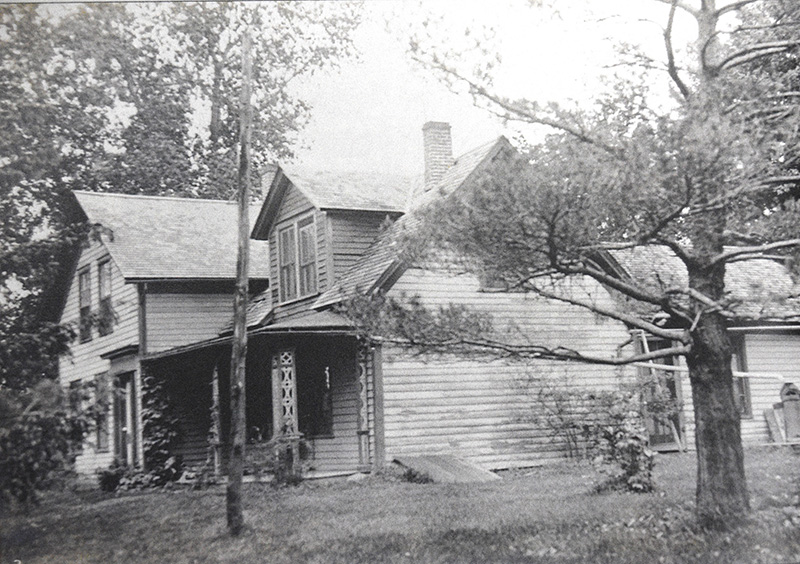
Photo courtesy of the Houston County Historical Society
Leave a Reply