
In the late summer of 1931, Joe Von Moos purchased a new Model A Ford Tudor Sedan from the Ender Ford dealership in Hokah, Minn., for $460 (roughly equivalent to $9,800 in 2025). Frugal as he was, he bought the car with yellow wheels but without the matching yellow body stripe. Living eight miles from town on a South Ridge, La Crescent Township, Houston County farm with his sister Kate – neither ever married – Joe could not have taken better care of his prized four-wheel possession.
He did not drive it everywhere and then only in warm months of the year. Every Sunday morning, it was four miles to church. About once a month, it was 12 miles to La Crosse for groceries and farm supplies. Beyond those routine routes, there were occasional family events.
Driving was not always the simple operation later drivers enjoyed. The primary issues with starting a Model A were the location of the valve to turn on the gas and how much to advance the spark and accelerator levers.
Joe’s Sunday arrival and departure from church was a ritual, described by then young boy observer David Beckman. “Kate always sat in the back seat and would exit the car by herself … Upon their arrival on Sunday mornings, Joe’s ritual was always the same. He would place the gear shift into neutral, set the emergency brake and exit the car with the engine still running. Going to the passenger side of the car, he would open the hood, turn off the gas valve and wait until the engine had stopped running before closing the hood and returning to the driver’s seat. There, he would place the shifting lever into low gear and remove the key from the ignition. Since the only external lock was on the passenger door, he would again walk around the car and reach across the front seat to lock the driver’s door and then lock the passenger door using a separate key.
“When the church service was over, the ritual would resume. Joe first unlocked the doors and then opened the hood to turn on the gas valve. Getting into the driver’s seat, he turned on the ignition, moved the shift gear into neutral and advanced the spark and accelerated levers.
“That’s when the most puzzling thing occurred. Joe would reach into the back seat and take out the hand crank, which was laying on the floorboard and insert it into the crank hole below the radiator making sure the crank was properly fitted so the handle would be at its lowest position. With a quick upward pull of “just one-half-a-turn,” the engine would instantly rumble into action, the sign of a well-maintained car. Many an arm was severely jammed and some even fractured in those days when the engine would backfire while the crank was incorrectly being “spun” in a continuous rotation with a stiffened arm.”
It was somewhat a mystery why Joe chose to start the car with the hand crank instead of the starter motor. Maybe, he did not want to wear out any parts of the car. Or maybe, he just enjoyed using his own muscle power to start the engine. Regardless, Joe took meticulous care of this automobile.
Joe’s Model A was never driven in winter. In early autumn, always before the first snowfall, Joe would put the car up onto blocks in the shed and cover it with a tarpaulin. If the water was drained from the radiator, then it would not need to be filled with alcohol. Tires were best preserved by letting out the air. But a hand pump would then be needed to fill the tires again in the spring.
All winter, Joe would use his Model T truck with its dual rear tires and set of chains. The Model A would hibernate until the gravel roads dried out in the spring.
Every car manufactured up into the 1950s required a break-in period. One instruction for the Model A was to “keep the oil at “F” on the measuring rod, especially during the first few hundred miles. Never let it get below the mark “L.” Remove measuring rod and wipe with a dry cloth before testing the level. OIL SHOULD BE CHANGED AFTER THE FIRST 500 MILES AND EVERY 500 MILES THEREAFTER. Summer oil should conform to S. A. E. specification 40, and Winter oil to S. A. E. specification 20”
Although the speedometer showed a maximum speed of 80 miles per hour, the break-in instructions for the Model A stated, “Avoid high speeds when the car is new. To obtain best results, IT SHOULD NOT BE DRIVEN FASTER THAN 35 MILES PER HOUR FOR THE FIRST 500 MILES. CAUTION DO NOT RACE THE ENGINE, ESPECIALLY WHEN COLD.”
Later model cars generally had break-in speed limitations of 50 to 55 miles per hour for the first 1,000 miles. Others had a limit of 30 to 35 mph for the first few hundred miles.
When Joe bought the Model A in Hokah in 1931, the population of the town was 425. John Ender and Manny Hoffman operated a hardware store, which eventually included a Ford dealership. When it all burned to the ground sometime in the 1920s, Ender opened his own Ford dealership across the street where he employed several of his nephews, including Leonard Ender, who sold Joe the Model A.
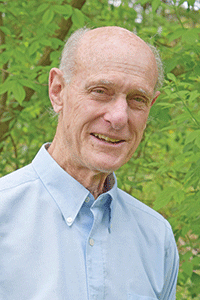
Joe, born in 1882, sold his Model A at auction to the same David Beckman, who had been enthralled with the car since his childhood. That 1969 auction occurred shortly before Joe moved into the nursing home in La Crescent. Two years later, he died at age 89. His younger sister Kate had died in 1954 at age 67.
Source: Joe’s Old Car, by David Beckman, 2018.
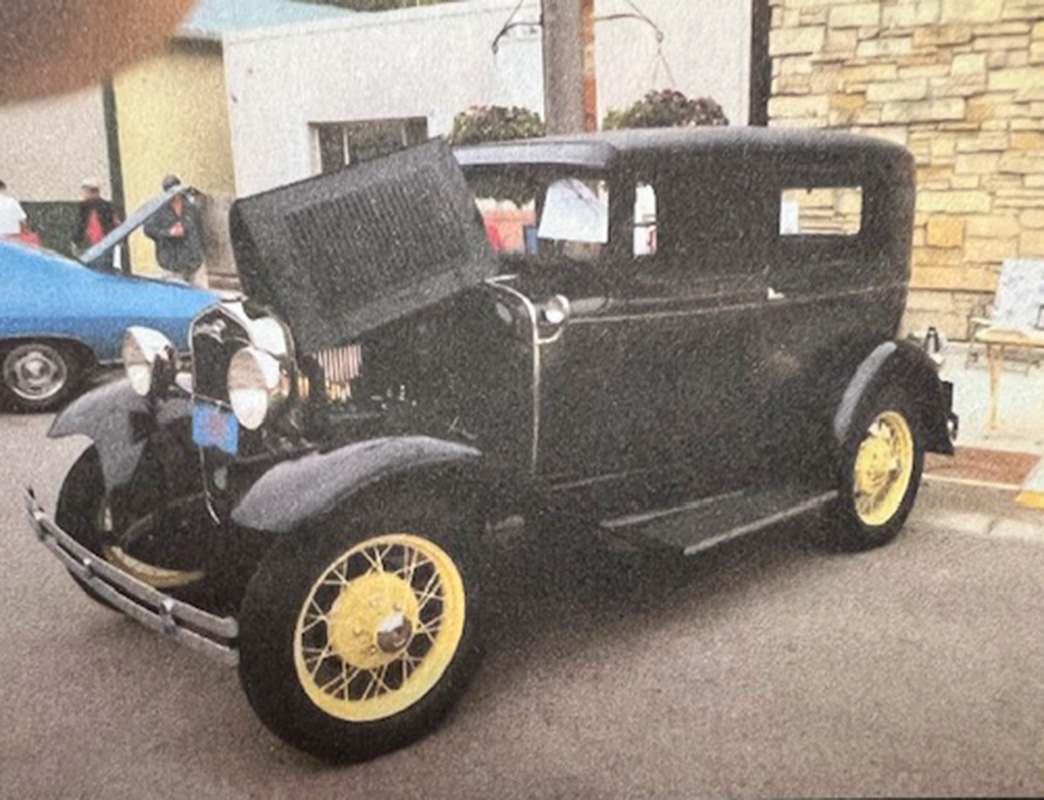
Photo courtesy of David Beckman
Leave a Reply