

The well known ditty, “A shave and a haircut, two bits!” was more than an often vocalized musical phrase, dating back to a song in 1899; it was a fact of life in the 1930s, at least at the Hokah Barber Shop on Main Street in Hokah, Minnesota. “Two bits” was slang for 25 cents, which had the purchasing power then as does about $6 in 2025.
Going to church on Sunday and going shopping in town on Saturday were two social breaks for otherwise rather isolated farm families. Saturday was an eagerly anticipated excursion for shopping, socializing and maybe some entertainment. About dusk in Hokah, the local merchants sponsored a free movie in the alley between the bank and Butch Reilly’s store. Don Archibald was the projectionist in residence. More than six decades later, Bob Sauer recalled two of his most memorable movies, “The Last Days of Pompeii,” staring Basil Rathbone (1935) and what he termed spooky, “The Thirteenth Guest” (1932).
The shopping and festivities continued into the night. Saturday night in Hokah was locally known as “Bank Night,” an event sponsored by the merchants. Customers received a free chance for every $2 spent on merchandise during the week. After the stores closed at 10 o’clock on Saturday night, a drawing was held for $50 in prize money in various denominations with the big prize being $10 (about $240 value in 2025).
Many men had their shave and haircut, all for 25 cents, after completing their Saturday shopping. Unlike the other merchants, the Hokah Barber Shop did not close at 10 p.m. but stayed open on Saturday night until midnight or sometime later as part of the weekly social and shopping scene. Taking a bath and getting a haircut was a Saturday night ritual in order for men to look their finest for Sunday church services. Charley Sauer and Paul Guenther owned the barber shop, their motto being, “Been Scalpin’ for 20 years.”
The barber shop was always crowded every Saturday night, not surprisingly due to a free cigar and free beer. A keg of beer was tapped in the middle of the shop, again all for the price of “A shave and a haircut, two bits!” However, a hat was passed throughout the night until the cost of the beer was covered – or surpassed. In 1934, a year after Prohibition had ended, imbibing in public was quite an occurrence.
Many wives still disapproved of downing alcoholic beverages and did not allow their husbands to drink. But wives did not frequent the barber shop.
When the shaving and the scalpin’ was completed, many of the just-shorn customers remained for additional refreshment. Therefore, when a new patron arrived and seeing the crowded premises, might turn to leave, not knowing how many were in line ahead of him. But Paul or Charley would call out to them, “You’re next” or “There’s only one ahead of you.”
Saturday was boost to the village economy. One year, additional entertainment was provided by Charley’s seven-year-old son, Bobby. The family lived upstair above the barber shop. With his 8:30 bedtime, Bobby would sneak down to the busy, crowded barber shop about 8:00. He was not a singer or dancer but he perfected an unforgettable performance that may well have made him the most enterprising person in town. Barber shop patrons were not always the best of role models. For about five minutes, Bobby would let out a steady stream of profanity that he had learned from hanging around the shop. His enthusiastic audience would throw pennies and an occasional nickel down on the floor during the performance. The cussing kid would collect the coins and head back upstairs for bed.
Charley and Paul, like barbers of any era, were quite aware of most men’s views of local politics. They saw each customer at least every three or four weeks at haircut time. Discussions could become quite heated. But no one wanted to argue strongly with Paul or Charley when either had a shaving razor near one’s neck. Mayor Herb Wheaton was quoted as saying, “I don’t know why we have these town council meetings every month when every issue is finalized at the barber shop on Saturday night.”
Source: “Saturday Night at the Barber Shop,” by Bob Sauer, 1997, in the book Stories of Hokah from Aggie’s View, by Agnes Tippery, 2001.
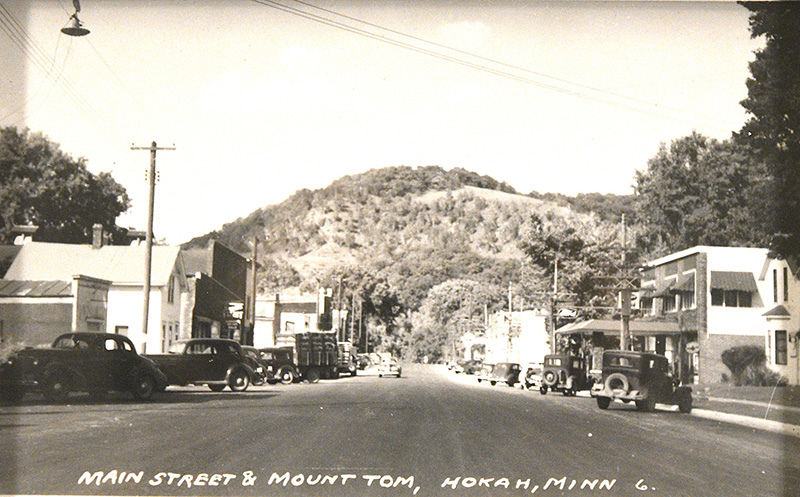
Photo courtesy of the Hokah Public Library
Leave a Reply