
Part two of a series begun in June, 2022
A certain man wanted to be the next Secretary of Transportation and phoned President Calvin Coolidge at 3 a.m. and said, “President, your Secretary of Transportation just died and I’d like to take his place.” Coolidge, aroused from sleep, replied, “It’s OK with me if it’s OK with the undertaker.”
That was one of many jokes Franciscan Sister Mary Hafner included when she wrote about her childhood on South Ridge in Houston County, Minnesota. In 1858, her grandparents paid $1 for 640 acres, which they divided into four farms. Mary was born and raised on one of those farms, now across the road from Channel 19. As a senior citizen, she reminisced about her younger days during the Great Depression of the 1930s.
For most, all of one’s life savings was wiped out by the stock market crash of 1929. Many years later as an adult, Sister Mary attempted to trace her family’s financial loss. To her amazement, she located her father’s checking account from 1930, still open. She collected her inheritance of $6.40 and closed the account.
Sister Mary enumerated some favorite memories from her childhood, especially after her six decades as a teacher, those in contrast to the experiences of her students.
- Living on a farm near animals. The children knew the temperament of each horse, which cow was gentle at milking time and which was the “precocious leader” in a litter of kittens. Could they succeed in getting the runt pig to survive? Hearing the birds was like listening to music. “Night skies seem to be studded with thousands of stars and constellations.”
- Hearing her father say, “The first corn is sprouting.” The children rushed outside to see new life. “God, keep the periodic rains coming.”
- During playtime, picking a radish from the garden, rubbing off the dirt and eating it. How delicious that was along with fresh, warm milk, which dad had milked into a tin cup.
- There was always enough time for everything. No “surfing the Internet” and then wondering where the time went.
- “A healthy balance of work, play and prayer.” They worked to enjoy life without pressure to climb the corporate and social ladder. “Families daily ate meals together. Our lives were totally centered around family, church, school and neighborhood.”
- Family prayer and teaching children to pray. “Even though I knew I didn’t pronounce the words correctly, I knew I was praying and God was listening.”
- One-hour, six-mile horse-and-buggy caravans from South Ridge through two miles of woods” to school where they picked flowers during water breaks. On the way home, eating lunch leftovers, talking to neighbors in the buggy ahead or behind, telling jokes, studying for tomorrow’s test or just enjoying the fresh air.
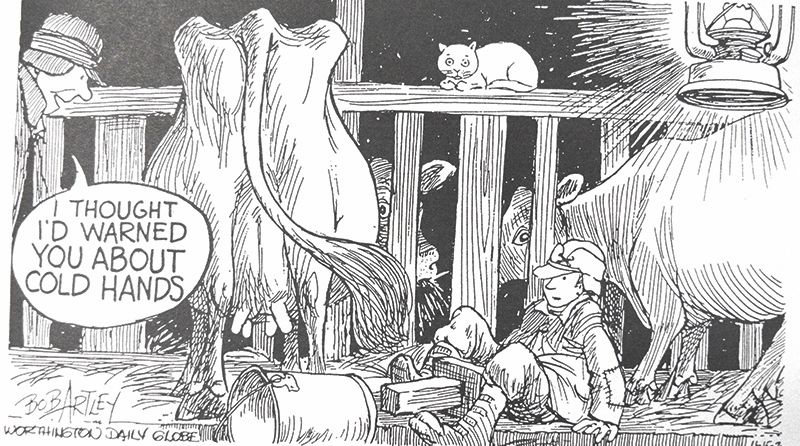
The Rural Electrification Act (REA) of 1936 provided federal loans for electricity to be extended from towns into isolated rural areas. It would be 1940 before a local cooperative would bring electricity to the Hafner farm. Before that life-altering arrival, there was no electric lighting, no toaster and no electric bill. Life indoors was illuminated by one kerosene lamp in the house and one hanging lantern in the barn.
The only ongoing income for farmers was the cream check. Milk was put through a “separator” to get the cream, which was sold to the Hokah Cheese Factory. The skim milk was served to pigs and calves.
The entire family was involved in that economic enterprise. Children’s chores were twice-a-day when it came to milking and feeding all the animals. The youngsters brought cows from the pasture to the barn, helped with the milking, washed separator discs and collected eggs. Cows were milked by hand while the child, perched on a three-legged stool, hoped not to be kicked off.
Butter was made in a small gallon churn or in a large cream can with a wooden stomper. “Just keep on churning or stomping until the cream turns into butter without preservatives or additives.”
As soon as kids were physically strong enough, they joined the cornhusking crew. A right-handed husker grabbed an ear of corn with his left hand and then with a hook on his right hand, pulled the hook across the ear to tear the husk away from the ear. The ear would then be broken loose from the stalk and tossed into a wagon. Corn stalks were fed to livestock; the field would be plowed and dragged for subsequent planting.
Human arm power was more eagerly offered when everybody agreed to take turns cranking the handle while making homemade ice cream. Boys chopped ice from a big ice chunk to fit into the ice cream freezer. This was an annual treat on the Fourth of July when everyone ate as much ice cream as desired during summer humidity with temperatures above 90 degrees.
Bringing cows in from the pasture before evening chores seemed to coincide with what was called “gypsy time,” which could continue well into the night. Gypsies, who arrived in two-seated surreys with long fringes on top, were unwelcome visitors, always suspected to be thieves. Her parents were certain gypsies stole gas from the barrel in the corn crib. Although Mary could not remember it happening, it was said Gypsies would even steal children. So, kids would run when a gypsy surrey was sighted.
Another chuckle from days gone by: Mother was disgusted because her small son simply would not eat his two prunes. “God is angry with you,” she ordered. “Go, and stay in your room!” A storm arose that evening; mother went to his room to check on him. As he was standing at the window and staring at the storm, she heard him say, “God, this is sure a lot fuss over two prunes!”
To be continued …
Sources: A series of guest columns published in the Houston County News, (La Crescent, MN) were later published in a book, Life on the Farm in the 1930s, by Sister Agnes Hafner, FSPA, 2004. The cartoons by Bob Artley were originally published in the Worthington (MN) Daily Globe, later in his book, Memoirs of a Former Kid, 1978, and again in 2004 in Sister Hafner’s book.
Leave a Reply