
Photo by Lee Epps
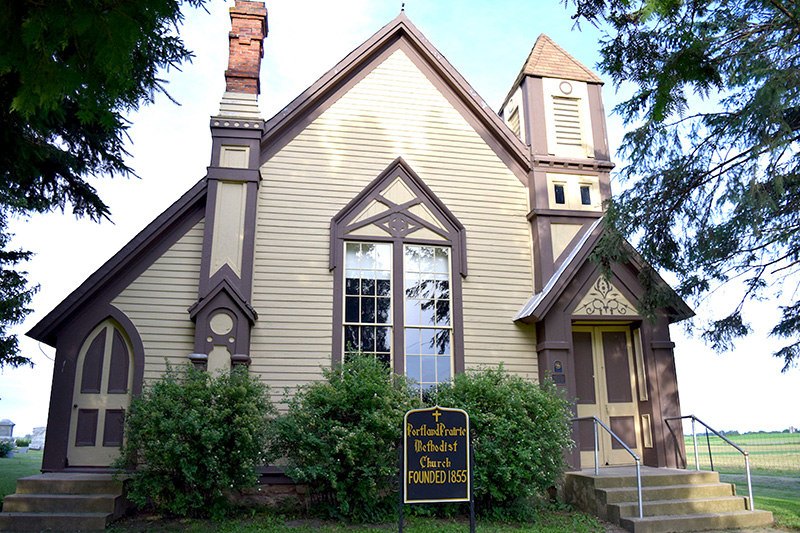
 It has a name and people live there, but it its not on a map. It was an agricultural community, not a village, which from the early days of settlement became known as Portland Prairie. If you visit historic Portland Prairie Church, you are on a short span of pavement named Portland Prairie Road, part of the dividing line between Wilmington Township and Winnebago Township.
The church, built in 1855, is about two miles northeast of the village of Eitzen in southern Houston County, Minn., in the heart of prairie land known as Portland Prairie, an expanse mostly in Minnesota along the Iowa state line. The road and the church are the only two places where the name survives on signage, except at the county fair on projects displayed by the Portland Prairie 4-H Club.
Minnesota Territory was organized in 1849, extending as far west as the Missouri River. The gold rush of that same year attracted the most adventurous pioneers, the 49ers. However, home seekers, escaping hard times, were drawn to farmland, including the new Minnesota Territory. Every year, there was greater traffic of steamboats heading up the Mississippi River toward the settlement of St. Paul. The counties along the river were quickly populated during the 1850s.
In 1854, there was no railroad west of Rockford, Illi., – somewhat west of Chicago. From Rockford, a stagecoach was available to Galena, near the Mississippi. From there, boats ran up to St. Paul, making stops at all the market towns along that waterway. Some left the river at Lansing, Iowa, without any predetermined destination in southeastern Minnesota. Hearing there was unoccupied land available about 20 miles to the northeast, some men went ahead to evaluate and returned with positive reports.
A few early settlers established claims on the Iowa side of the state line in 1851 and began to select claims on what would be the Minnesota Territory side after the government surveyed the state line in 1852 and before surveyors staked out what would become Winnebago and Wilmington Townships, among the first in Houston County to be settled by white pioneers.
The largest contingent of early Portland Prairie settlers came from northwest Rhode Island along with some from neighboring Massachusetts. Early on, the prairie was commonly referred to as the “Rhode Island Settlement.” Also among early-arriving families were the Everett brothers, who having first settled in Wisconsin, moved in 1853-54 to Minnesota Territory and what became known as the “Everett Neighborhood.” The Everetts were originally from New Portland, Maine, a village about 80 miles north of the city of Portland. Possibly the Everetts gave Portland Prairie the name that stuck.
Located between settlements of native Norwegians in Wilmington Township and Spring Grove Township to the northwest and German immigrants to the southeast in the village of Eitzen in Winnebago Township, the Portland Prairie pioneers migrated mostly from New England and New York in the northeastern United States, sometimes collectively referred to as “Yankees.”
But in those early years of settlement by those of European ancestry, there were reminders of even earlier inhabitants. Small groups of the Winnebago tribe of Native Americans remained along the Iowa River and the Mississippi bottoms, who occasionally appeared at log cabins to beg or barter for food or old clothing. An old Indian trail between the Iowa River and the Root River crossed Portland Prairie, roughly providing the course of the first road constructed across the prairie.
The rolling prairie was drained by ravines into Winnebago Creek and the Upper Iowa River and eventually into the Mississippi River valley about 13 miles east of the Winnebago and Wilmington township line. Those earliest settlers found wild prairie grass a foot or more in height. Near ravines, there was also fully grown timber, predominantly white oak, occasionally hickory, poplar or birch. Prairie groves featured poplar, wild cherry and wild crabapple as well as wild plum trees, some bearing plums about the size of small peaches.
The first-arriving pioneers did not occupy the open prairie but preferred locations to the south where there was good agricultural land adjacent to partial timber and proximity to water.
There was plenty of game, including large fish in the Mississippi as well as trout and other fish in the creeks. Feathered targets included quail, prairie chickens, ducks and wild geese. Rabbits abounded along with a few deer.
However, life could be difficult, especially in the earliest days. Sarah Albee, wife of C. F. Albee arrived in 1854, the summer she turned 29, with two children. As a senior citizen, she recounted her first week in Minnesota. Their first meal was some “milk, string beans about as large as your little finger and potatoes as large as marbles with a little flour.”
Most of their belongings had not yet arrived, and there was so much rain the Iowa River could not be crossed with a team of horses and a wagon. The thatched roof of the cabin leaked. “When it rained, we used an umbrella to keep off all the water we could.”
Illness was common. After a neighbor’s wife died from cholera, a coffin was hastily constructed with boards. While some were on their way to the funeral, a tornado struck the log dwelling. Floor boards, not yet nailed down, began to fly up, and roof shakes flew away. Fearing the logs themselves would tumble, she dressed her sick husband and grabbed her babies to wait by the door, ready to flee if the logs did tumble.
Then, she saw her father trying to keep up with the ox team in which women and babies were loaded.” The roof of their cabin was gone along with all their clothing and possessions.
Five days later, they were able to cross the Iowa River and obtain “flour and eatables from Lansing. We did not suffer for food any further. The crops were soon ripe, and we had both wheat and corn. We bought an improved place.”
Source: Old Times on Portland Prairie, Houston County, Minn., 1911
Leave a Reply