
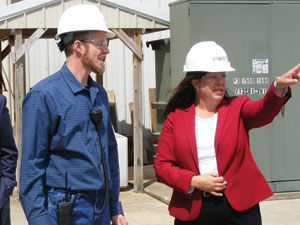
Minnesota Pollution Control Agency Commissioner Laura Bishop supports recycling and reusing waste materials to the greatest extent possible. POET General Manager Chris Hanson says there is 0% waste in the ethanol production process and water is recycled.
Bishop was appointed MPCA commissioner by Governor Tim Walz in January 2019. As MPCA commissioner she will manage the day to day work of the agency and its staff. She has worked both in the public (state and federal) and private sectors. Her last position was chief sustainability officer for Best Buy, Inc.
This was her first tour of an ethanol facility. Hanson gave a brief history of what is now the world’s largest ethanol producer (28 plants). On a Wanamingo farm in the early 1980s ethanol production was born. POET’s BPX (2004) patented raw starch hydrolysis process converts starch to sugar with a blend of enzymes. It reduces energy use because heat is not used in the process. This breakthrough process lets POET get more fuel with less energy.
Hanson explained they are constantly doing research and still growing. Ethanol added to gasoline displaces carcinogens (reduces tailpipe emissions), so it is better for human health and ethanol burns cooler than gasoline for engine health. Federal subsidies for ethanol ended a decade ago.
Ethanol is 100% home grown with 0% waste. The primary product produced is ethanol, but distillers grain (high protein animal feed), corn oil (used for animal feed and biodiesel; also used to blend into asphalt), and liquid carbon dioxide are all salable and profitable products. Distillers grains are exported to six continents. Carbon dioxide gas is produced from compressed gases in the fermentation process; it is turned into liquified carbon dioxide which is used as a food product (soft drinks). Hanson said 400 chemicals make up gasoline, but ethanol is just ethanol.
Ninety-seven percent of gasoline contains at least 10% ethanol. Recently, the EPA announced ending a summer ban on E15 blend, which can be used in cars 2001 or newer. Hanson maintained that E15 is the most tested fuel in the history of the world.
The water used to produce ethanol is 100% recycled through a total water recovery system which filters and treats water to a usable quality.
Hanson said they have to fight for market share; artificial market barriers are holding us back. Ethanol use allows for less foreign oil being imported and sustainable agriculture. It is a huge United States export.
Bishop noted Governor Walz is co-chair of the biofuels task force and a supporter of the ag industry. Hanson commented that ethanol and agriculture are one and the same and will rise and fall together. With year-round E15 there will be more growth.
POET holds 90 patents and employs 100 people in research. Hanson said Minnesota has a slow permitting process, which has driven investment out of Minnesota. Major expansions have not been made in Minnesota because of the permitting process. The “air quality” permit is especially complicated. Bishop said she is in the process of evaluating the permitting process. Hanson said there is a lot of repetition in the process.
Emissions during the production process of ethanol include volatile organic compounds, particulates, and carbon monoxide. Hanson maintained that the annual emissions from the plant are equal to that of 15 automobiles.
Project “Liberty” in Emmentsburg, Iowa, is the future. Corn stover is used; cellulose is broken down into starches and sugars. It costs more to make ethanol from stover than it does corn. The same technology could be used with wood waste. Hanson said any plant matter could be used to produce biofuel.
Bishop commented she was learning a lot and wanted to understand the business better. Hanson said we need to do a lot of education; not many industries have 0% waste.
Fillmore County issues
This reporter had an opportunity to sit down with Bishop and her staff to discuss pollution issues in Fillmore County. Bishop identified water quality and the health of streams and rivers in the county as primary environmental concerns, in part, due to the karst geology in the county.
Excess nitrates are the greatest threat to water quality. Bishop wants to minimize nitrates by first finding the causes.
The legislature didn’t fund a nitrate study. A Generic Environmental Impact Statement on nitrate-contaminated water is to be discussed at the Environmental Quality Board’s June 13 meeting.
The wet spring and heavy rains have contributed to runoff this year. Bishop said she is working on sustainable practices with the Department of Agriculture.
Activists took control during the recent Catalpa large hog farrowing facility permitting process. Bishop sees activism as essential.
Farmers get the lion’s share of the blame for water contaminates. Bishop was asked about runoff from urban lawns, golf courses, and road salt. MPCA senior advisor Darin Broton noted the state does ban phosphorous use on lawns. Other regulation varies city to city.
Broton said the PCA’s view is that we are all in this together. We need to reduce chloride and nitrates. One industry (agriculture) shouldn’t take on all the blame. Fillmore County has achieved 99% compliance with Minnesota’s Buffer Law (statewide 96% compliance).
Bishop feels the greatest environmental issues are water and air and the unpredictability of weather patterns.
Fillmore County requires septic systems to be inspected and brought into compliance as property transfers. Recently, the court ruled in favor of the government to require Amish property owners to install gray water systems. Human waste, if not treated properly, is a source of water contamination.
A significant percent of individual rural wells have high nitrates or other contaminants. Some of these wells are old and not up to current standards. New wells are expensive. Bishop said people of all income levels should have equal access to clean water.
The report produced through the collaboration of the Minnesota Department of Health and MPCA entitled “Life and Breath: How Air Pollution Affects Health in Minnesota” was just released. The report estimated that 5-10% of residents who died and one of five of all residents who visited an emergency room or hospital for heart and lung problems, did in part because of fine particles in the air or ground-level ozone. Bishop commented, “Minnesota meets all the federal standards for air quality, yet people’s health is affected even where air quality meets the standards.”
Walz proposed 100% clean energy by 2050; it was not passed by the legislature. Bishop said it is important to have 80% greenhouse gas reduction by 2050. MnDOT is being encouraged to decarbonize the transportation system; going away from fossil fuels. How can we bring more sustainable fuels into the industry?
Bishop pointed to technologies that capture gases from food waste and gases from landfills to use as an energy source. Organic recycling and the use of biodigesters are ways to reuse and recycle waste. Rochester burns waste at very high temperatures which results in less emissions. What can be done with this resulting ash? Bishop stated that they are looking into blending it into asphalt and that we need to reuse as much as possible.
Minnesota law allows uncontaminated concrete (no paint, stain, lead, tile, etc. attached) to be used as a substitute for conventional aggregate.
In the last legislative session there were grants for recycling to develop a local market for recycled materials, funding to reuse food waste, and SCORE grants.