
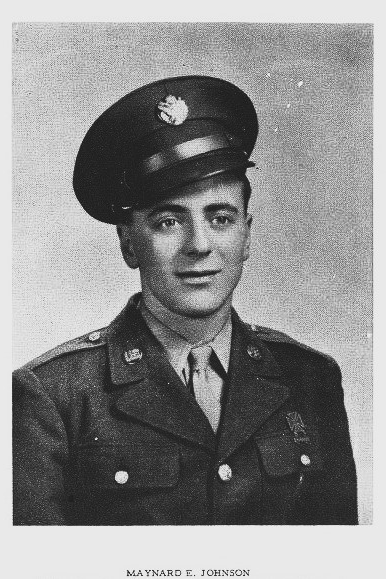
Photo submitted
By Gretchen Dahlen
Former Mabel resident
Maynard E. Johnson was born in 1924 in Newburg (rural Mabel), Minn. He graduated from Mabel High School and entered the University of Minnesota. He was inducted into the Army in June 1943 and sent to Texas, receiving training through the Army Service Training Program (ASTP).
Pulled out early, he was assigned to the 66th Infantry Battalion of the 12th Armored Division, which entered France in the first part of November 1944. The 66th was in the vicinity of Herrlisheim, a small town in Alsace, France in mid-January 1945. PFC Johnson was killed in action by a landmine on January 20, 1945. He was 21 years old.
Early Life
Maynard Everett Johnson was the second child of four known to be born to Iva Lenora (Todt) and Leonard Julian Johnson. He was born on January 10, 1924, in Newburg, rural Mabel, Minn., (Fillmore County). His father, Leonard “Lennie,” was a rural letter carrier for the US Post Office and a veteran of the first World War (SN 36273481).
In the 1930 census, Maynard was six years old. His siblings were Kenneth, age 11, Lois “Arlene” (3) and Robert (10 months). His parents owned their home in the village of Mabel, a town small enough that street addresses went unrecorded. By the 1940 census, Kenneth, 21, was working as a grocery clerk. Maynard was 16, still in high school and active in sports, namely football and basketball. Arlene and Robert were grade-schoolers.
Maynard graduated from Mabel High School in 1942 at age 18. He registered for the draft in June that year (in Fillmore County). No employment was listed. He stood 5’8”, weighed 125 pounds, had blue eyes, brown hair and a light complexion (white race). Military
According to the Mabel Service Record World War II Mabel published after the war, Maynard entered Army service at Fort Snelling, Minn., on June 28, 1943. His service number was 37567869. His final rank was Private First Class.
He was in the (ASTP) at Texas A&M university, which was developed to produce junior officers and soldiers with technical skills, but the program was closed and men reassigned. Maynard had military training at Camp Fannin, Tex., (an infantry replacement training center, and at Camp Barkeley, in Abilene, Tex.
Camp Barkeley became the home for the 12th Armored Division. Within that division were three infantry battalions: the 17th, the 56th and the 66th Armored Infantry Battalion. Maynard was assigned to the 66th in about April 1944.
The 12th Armored Division completed its move to Camp Shanks on September 13, 1944, near New York City, a staging area for shipping the troops overseas. It was the largest U.S. Army embarkation camp during WWII. While some men got 12-hour passes to NYC, time was short. The 12th Armored left within a week to the point of embarkation, and arrived in England on October 2.
By Ocober 5, they were at Tidworth Barracks, where during the next 30 days some received 48-hour passes to London. They were alerted on October 30 to get ready to ship out to France, then left November 9 for the ships awaiting them at Weymouth and Southampton. Crossing the English Channel, they disembarked at Le Havre, France on November 11.
Over the next three weeks, the 12th Armored Division was moved into position in France. Three hundred miles of it was a motor march from Auffay to Luneville. On December 5, they were in combat with the Seventh Army.
By early January, PFC Johnson and the 66th Armored Infantry Battalion (AIB) found themselves in the cold and snow near the Rhine River. They were at the southern end of the “Bulge” that the Germans were now losing. According to the 12th Armored Division history, von Rundstedt shifted German units to villages of Gambsheim and Herrlisheim, where he would attempt to retake Strasbourg (part of Operation Nordwind). The population in this part of France had many pro-German tendencies and the canals made it difficult for tanks to be effective. The U.S. Army Combat Chronicles said that the “German defenders repulsed Division attacks in the most violent fighting in the history of the 12th, 9 to 10 January 1945.” The 66th Armored Battalion was ordered into the fight near Herrlisheim and the forest south of the town. Apparently, “The American attack went badly from the start.” – (Historynet.com
“Battle for Herrelsheim [sic]”)
Death and Burial
As the Division attempted to seize Steinwald Woods (often labeled “Stainwald” in historical records), they were stopped. Heavy fire and German counterattacks held back any gains. Companies A and C of the 66th attacked the southern portion of the Steinwald Woods on January 16, but lost most of their men – dead, wounded or prisoner-of-war. George Rich, a veteran taken prisoner that day said, “Our company was practically wiped out.” (Abilene Reporter News) The 43rd Tank Bn fared no better, taking fire from three directions – the Steinwald (from the south), Herrlisheim (north) and Offendorf (east).
The next day, the Division took another go at the Steinwald Woods and Herrlisheim. The 66th AIB was reinforced, but “that effort went no better than the day before, and by 7 a.m. the 66th had been thrown back to its line of departure along Landgraben River.” The battle, with both sides fighting at their best, continued for another couple of days. On January 20, the 12th Armored Division pulled back, and the 36th Infantry Division came in to assume their positions.
That was the day that PFC Johnson was killed in action. Somewhere in all this fighting and chaos, he died on the battlefield, killed by a landmine. Maynard had celebrated his 21st birthday 10 days earlier. His parents got the terrible news six weeks later. Maynard’s brother Kenneth was with a medical corps in England at the time; Arlene and Robert lived at home.
PFC Johnson was temporarily buried at Epinal, France. His body was brought back to the U.S. three years later. Mabel Methodist Church held the memorial service for Maynard on the afternoon of April 26, 1948, and he was laid to rest in the Mabel Lutheran Cemetery.
We honor your life and grieve your sacrifice.
See fold3.com for more of Gretchen Dahlen’s Stories Behind the Stars Project articles.