
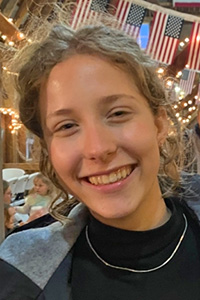
By Mila Friske
“I feel sorry for your generation. You have to live in such a difficult world.”
I hear this sentence surprisingly often in conversations with my fellow human beings. And although it is well-intentioned, there is something about it that bothers me considerably: the assumption that there is hardly any room for hope in my generation. That we are being left with a world that is too broken, too complicated, too late to be changed.
I don’t want to believe that.
Of course we have problems, very big problems even – climate change, wars, social inequality, political division. But let’s look at this together. Dig into your own memories and what you remember from history class: When was our world ever perfect, completely problem-free? Every generation has faced seemingly unsolvable crises. And yet they were solved — not because there was certainty, but because people chose to put courage before fear.
Imagine Europe in 1945: cities in ruins, hunger, millions dead and with them millions of families mourning their loved ones or still searching for them. A continent in shock. No one knew how to move forward. And at that very moment, barely five years later, European states decided to found the Council of Europe – an institution designed to protect human rights, democracy and the rule of law.
It was founded in 1949, and Germany joined in 1950. Former enemies sat down at the table, having just emerged from a war that had destroyed everything. In 1948, the world had adopted the Universal Declaration of Human Rights – and Europe made it practical: binding, verifiable, enforceable.
This step was not a matter of course. It was a risk. But it shows that even after the darkest times, cooperation can emerge.
At another time, another person changed the world: Edward Jenner. At the end of the 18th century, he observed that milkmaids who had contracted cowpox were immune to the deadly smallpox. From this inconspicuous observation, he developed the world’s first vaccine. And the real power lay not in Jenner’s discovery alone, but in the fact that doctors, scientists, and volunteers spread his idea across borders – from village to village, in crisis regions, across continents. Decades later, this led to something that no one would have thought possible: the complete eradication of a disease that had brought fear and devastation for centuries.
Or let’s think of Rosa Parks, who remained seated on a bus in Montgomery in 1955. No manifesto, no plan, no guarantee of success. Just one decision: this far and no further. Her silent protest sparked a movement that would change civil rights in the U.S. forever.
These examples show that progress rarely begins loudly, but always with courage and confidence in the cause. And it is precisely this potential to tackle things courageously and with confidence that I see in my generation.
A generation that is already taking action.
When I look around, I see young people taking responsibility before anyone tells them they are ready.
I think of Malala Yousafzai, who said, “We were scared, but our fear was not as strong as our courage.” She didn’t stand up because she was sure she would win. She stood up because she knew what she stood for.
I think of the young women in Iran who burned their headscarves after Mahsa Amini’s death, cut their hair, and sparked a women-led movement that showed how powerful hope can be, even in the face of deadly threats.
I think of projects like The Ocean Cleanup, which started as an idea from an 18-year-old and now cleans up waterways around the world. And initiatives like Rock The Vote, in the U.S., which mobilizes millions of young people politically.
Everywhere I look, I see courage, creativity, and a sense of responsibility – not just in large demonstrations, but in everyday actions: school projects, volunteer work, youth councils, neighborhood initiatives. Hope is not always loud. Sometimes it is simply a young person who decides to do something.
Together instead of alone.
Because all these historical stories have one thing in common: it was not individuals who changed the world – it was movements. Community. People who gave each other hope.
One of my favorite artists, Bruce Springsteen, reminds us in his song “Dancing in the Dark”: “You can’t start a fire without a spark.” And we must keep reigniting this spark, this spark of hope.
Because hope is not just a feeling, but a driving force.
And perhaps that is the point I would like to make to older generations: we don’t need pity. You can’t imagine how much that takes the wind out of our sails. Yes, the path is not free of obstacles, and yes, those obstacles are quite significant. But we, as a generation, as a society, must believe that we can overcome these obstacles together. Because we have always done so, because we can count on brilliant, committed people, and because we have faith in ourselves.
Hope is not a feeling that you simply have or don’t have. Hope is a decision. It arises when people trust each other and themselves that change is possible.
So here’s my appeal:
The next time you talk to a young person, please don’t say, “I feel sorry for you.”
Instead, say, “I believe in you.”
Because that one sentence can make more of a difference than you think.
Mila Friske is a Spring Grove High School student, one of 10 area students participating in the Journal Writing Project, now in its 27th year.
Leave a Reply