

By Bretta Grabau
Fillmore County
Historical Society
In the early years of Fillmore County, small family farms dominated the fabric of the resident’s way of life. Often these farms had a variety of animals – cattle, chickens, pigs, and horses – rather than only raising crops, cattle or pigs. However, farmers acquired bigger herds and oftentimes would need an entity that would purchase their excess production. In the case of cattle, this is where creameries came into play.
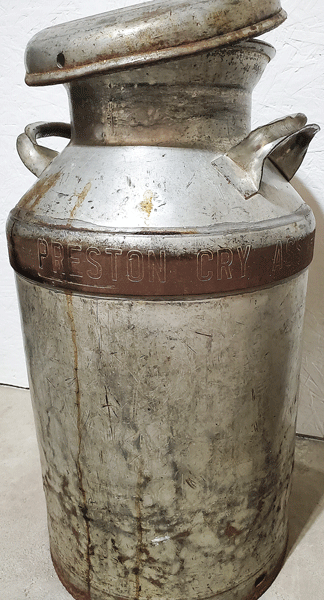
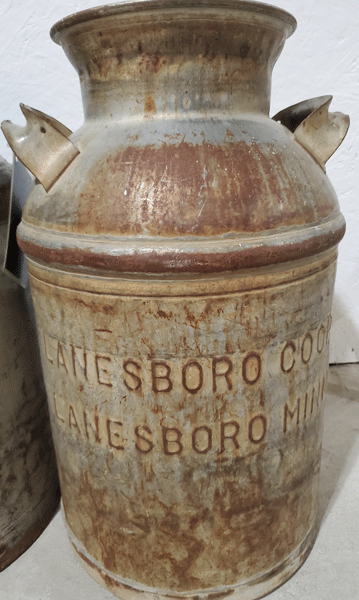
Beginning in the 1880s, communities all over the county formed creamery associations where a farmer would be able to ship his milk. Rushford was one of the earliest with their first creamery formed in 1881. Other communities soon followed such as Whalan, Fountain, Preston, Harmony, Spring Valley, Wykoff, Granger, and many others. The milk haulers would pick up the farmer’s milk in milk cans often labeled with the creamery name. Once at the creamery, milk would be separated from the cream. You may have seen smaller versions of a cream separator outside decorating someone’s front yard.
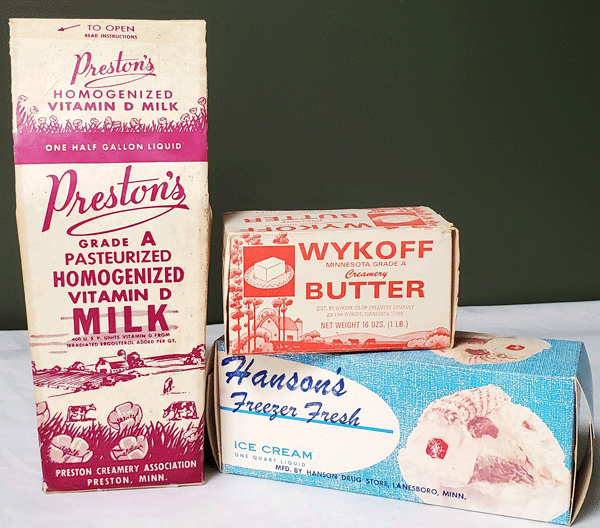
Each creamery would use the milk and cream to make ice cream, cheese and butter, besides selling pasteurized milk. At one point butter would be sold by the pound, as it is today, but it may not have been cut into four sticks. Regardless, creameries would also have their own designs of cartons to put the pounds of butter. Products were most often sold locally, but occasionally any overflow was exported. An example of this was the Wykoff Co-op Creamery.
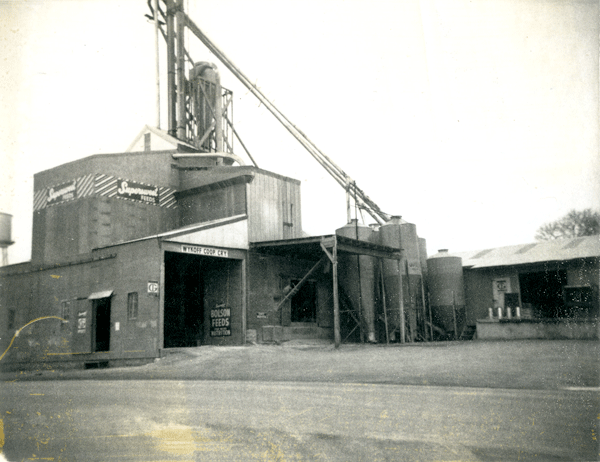
Wykoff’s Creamery was formed in 1906 to provide the community with a full-service milk receiving station. During its life, the highest capacity the creamery handled was 120,000 pounds of canned milk, dumped in by hand. After running through the separator, the cream was boiled and pasteurized and made into butter. The creamery shipped the buttermilk off to St. Charles where it was processed into by-products.
Once the butter formed, it was divided in a machine which could handle 64 pounds at one time. The sticks of butter were then wrapped by hand and placed in the boxes to sell to local customers. Any overflow made its way to Chicago to be sold.
Eventually, farmers purchased larger, newer bulk tanks rather than shipping their milk to the creameries. Because of this, by the mid-1900s creameries were on the downswing. Soon bigger businesses such as Land-O-Lakes became the predominant outlet, and the smaller family farms were quickly disappearing. Milk haulers had come a long way from the horse and wagon days to open bed trucks meant for holding larger milk cans. But soon these smaller trucks were replaced by larger, refrigerated trucks and semis designed to hold the milk in bulk. The days of the milk cans were no more.
Wykoff was no exception to the fading of the creameries. The Wykoff Co-op Creamery survived by purchasing the Wykoff Feed Mill in 1959 and the Wykoff Farm Store in 1973. At this time the name was changed to the Wykoff Cooperative. The Creamery portion closed in May 1980, only handling 17,000 pounds of milk per day. Milk was then sent to the Land-O-Lakes Creamery in Spring Valley. The Wykoff Cooperative ultimately dissolved in 1985.
The death toll of the local creameries commenced ringing in the mid-1900s, heralding the closure of an important piece of the community’s structure. However, their traces remain in some of the buildings that remained standing and converted into new businesses or as equipment they used in the day-to-day work, all of which are an integral part of Fillmore County’s history.
Dennis Cleghorn says
My dad spent a lot of years working in the Spring Valley creamery. Lots of memories growing up.