

By Cheryl Boyum Eaton
1877 Peterson Museum
Board Member
Many people are familiar with the talents involving Norwegian descended women, notably the baking of lefse, rosettes and krumkake, and the fine handiwork like tatting, weaving and rosemaling. Fewer are aware of the folk art products made by Norwegian men. These talents have been “passed down” to their descendants. All involve woodcarving skills, namely carved figures, wooden wall hangings, mangles and kubbestols, plus making furniture for their homes.
Woodcarving as an ornamental art dates back to the Viking Age, around 800-1050 A.D., noted by the carvings on their pagan Viking ships that have survived in museums. When the Catholic Church brought Christianity to Norway during the 11th century, it commissioned 2,000 stave churches to be built. These churches were decorated with carved figures of dragons and horses like the Vikings had used to decorate their ships. Later, in the Reformation during the 16th century, the Norwegian king became Lutheran and so did the country of Norway, but many of the stave churches survived.
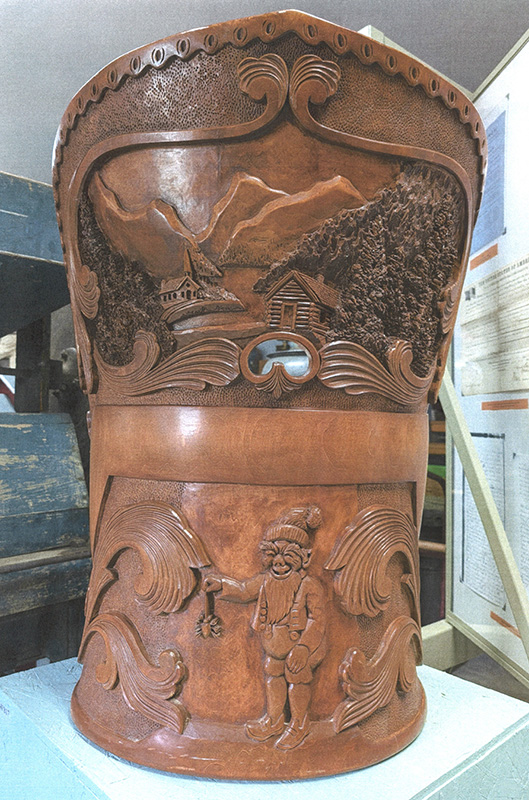
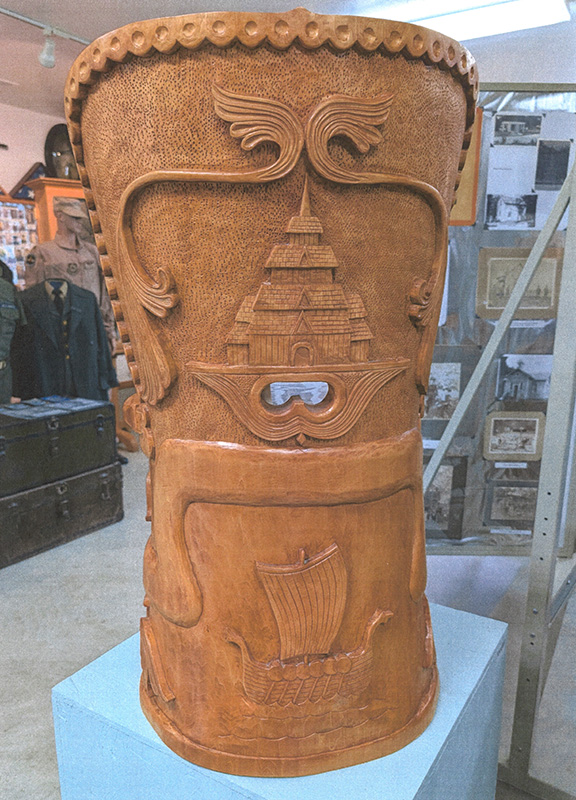
So, what is a kubbestol? It is interpreted as a “log chair.” The first one I recall seeing was at Good Shepherd Lutheran Home in Rushford, Minnesota. Olga Hoegh brought not one but two kubbestols with her when she was admitted to the nursing home in the early 2000s. She said they were carved by an area woodcarver of Norwegian descent, Halvor Landsverk. He had learned woodcarving from his father Tarjel Landsverk. They were a beautiful work of art!
Halvor carved for King Olav when he visited the Vesterheim Norwegian-American Museum in Decorah, Iowa, in 1968. He was also featured in a University of Minnesota woodcarving video. After that aired, he then received orders for kubbestols from all over America.
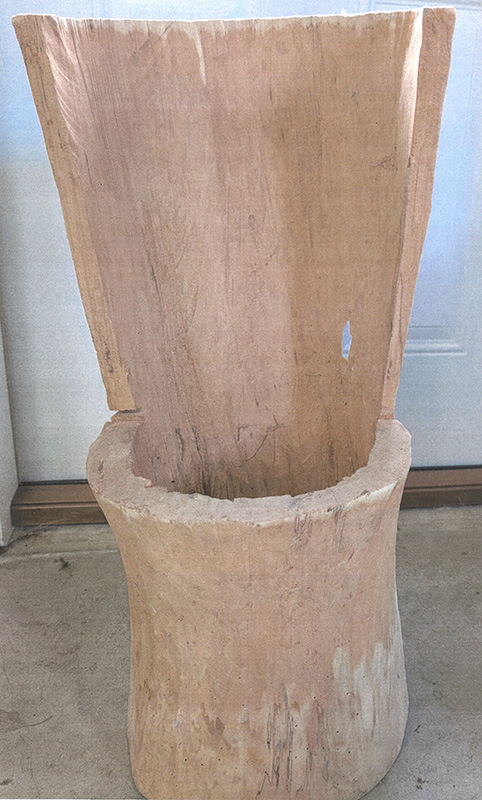
How is a kubbestol made? Trees of significant girth, at least 22 inches in diameter or more, which takes about 75 or more years of growth, are cut down in winter when the sap has settled into the roots. The trees are then cut into 3- to 4-foot lengths, rough shaped and the ends are sealed. This slowed the drying process and kept the log from cracking or splitting. This drying process took two years. Then the log was rough shaped, hollowed out so the chair wouldn’t be so heavy, and a slice of wood was shaped to form the seat. Paul Agrimson, another local carver stated, “The bottom of the chair is usually carved with a ring or small band which signified God has no beginning or end. Immigrants also wanted a symbol of their journey and often carved a ship on the ocean or a stave church. The chair had a hole carved just above the seat, used for picking up the chair. Other carvings were the acanthus leaf and other designs as the customer desired.”
In Norway, a family would have only one kubbestol reserved for the head of the house. If they were wealthy, they may have more than one. It was usually placed by the hearth, the bedside, or used at the table for meals. If company came, the head of that family was invited to sit in this place of honor – the kubbestol.
Kubbestols became an heirloom to pass down through the generations. Few were brought to America due to limited space an emigrant had on the ship, so most of the kubbestols seen here are made in America!
Credits: Kubbestol article by Paul Agrimson and Vesterheim booklet: What is Norwegian Woodcarving? By Phil Odden, professional woodcarver & Vesterheim Gold Medalist
Leave a Reply