
By Julie Little
How many of these words inspire pictures in your mind: Samurai, Sudoku, Origami, Bonsai, Sushi, Koi, Manga, Karate, Kimono, Ninja, Pokemon, Nintendo, Haiku…? Here in southeast Minnesota we aren’t exposed to a lot of Asian culture, and yet it is still very much a part of our awareness. Fillmore Central’s fourth grade students have recently added “Onigiri,” “Kabuto,” “Koinobori,” “Konnichiwa,” and “Ohayo” to their vocabularies.
This spring, the three fourth grade classrooms have been reading several books that take place during World War II. Teacher Jolene Nelson says, “We are able to show multiple perspectives by reading different accounts of the same event.” Books include: Sadako and the Thousand Paper Cranes by Eleanor Coerr, about a young Japanese girl poisoned by the nuclear bomb dropped on Hiroshima, What Was Pearl Harbor? by Patricia Brennan Demuth, about the Japanese attack that started U.S. involvement in the war, and Number the Stars by Lois Lowry, about the heroic efforts of the Danish to save Jewish people during the Holocaust. “We’ve always read Sadako,” says Nelson, “and [students] ask, ’Why did the U.S. bomb Hiroshima?‘ Now they can have a view of how each side was impacted and how one decision in war can lead to another….We feel that through these reading materials, the students realize not every decision in life is easy, and there are consequences for our actions.”
There are several connections students make with Sadako and questions the story raises for them. Ms Nelson relates that students ask questions like, “Why do we have war?” and “How come they want to hurt people?… [Students] also connect that they are lucky to be healthy because [Sadako] became sick and died when she wasn’t much older than they are now. Almost every child can also connect to that book because they know someone who has had cancer.” When Sadako is sick, a friend tells her that if you make a thousand paper cranes you will be granted a wish. Every day at the hospital while she is dying, Sadako folds paper cranes. Her wish is to live in a world where there is peace.
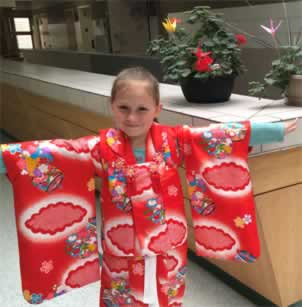
Because of the paper cranes (origami) and other parts of Japanese culture students read about in Sadako, the fourth graders develop an interest. Cindy Ofstedal, former Harmony teacher, 25-year teacher in Japan, and owner of Asahi Loft, a Japanese style B&B in Harmony, brings a meaningful Japanese culture experience to school for the fourth graders. On Friday, April 28, the three fourth grade classes joined art teacher Ann Sparks and Cindy Ofstedal in creating this experience.
The first week in May in Japan is a special time called “Golden Week,” Ofstedal explains, “so this is a prime time to share the culture.” As part of Golden Week, each May 5, the Japanese people observe one of their most beloved and popular national holidays, Children’s Day, (Kodomo no hi). This is also a day when children are honored, respected, and celebrated for their individual strengths. It is a time when health, happiness, and good fortune are wished upon them.
Several traditions are part of the celebrations and Ofstedal brings them to life for students. Prior to class, she prepared sticky rice, which is the basic ingredient in onigiri. No celebration would be complete without food, and onigiri is a must for a real Japanese experience. Onigiri is basically a ball of sushi rice that can be filled with all kinds of things. “Onigiri,” Ofstedal explains, “is to the Japanese what peanut butter and jelly sandwiches are to Americans – the staple fall back food and lunch box filler, the quintessential Japanese convenience store item.” In this class, students made their rice balls unique — they added faces.
A cultural icon from Japan that you may find familiar is the Samurai warrior, a hero able to inspire the qualities of strength and courage in others. Warriors who are both strong and kind are found in many beloved Japanese folktales. Samurai wore special hats known as “Kabuto.” As part of their Japanese experience, students also made origami kabuto hats.
“Kids in Japan do origami all the time,” says Cindy Ofstedal, “you will see them do origami on the train or to pass the time while waiting. It’s done in the hospital during healing — it’s done everywhere.” In Ofstedal’s experience, some people just take to origami. “It’s creative but also methodical, there are boundaries and directions that must be followed. In the end, you have created something wonderful.” Ofstedal says that, in her experience, even a small exposure like folding a kabuto hat can lead a child to a serious interest in origami. “Some kids get exposed to it, and it just explodes for them!” If a spark catches for their child, parents can look for templates. There are many available in books or online.
The whole time students are busily working on their onigiri and kabuto hats, Cindy Ofstedal “talks nonstop about Japan.” She tells stories, finds where students’ interests lie, and answers their questions. One aspect of Children’s Day that many students find especially intriguing is “koinobori.” Koinobori are windsocks in the shape of carp (koi) that represent each member of the family and symbolize determination and vigor, with the ability to overcome obstacles to reach your destination. Japanese families mount their koinobori high on poles outside their homes. Businesses also display koinobori. Ofstedal says, “When you drive around Japan this time of year, you see the big windsocks flying above buildings everywhere.” When the koinobori catch the wind, they shimmy and look as though they are swimming. If you’re observant, at various times in May, you will notice the 20-foot koinobori that Ofstedal hangs at the baseball field by the school in Preston.
An interesting aspect of Children’s Day in Japan is that it is not focused on children alone. It is also a time for children to show respect and appreciation to the adults in their lives — their teachers, parents, relatives and others — that care for them and help them grow up strong and kind, more able to overcome the obstacles they are bound to encounter in life.
So now that you know what our Fillmore Central Elementary fourth graders are up to, if a child you know greets you in the morning with a sunny, “Ohayo gozaimasu,” (good morning!) try responding with “Ohayo” in return. Domo!