
Image submitted
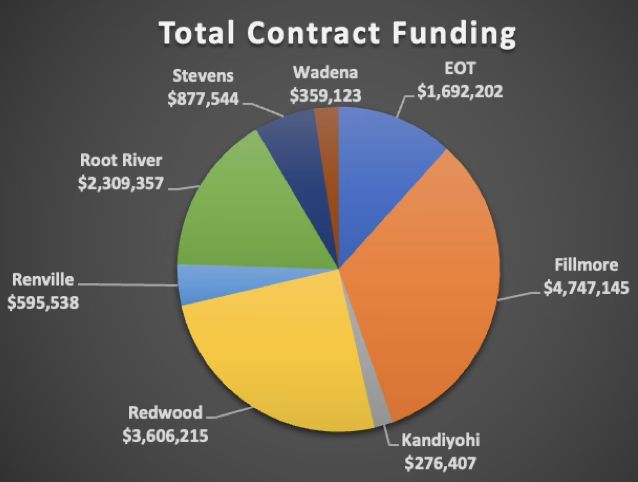
Despite funding pauses and a government shutdown, Fillmore and Root River SWCDs Administer over $7 million to Local Producers Implementing Climate-Smart Agricultural Practices.
Fillmore and Root River SWCD have partnered to enroll in a pilot program aimed at increasing the adoption of Climate Smart Agricultural Practices. The Alliance to Advance Climate-Smart Agriculture is a USDA program with a mission to enhance the adoption of agriculture practices that both reduce greenhouse gas emissions and increase soil health.
Four states were selected to participate in the program – Minnesota, Virginia, Arkansas and North Dakota. In Minnesota, eight counties applied to participate in the program, and selected counties include the Fillmore and Houston County Partnership.
Local producers chose to enroll in a practice such as cover crops, no-till, nutrient management, and conservation crop rotation, to list a few. Producers are compensated ~$100 per acre to implement these practices into their production.
Fillmore and Root River SWCD has enrolled an estimated 67,236 acres into the program including:
- 22,208 acres of cover crops;
- 25,251 acres of nutrient management plans;
- 10,137 acres of no-till/strip till;
- 8,160 acres of reduced till;
- 1,458 acres of conservation crop rotation;
- 10 acres of prescribed grazing;
- 10 acres of pasture and hay planting.
Although program contracts and acreage do have the ability to change, it is estimated that enrolled practice acres totaled $7,054,502.25 in cost share payments to local producers. Practices are estimated to reduce nitrogen by a total of 471,198 lbs of Nitrogen, 18,579 lbs of P, and 3,267 ton of TSS pounds annually into local waterways using MN Pollution Control Agency Nutrient Reduction Calculators*.
Fillmore and Root River SWCD’s thank local producers for applying to implement these voluntary practices.
*Note, pollutant load estimates were created using the Root River MNPCA Pollutant Load Calculator for ease of assessment. Actual practice locations may reside in neighboring watersheds adjacent to the Root River.
Leave a Reply