
Photo by Wanda Hanson
The Chicāhuac Exhibition, currently on display at the Driftless Fiber Arts Collective in Lanesboro, highlights the strength and sacrifices of six incredible women from Mexico: Oligaria, Doña Conchita, Fatima, Concepciona, Veronica and Doña Teresa. The word chicāhuac means strong, robust and powerful in Nahuatl, an indigenous language of Mexico and the first language of many of the people presented in the exhibition.
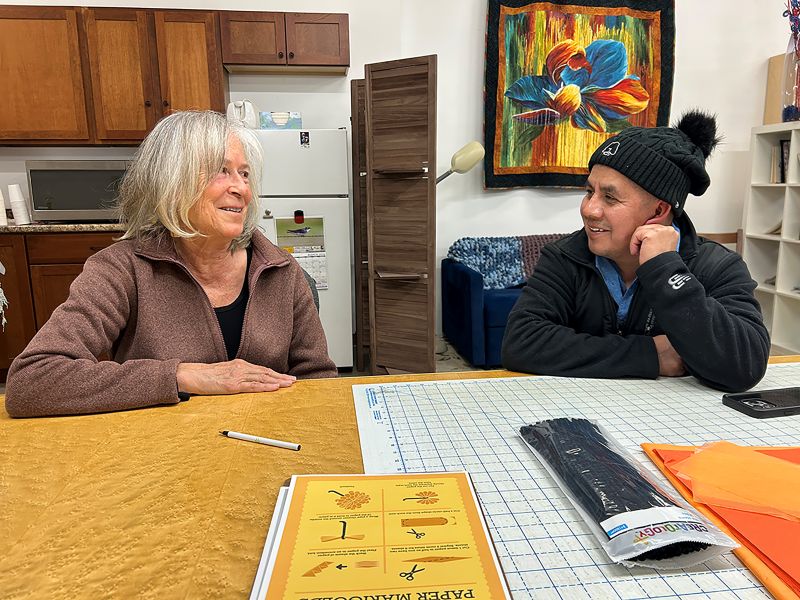
At the opening reception on March 13, visitors were able to explore the exhibition, use the QR codes on each board on the display to listen to the stories of the women, write postcards to them, post interactive questions on the wall, enjoy snacks and create their own marigold flowers at a craft station.
Ramón, son of Oligaria, explained that marigolds are important in their culture, representing the sun, light and life. Marigolds are placed on altars as a symbol to let deceased family know that they miss them and are welcoming their spirits back.
Mercedes Falk, the director of Puentes/Bridges, spoke to share how the exhibition came about. Puentes has been taking area dairy farmers on trips to Mexico to visit the families of their employees since 2001. John Rosenow, a farmer and one of the founders of Puentes, had visited with a woman on several trips to Mexico, but didn’t know her name. He felt they needed to learn more about the families.
In 2025, the Puentes group traveled to Zongolica, Veracruz which is two hours in from the east coast and four hours from Mexico City to visit the families of some men working in western Wisconsin. While there, Puentes interviewed women from some of the families and then collaborated with the University of Wisconsin and the Wisconsin Latinx History Collective to create the Chicāhuac Exhibit.
Mercedes brought along some of the men of the families to the opening reception to tell their stories in their own words while she translated for them. Ramón told of his mother Oligaria’s wish for her sons. She had said, “I really want all my children to build their houses and live together.” Oligaria herself had come to the U.S. to work on a farm tending calves to earn enough money to build a home in Mexico.
Ramón now works in Wisconsin; he shared that he would not have been able to build their larger home without his wife. He needed someone back home he trusted. Ramón told of how he built a cardboard model of a house and sent it to his wife so she could get the supplies ordered to build the house.
Ramón came here to give his children a better life, but he would like to go back to see his son Sebastian and be there for some of his childhood.
Ramón’s story illustrates how the families work as partnerships across the distance to create a better life for the families.
Luis, son of Teresa, told of how Teresa had made and sold tortillas house to house and washed clothes to support their family after his father died when she was 24. Often she would only sleep four hours a night. According to Luis, having supper together is very important to Teresa. She realizes that her children have to sacrifice being together in order to provide a better life for their children.
Luis had wanted to come to the U.S. to work for a long time; he was grateful to his mom and siblings for helping him get here. Luis plans on staying in the U.S. as long as he needs to to earn money.
Roberto is the son of Concepciona and the husband of Veronica. He has three children and tries to visit Mexico often Outgoing and tri-lingual, Roberto was happy to share his family story with everyone; he told of how his mom and dad were both orphans. Roberto wanted to work with his dad cutting trees rather than go to school, but at nine he was sent to school. Speaking only Nahuatl, an indigenous language, he understood very little of the Spanish in school at first. Roberto always wanted to find a job. In his village he was a quilting vendor and a baker. He commented that sometimes he’d thought he should have become a teacher, but the money called! In the U.S. he has worked as a gardener, a construction worker, a factory worker in a cigarette factory and a groundskeeper at a golf course. Currently, he works on a dairy farm in Wisconsin.
Roberto found a woman studying to become a police officer who taught him English. While Roberto worked here, Veronica used the money he sent to build a house and raise their children. Kevin, their oldest son, has joined Roberto to work here. Roberto is proud of the education his children are getting; his middle child will graduate from high school soon, and his daughter Megan is adamant that her father come home for her primary school graduation!
With a chuckle, Roberto informed the group, “My wife is a strong woman. When she says time to send me money, I have to!”
Roberto lost his job when they were in the middle of adding to their home. Ever positive, Roberto declared, “We learn from all the challenges.”
Mercedes closed the conversation commenting, “the more we know each other as human beings, the more we understand each other.”
The Chicāhuac Exhibition will be on display from March 2 through April 30 at the Driftless Fiber Collective. Leah Steding who is on the board of Driftless Fiber Arts Collective collaborated with Mercedes Falk, the director of Puentes/Bridges to bring the exhibition to Lanesboro. Stop in and view the exhibit; it’s well worth your time!
Leave a Reply