
Give a man a fish, and you feed him for a day; teach a man to fish and you feed him for a lifetime.
That statement defines the Food Resource Bank, an organization with which locals, Gary Broadwater and Jim Keune, recently began working.
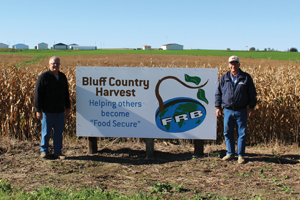
If you’ve driven down Highway 16 between Spring Valley and Preston lately, you’ve probably noticed the Food Resource Bank/Bluff Country Harvest sign next to a cornfield by the Fillmore County Airport. The three-acre cornfield the sign sits beside was donated to the Food Resource Bank by Jim.
Gary was first introduced to Food Resource Bank by Marlin Hershey in 2015. At the time, Gary was renting land from Marlin. Marlin suggested that Gary attend the Food Resource Bank’s annual meeting, which was held in Lincoln, Nebr., that year.
By the time Gary left the meeting, he was sold. “I really liked the concept of the program,” he said. Gary told his friend of over 30 years, Jim Keune, about the program, and Jim jumped on board with it, too. They spoke to the stewardship team at Christ Lutheran Church in Preston about partnering with Food Resource Bank, or FRB, to set up a Growing Project in the Fillmore County area. Director of Resource Development, Ron De Weerd spoke with the team to describe what FRB does and answer any questions before a decision to start a Growing Project was made.
FRB was started in 1999 by a small group of farmers, churches, individuals, and organizations who saw the world’s hunger and poverty issues and decided to address that need. Their mission statement reads, “As a Christian response to world hunger, FRB links the grassroots energy and commitment of the U.S. agricultural community with the capability and desire of small-holder farmers in developing countries to grow lasting solutions to hunger.”
FRB raises money to teach people in third world countries how to grow their own food. “What I like about the program is that they don’t just give money to them, they teach them how to take care of themselves,” Gary said. FRB supports 50-60 overseas programs through the help of the Growing Projects in the U.S. Growing Projects are started by and run by volunteers and organizations to raise money for FRB.
There are around 205 Growing Projects in 22 states. They are started on donated or rented land and supported by donations of time, farm equipment, seeds, money, etc. For example, the Growing Project that Gary and Jim started, called Bluff Country Harvest, is run with three acres of land that Jim donated to the project. Steve Redalen with Wyffels Hybrids donated the seed corn, and Jim’s son, Jared Keune furnished the equipment needed to plant and harvest the crop. Gary will combine the corn and haul it to a grain elevator to sell. The proceeds will be deposited in a special account while the Bluff Country Harvest volunteers decide what FRB overseas project to donate the money to.
Bluff Country Harvest is also supported by Christ Lutheran Church in Preston, Preston Dairy & Farm, and the John Deere Foundation.
FRB shows the love of God by helping those in developing countries learn to support their families through agriculture. It is not affiliated with any specific church or religion, but strives to live out the Bible commandment to love your neighbors.
Instead of trying to reinvent the wheel, FRB partners with organizations such as The Alliance to End World Hunger, Catholic Relief Services, Church of the Brethren, Farmer to Farmer, The John Deere Foundation, Lutheran World Relief, Seed Programs International, World Renew, and more. By doing so, they are able to combine resources and knowledge and reach more people.
FRB is very open about how the money it receives it used. “A lot of times, you give money and don’t know where it’s going,” Gary noted. The overseas project areas are open for anyone to visit. They also host mission trips.
While Christ Lutheran is heading Bluff Country Harvest, it’s not a church project. It’s a community project with which anyone is welcome to participate. “We’re hoping to get more churches, individuals, and businesses to partner with and grow,” Jim said. He would like to see more land being donated or rented to the project and is hoping that more churches join and a board can be formed.
“We’d like to expand and get more people involved,” Gary added.
It’s not just farmers that can help FRB. Anyone can raise money using different methods or can donate their time or other resources. “It isn’t about raising a big pile of money,” Gary pointed out.
Marlin Hershey described how the people of one overseas project area were just throwing corn on top of the ground to plant it. Naturally, a lot of the corn didn’t germinate and the seed that did, did not grow into a healthy plant. FRB taught them how to plant the corn so it would be a successful crop.
The women and girls of another project area spent their entire days walking to get fresh water. FRB showed the community how to install dams and lagoons to catch water and irrigate properly, which freed up a lot of time for the women. This allowed the girls time to go to school and get an education, showing that FRB enriches lives in many different ways.
Often communities that FRB has helped share their newfound knowledge and agricultural techniques with their neighbors, spreading the organization’s impact even further. “Those are the factors that really tripped my trigger, so to speak,” said Jim.
More information on Food Resource Bank can be found at foodresourcebank.org. If you’re interested in learning more about Bluff Country Harvest, you can contact Jim Keune at (507) 273-8536 or Gary Broadwater at (507) 251-8230.