
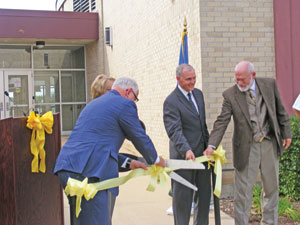
A crowd gathered in the parking lot outside the Fillmore County Courthouse to celebrate the creation and implementation of Minnesota’s Third Judicial District Veterans Treatment Court on Friday, September 20. This day was also National POW/MIA Recognition Day. Minnesota Supreme Court Chief Justice Lorie Gildea spoke later in the ceremony, quoting JFK, “A nation reveals itself not only by the men it produces but also by the men it honors, the men it remembers.”
Judge Ross Leuning, who served his country in the military for nearly 38 years, was tasked in 2017 to take the initiative to create a districtwide veterans court for the Third Judicial District. He was appointed District Court Judge in 2011.
Leuning read the Remembrance Day script for POWs/MIAs. A table was set with a single seat. “This small table is set in a place of honor. It is set for one… We support and recognize those who are missing from our midst. They are commonly called POWs and MIAs. We call them BROTHERS. They are unable to be here with us so we REMEMBER them.” The script continues, detailing the items on the table and what each of them symbolizes and the chair which is empty.. “They are not here.” Finally, “Pray for them and remember them.” After the reading Bugler Dan Brewster sounded taps.
A Veterans Treatment Court (VTC) is an intensive probationary program. It is a specialty court which utilizes treatment rather than incarceration to prevent further illegal activity. The court works with veterans who are in legal trouble.
Leuning recognized and thanked members of the team that worked with him in the creation and implementation of this specialized court. The intention of the court is to create connections for veterans to help them get their lives back on track. Veterans may have a combination of issues that lead them into criminal activity. Issues may include, but are not limited to, drug or alcohol abuse, mental health issues, domestic abuse, or PTSD. Treatment court has been proven to be more effective than general probation.
A pilot court convened on March 1, 2019, in Steele County which will serve the western six counties of the judicial district. Leuning said he is very pleased with how this experiment is going. They have worked with seven veterans who were charged with various criminal offenses. Representatives from the veterans administration attend the biweekly sessions. This helps cut through the red tape and streamlines the process. Participants are enthusiastic and committed, which is remarkedly different from what is normally seen in regular court. Leuning pointed out that we are learning as we go and expect to evolve with new ideas.
Leuning maintains those in need must be identified; those that are struggling often end up appearing in our courts. Combat affects everyone differently.
Veterans go through a screening process and will need to meet certain criteria to participate in the program. The staffing team considers motivation level and commitment. The court meets every other week to give the veteran time to work on a task between appearances. There is a team that works with the veteran and they help come up with a treatment plan which is reviewed before each court appearance. Leuning said this is about more than veterans; it is about community and what the community can do to help make these veterans better citizens in their communities.
This ribbon cutting ceremony is to mark the beginning of a districtwide Veterans Treatment Court. Judge Leuning will preside in Steele County serving six western counties (Dodge, Freeborn, Mower, Rice, Steele, and Wasceca Counties) and Judge Joseph Chase will preside in Fillmore County serving five eastern counties (Fillmore, Houston, Olmsted, Wabasha, and Winona) in the third judicial district. Two locations were necessary to serve this large geographic area. The districtwide court will allow veterans in smaller counties the opportunity to participate.
Veterans Treatment Court involves judges, attorneys, law enforcement, probation, counselors, VSOs, employment advice/workforce centers, and community based volunteers and mentors. Volunteer mentors follow veterans in VTC providing support and guidance.
There are 460 VTCs nationwide. VTCs help veterans make connections with the Veterans Administration (VA), medical care, and suicide prevention programs. Seventy percent of veterans that commit suicide have never been in contact with the VA.
The statistics are shocking. One in six veterans have PTSD, one in five have substance abuse issues, and the most shocking of all, every day 20 veterans commit suicide. Minnesota veterans ages 18-34 commit suicide 4.5 times the national average. Getting veterans connected can literally save lives.
The ribbon cutting ceremony was attended by special guests Governor Tim Walz and Chief Justice Gildea. Also, in attendance were Congressman Jim Hagedorn, State Senator Jeremy Miller and Rep. Greg Davids. Numerous other state and local government representatives attended the ceremony.
Letters were read from Hagedorn and Senators Amy Klobuchar and Tina Smith. Hagedorn’s letter stated VTC serves veterans who need a helping hand; it reduces veteran suicides. Klobuchar’s letter spoke favorably of the court, citing its ability to deal with troubled veterans and combating trauma tied to criminal behavior. No veteran should be left behind. Smith’s letter stated veterans sacrifices should not be forgotten. We should honor our veterans by making sure they are cared for after arriving home.
Judge Chase volunteered to serve as the judge for the eastern counties. He told the story of a veteran that appeared in his court due to participating in a home invasion. He had been deployed to Iraq three times and was an American hero. Five years ago this veteran was alcohol dependent and had PTSD. The veteran was put on probation and treatment has been successful to this point. Chase said he knows that treatment courts save lives.
Chief Justice Gildea has served on the Minnesota Supreme Court since 2006 and as Chief Justice since 2010. She said we should support returning soldiers, especially those who carry the wounds of war, which can be both physical and/or invisible wounds. VTC focuses on treatment and recovery. The success of these courts has been proven time and time again, achieving better outcomes.
The last speaker was Governor Walz, who insisted we must commit to care for our warriors. He urged that have a responsibility to make the wounds of war right; these are our neighbors. VTC is not a get out of jail free card. Some veterans loose a connection to what they value most, and VTC provides a means to connect back to community and helps make individuals whole. When a veteran commits a criminal act that lands him/her in the justice system, there is a greater chance for that veteran to move on from that crime and get back on track with the resources and support of a VTC. Members of our military are deployed to defend freedom and justice. We need to be there for them when they come home.