
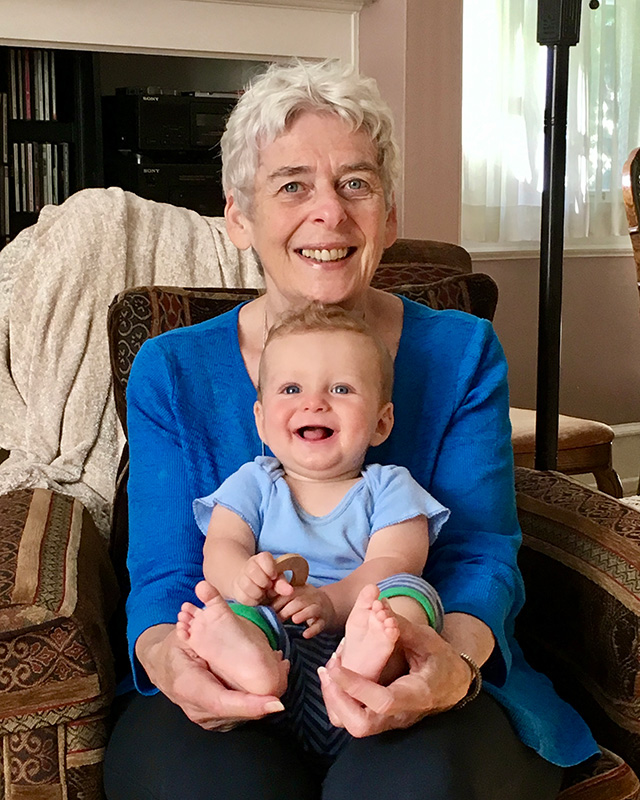
Photo by Wanda Hanson
On June 13, 2026, Katie Ruen’s celebration of life was held in an old barn that had been built in 1910 by local farmers near Lanesboro. Why was this barn chosen for such a purpose? What did that barn mean to Katie and her family?
Katie and Ed Ruen had bought the family homestead over 40 years ago. It became a private retreat for family get-togethers. They treasured it and considered it a “delightful trust.” Nature conservation was the emphasis at the farmstead. Katie and Ed traveled back and forth between their home in Shorewood, Wisconsin. and the farm for many years. They thoroughly enjoyed coming to the farm and working on projects.
The Ruens viewed the barn as central to the farm and decided to preserve the failing building. According to Ed, they had caught the building’s foundation just in time. A metal roof was added and beams were shored up by Amish workmen using cables.
At one point, an addition had been built on the barn using lumber from the old Elstad Church building. The structure became a combination of the craftsmanship of rural carpenters and the church’s old materials, a monument to both agriculture and religion. Peter, Katie and Ed’s son, calls the old barn a “rural cathedral.”
Serendipitously, the barn restoration was finished just in time for the Ruens to offer its use for the Elstad Church’s 100th Anniversary service in 2011. Since that time several church services have been held there.
Ed, a minister, performed baptisms in the creek running through the farmstead. He registered those baptisms at his church, Our Savior Lutheran Church in Milwaukee, Wisconsin.
First Meeting
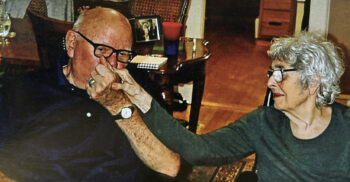
Photo submitted
Ed and Katie met at a party while living in New York. As they played a game in which they were given scenarios to finish, Katie was told she had run into a wall and asked what happened next. Katie had replied that she pulled a log over to the wall so she could see over it. What she saw was a white cabin with a picket fence. They ended up living in just such a cabin on their farm.
Ed was a theological intern at St. Peter’s in the South Bronx, working to become an ELCA pastor. Katie was a nurse who came from a strong Catholic background in Pennsylvania. They each held staunchly to their own religion.
One day, Ed purchased a painting from an artist in the park and took it to Katie’s apartment. He told her, “I’d like to be able to enjoy this for the rest of my life!”
Katie’s response was, “Are you asking me to marry you?” Ed and Katie went on to get married in a Manhattan Catholic church with both a Catholic priest and an ELCA pastor officiating.
After that the couple remained “committed to couples who found themselves in untenable situations like ours,” Ed shared.
Ed’s father had expressed his concern that by marrying Katie, Ed had thrown away his education and his job – his whole life. He didn’t understand why Ed had done it.
Ed’s response was, “Dad, what I understand is love. If the church wants me, fine.” Ed was unsure if any church would want him as a pastor with his views on civil rights and his interfaith marriage.
The community of the poor South Bronx church ended up petitioning the congregation to call him to “be with them in their suffering and bury their dead.” Ed and Katie worked hard to serve the community, treating all with respect. Katie followed an adage she’d once seen, “Bloom Where You Are Planted.” Katie bloomed in every parish they went to. Ed was later called to serve Our Savior’s in Milwaukee.
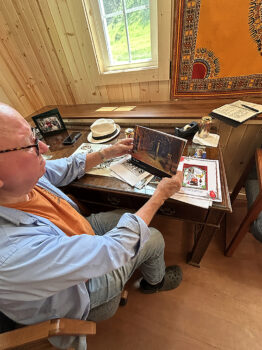
Photo by Wanda Hanson
Katie was very involved in all the renovations at the farm. She’d work all day and then make a “big old meal” at night, according to Peter. The kids loved to put on plays and dances in the barn, and Katie loved to sit in the barn and listen to music. Family life was singing and dancing. Friends from Milwaukee would visit the farm to go canoeing, biking and attend the theater.
As Ed and Katie got older they began to think they might need to sell the farm. At that time, Peter had been working in New York as a Broadway stagehand. While visiting the farm he broke his heel in five places. “Life fell apart,” Peter shared. His career was done, and he had to spend six months recovering at the farm.
Peter ended up staying at the farm and still lives nearby. With his background, he thoroughly enjoyed working on the old buildings. The cabin was remodeled 22 years ago, doubling the footage of the home. Exposed logs still tell the story of the old home.
“Peter has an ability to try to provide opportunities for me to spend money,” Ed chuckled.
Peter laughed, “He asks me to do it! I’ve been a project manager!”
Recently the old chicken coop was remodeled into a modern office for Ed to accept visitors. Similar renovations are planned for the nearby granary next fall.
The Move to the Farm
Katie was diagnosed with amyloidosis, a rare genetic disease she had inherited from her Irish family. Through the years she became an advocate for the disease; she often had to explain the disease to her doctors.
Katie had wanted to die in their Shorewood home, but her daughter convinced her to move to the farm when she needed more care last June. Ed was Katie’s caretaker for five years. Ed shared, “It was a gift in many ways to care for Katie.” St. Croix Hospice and Bright Star took good care of Katie. Friends were able to come and spend time with her at the farm.
Every morning for five years Katie would do a little step dance when she got up before starting her day. She truly enjoyed life to the fullest. “She danced right up to the end!” Ed reminisced.
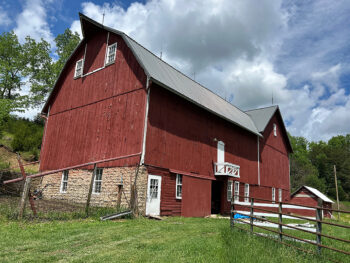
Photo by Wanda Hanson
Ed and Katie had organized their funerals together. They had a box with their names on it to hold their ashes. The box will be interred near a rock overlooking the house and the creek at the farm.
In December, Ed had been hospitalized with COVID and pneumonia; it affected Katie immensely to not have him nearby. In January, Ed was able to join Katie at the hospital. In her final words to Ed, Katie asked, “Ed, how did we end up here?”
“I lost the love of my life and my full-time job when Katie passed away,” Ed declared.
Katie’s celebration of life was held in their old barn, the centerpiece of life on the farm; her final resting place will be near that old barn full of family memories.
Gary Davidson says
I remember going to school at the Abrahamson country schoolhouse with his younger brother Donald and Ed also attended with many others from the immediate area, where Mabel Bergey was our teacher – good memories!
It sounds like Ed and Katie had a wonderful life together – bless them both!
Rose Haugerud says
I am so sorry to hear of Katie’s passing.